
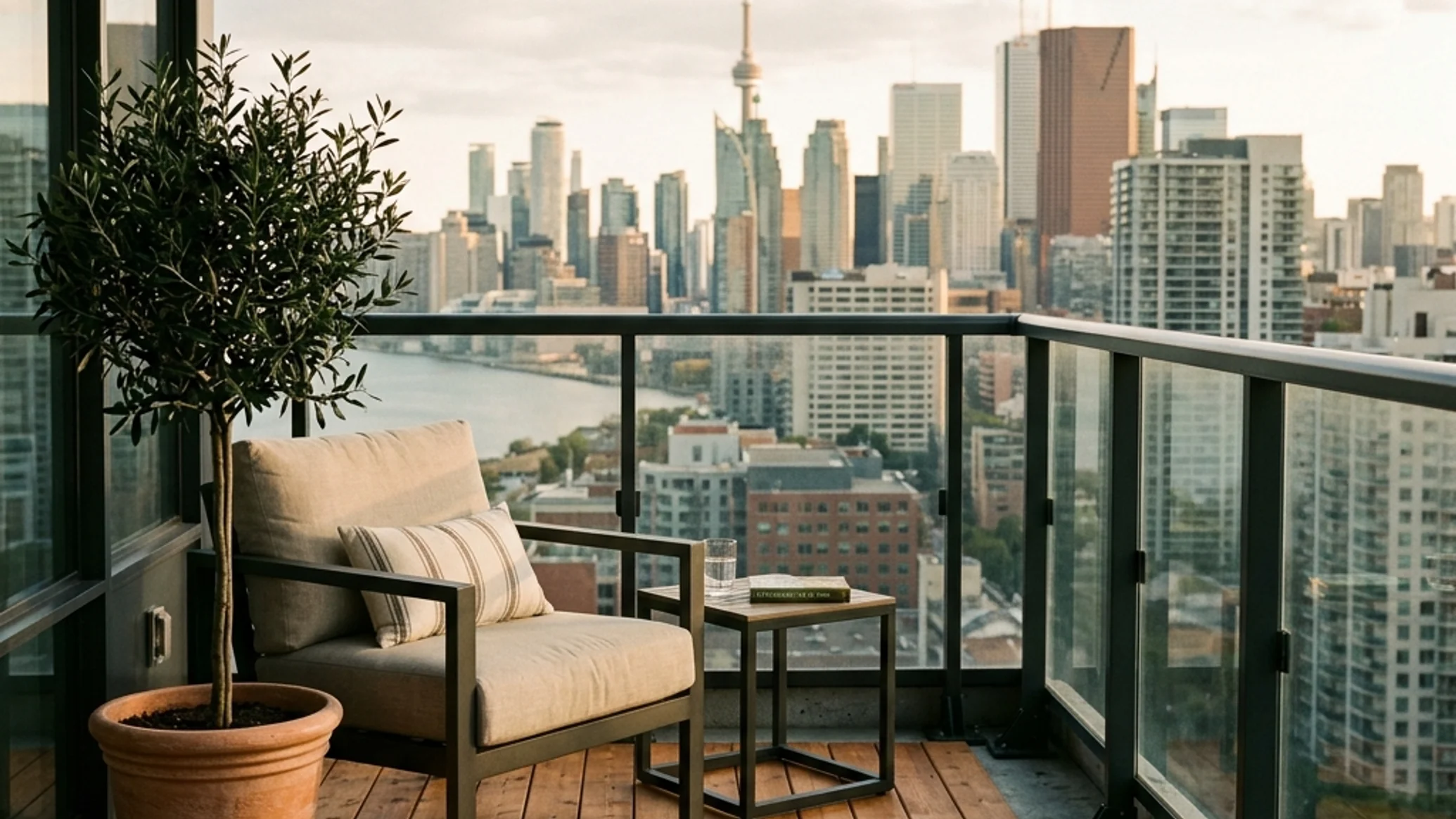
Roughly 30 percent of Toronto housing is condo or townhouse, and a meaningful fraction of those units have wooden balcony surfaces, wooden privacy panels, or shared wooden deck areas that need restoration. The work is different from single-family deck restoration in three ways: the legal structure (who owns the surface, who pays to restore it), the procurement process (boards, property managers, scheduled access), and the scale economics (8 to 40 units done sequentially produces unit pricing well below single-family rates). This guide covers what condo and townhouse balcony wood restoration actually involves in Toronto.
Why Balconies Are Restored, Not Replaced
Balcony wood replacement in a Toronto high-rise or townhouse complex is structurally and procedurally expensive. Restoration is the dominant choice for three reasons:
- Reserve fund alignment. Condo reserve fund studies typically schedule wood balcony replacement at 20 to 30 year intervals. Restoration every 4 to 7 years extends that replacement horizon and keeps reserve fund draws predictable.
- Construction permitting overhead. Replacing balcony decking in a high-rise often requires building permits, engineering sign-off, and crane or hoist scheduling. Restoration is maintenance and avoids the regulatory load.
- Resident disruption. Replacement means temporary balcony closure for 1 to 3 weeks per unit. Restoration is typically 1 to 2 days per unit with sock-foot return that evening.
The decision to replace vs restore is driven by the structural condition of the wood, not its cosmetic condition. A 15-year-old balcony with sound boards and failed finish is a restoration candidate. A balcony with rot, structural cracking, or fastener failure may need replacement regardless of finish.
Exclusive-Use vs Common-Element Wood Surfaces
Ontario condominium law distinguishes between common elements (owned by the corporation, maintained by the corporation), exclusive-use common elements (owned by the corporation but used exclusively by one unit), and unit property (owned by the unit holder).
Balconies are typically exclusive-use common elements, which means:
- The corporation owns the structural balcony.
- The unit holder has exclusive use of it.
- Maintenance responsibility depends on the specific condominium declaration — read your declaration to be certain.
Common patterns:
- Corporation pays for all balcony wood restoration: common in mid-rise and high-rise corporations where balconies are visually unified across the building.
- Unit holder pays for cosmetic restoration: common where balcony appearance is considered part of unit interior aesthetic.
- Cost-shared: structural restoration corporation-paid, cosmetic upgrades unit holder-paid.
Townhouse complexes follow similar patterns but with more variation. Stacked townhouse and freehold townhouse condominiums often have the corporation responsible for the rear deck or balcony, while front porches and entry decks may be unit holder responsibility. The declaration is the definitive source.
Three Common Balcony Surface Types
Toronto buildings constructed between 1990 and 2020 typically have one of three balcony surface configurations:
Wood plank flooring over concrete slab. Pressure-treated or cedar planks installed over the structural concrete balcony, usually with sleepers and drainage gaps. Restoration is straightforward — clean, brighten, restain. Concrete waterproofing membrane underneath is independent and not part of the wood restoration scope.
Tile-style wood decking tiles. Interlocking wood deck tiles (typically 12-inch square units) sitting on the concrete slab. Restoration usually involves removing tiles, cleaning and restaining off-balcony, then reinstalling. Easier to access and treat than fixed planking but slightly more labour.
Cedar privacy panels and dividers. Vertical cedar slats forming privacy screens between adjacent balconies. Common in mid-rise condos and townhouse complexes. Restoration is similar to fence staining at scale — vertical surfaces, both faces, brushed or sprayed application.
Mixed configurations are common — many balconies have both wood flooring and a cedar privacy panel. Both are typically restored on the same project.
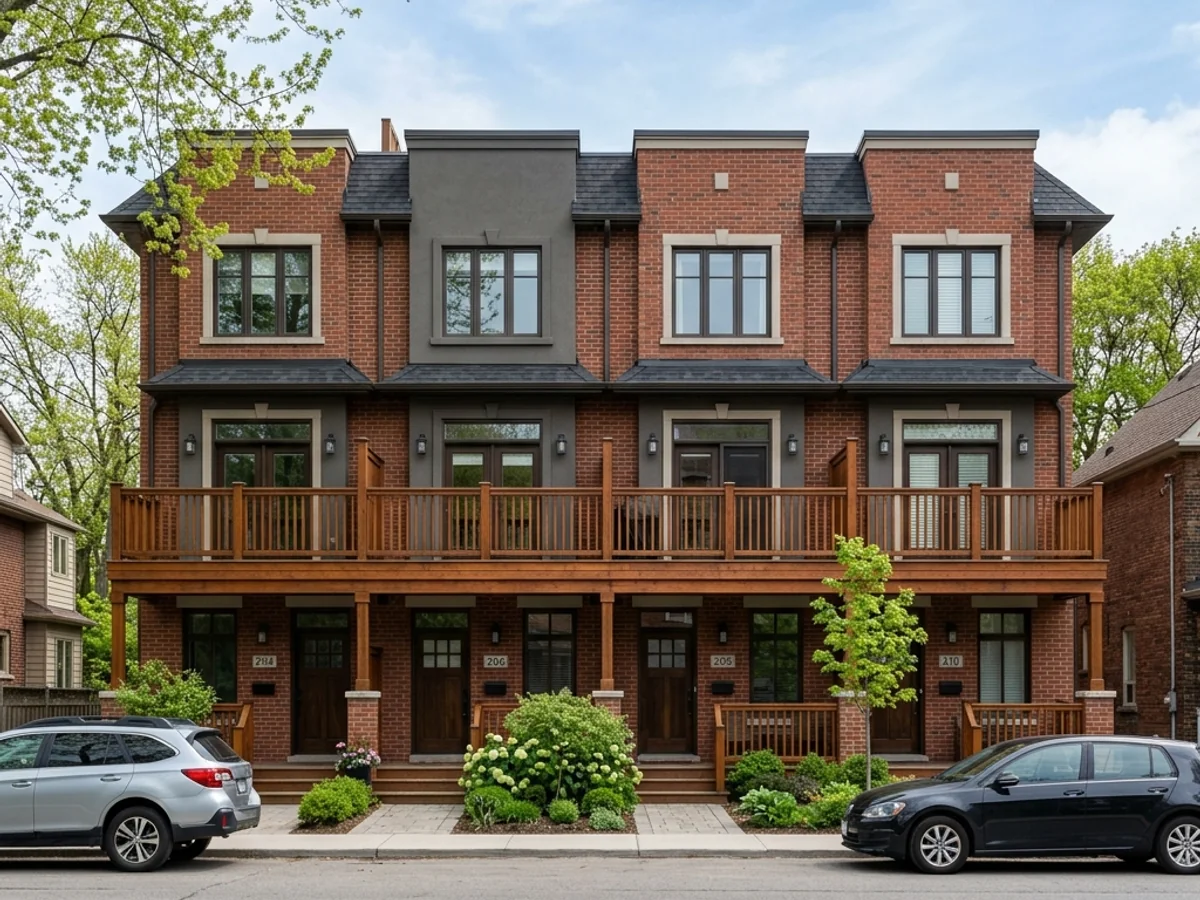
Townhouse Complex Economies of Scale
Per-unit pricing improves substantially as complex size increases. The setup, mobilization, and supervision costs are largely fixed per project, so spreading them across more units lowers per-unit rates:
- Single unit standalone (1 balcony): $400 to $900 depending on balcony size and configuration.
- Small townhouse complex (4 to 8 units): $300 to $650 per unit.
- Mid-size townhouse complex (10 to 20 units): $250 to $500 per unit.
- Large townhouse complex or stacked townhouse (20 to 40 units): $200 to $450 per unit.
- High-rise balcony program (typically scoped per floor or per stack): custom pricing based on access, hoist requirements, and unit count.
Complexes with uniform balcony configurations price more efficiently than mixed-configuration complexes. Pricing also improves substantially if the restoration is scheduled during shoulder seasons (April-May or September-October) when contractor capacity is more available.
Working With Condo Boards and Property Managers
Condo board and property manager procurement is more formal than single-family residential work. A defensible proposal package for board review typically includes:
- Certificate of Insurance (COI) naming the corporation as additional insured, with appropriate liability limits (typically $2M to $5M general liability).
- WSIB clearance certificate current within 60 days.
- Detailed scope of work by surface and by unit, with specifications for cleaning, brightening, stain product, and application method.
- Sample colour selection if the board has not already specified.
- Schedule with daily unit count and resident communication plan.
- Reference list of comparable complex work completed.
- Written warranty terms — typically 3 years on workmanship.
Board approval usually takes one to two regular board meetings (4 to 8 weeks). Property manager pre-screening can compress this if the manager has previously approved the contractor for similar work. We routinely work with Toronto property managers and condo corporations and can provide a complete proposal package within 5 business days of an on-site assessment.
Stain Choice for Balcony Exposure
Balconies in Toronto high-rise and mid-rise buildings experience exposure conditions that differ significantly from single-family residential decks:
- Higher wind load. Above 3-storey height, wind-driven rain hits balcony surfaces at angles that single-family decks rarely see. End-grain sealing matters more.
- Concentrated UV. South and west-facing high-rise balconies take more UV per year than ground-level surfaces because of less shading from surrounding structures and trees.
- Reflective heat load. Balconies near windows take additional radiative heat that accelerates finish breakdown on horizontal surfaces.
Penetrating semi-transparent stains in the Expert Stain & Seal line are well-suited to these conditions — UV-resistant pigment density, penetrating chemistry that handles dimensional movement, and proven track record on Toronto exposure profiles. Film-forming finishes (urethanes, polyurethanes, lacquers) are not recommended for balcony wood because dimensional movement cracks the film and the maintenance cycle is impractically short.
What Residents Experience During the Work
For unit holders during balcony restoration:
- Pre-work notification: typically 7 to 14 days in advance with specific work date.
- Balcony clearance: residents are asked to remove furniture, plants, and personal items 24 hours before work.
- Work day 1: cleaning, brightening, and prep. Balcony is unusable but the work is contained.
- Work day 1 or 2: stain application. Balcony unusable for 4 to 12 hours after application depending on conditions.
- Post-work day 1: sock-foot light traffic typically acceptable.
- Post-work day 3 to 5: furniture replacement acceptable.
- Post-work day 7 to 14: full cure complete.
The single most disruptive element for residents is the balcony being unavailable for 3 to 5 calendar days. Communication and scheduling matter substantially for resident satisfaction — concentrating work in a 4 to 6 week project window with clear advance notice produces meaningfully better feedback than spreading restoration over an entire season.
Frequently Asked Questions
Frequently Asked Questions
Can you restore a condo balcony deck?
Yes. Condo balcony wood — pressure-treated planks, cedar tiles, or cedar privacy panels — can be cleaned, brightened, and restained using the same protocols as residential decks, adapted for high-rise exposure conditions. Restoration is the standard maintenance approach across most Toronto condo corporations because it costs a fraction of replacement and avoids the engineering, permitting, and resident disruption that replacement requires. Typical condo balcony restoration: 1 to 2 days per unit with sock-foot return the same evening.
Who pays to restain a townhouse fence in a complex — the homeowner or the corporation?
It depends on the condominium declaration. In most Toronto townhouse condominium corporations, perimeter fences and shared privacy panels are common elements and the corporation pays for their maintenance. Individual rear deck or yard fences within a unit boundary may be unit holder responsibility depending on the declaration. The single source of truth is the corporation declaration — read it or ask the property manager for the relevant section. Working with a contractor who routinely handles condo corporation work helps because the contractor can produce the right documentation regardless of the cost-allocation structure.
Do condo boards hire wood-restoration contractors directly?
Yes, regularly. Condo boards procure wood restoration through a formal proposal process — Certificate of Insurance, WSIB clearance, detailed scope, schedule, and references. Most boards work through the property manager who pre-screens contractors and brings shortlisted proposals to the board for approval. Approval typically takes one to two board meeting cycles (4 to 8 weeks). For straightforward maintenance work under a budgeted threshold, property managers can sometimes approve contracts without full board review.
How long does balcony restoration take for a condo unit?
A single condo balcony restoration typically runs 1 to 2 working days on the balcony itself, with 3 to 5 additional days before furniture can be replaced and 7 to 14 days before the finish is fully cured. Multi-unit complex restoration schedules typically complete 4 to 8 units per day of contractor presence depending on balcony size and configuration. A 20-unit townhouse complex is usually fully restored within 4 to 6 calendar days of contractor on-site time, scheduled over 1 to 2 weeks to accommodate weather windows and resident clearance.
Get Your Free Quote
Tell us about your project — we get back within 1 business day with honest pricing.