
Hardwood floor refinishing is one of the most cost-variable services in the residential trades. A 600 square foot Toronto living room refinish can land anywhere from $2,400 to $5,500 depending on the floor condition, the finish choice, and a handful of factors most contractors do not surface on the quote. Homeowners shopping the market get three quotes that are sometimes within 25 percent of each other and sometimes nearly 3x apart, and the spread is rarely random — it usually reflects different assumptions about prep depth, finish system, and what is or is not included. This guide breaks down what hardwood refinishing actually costs in Toronto in 2026, the six factors that move the price within and outside the standard range, and what should be itemized on any quote you take seriously.
Toronto Hardwood Refinishing Cost at a Glance
Hardwood floor refinishing in Toronto in 2026 falls into four standard cost tiers depending on what your floor actually needs:
- Basic refinish (3-pass sand + 3-coat water-based poly): $4.00 to $6.00 per square foot. Suitable for floors in solid structural condition with minor surface wear.
- Standard refinish with stain colour change: $5.00 to $7.50 per square foot. Adds a stain step before finish coats and adds roughly 12 to 24 hours to the project timeline.
- Heritage or deep-damage refinish: $6.00 to $9.00 per square foot. Includes board repair, deep sanding to remove prior shellac or paint, gap filling, and tone correction on aged oak.
- Hardwax oil refinish: $5.50 to $8.50 per square foot. Different finish system, different long-term maintenance economics — covered below.
These ranges hold for typical Toronto job sizes — 400 to 1,500 square feet. Small jobs under 300 square feet usually carry a minimum charge that brings the effective per-square-foot rate higher, and jobs over 1,500 square feet typically benefit from a volume reduction of $0.50 to $1.00 per square foot. Staircases, baseboards, and closets are nearly always quoted separately.
The Six Factors That Move Your Quote
Three quotes on the same floor can differ by 30 to 70 percent. Six factors explain most of the variance:
1. Existing condition. Sanding depth is the single biggest cost driver. A floor with light surface scratches needs one fine-grit pass to look new. A floor with deep gouges, water rings, and pet-urine staining needs three or four progressively finer passes plus spot repair. Quotes that do not specify the number of sanding passes are leaving themselves room to do less.
2. Wood species and age. White oak sands faster than red oak. Maple is harder than both and takes longer. Pre-1950 narrow-strip oak is more brittle than modern oak and requires lower-aggression grits to avoid edge chip. Older pine in mid-century homes is softer and easier to sand but easier to over-sand — a different kind of risk.
3. Square footage. Setup, masking, and dust containment take roughly the same time on a 400 square foot job and a 1,200 square foot job. Larger jobs spread fixed costs across more area, which is why per-square-foot rates drop above 1,500 square feet and rise sharply below 300.
4. Finish system. Water-based polyurethane is the standard Toronto residential finish — low odour, fast cure, 10 to 15 year lifespan with normal residential traffic. Oil-based polyurethane is slightly cheaper per square foot but takes 24 to 48 hours longer to cure between coats and carries strong odour for two to three days post-application. Hardwax oils are a different category entirely — penetrating rather than film-forming — and the lifecycle economics are different.
5. Colour change. Adding a stain step before finish coats adds $0.75 to $1.50 per square foot. Going from a natural oak to a dark walnut tone requires complete sanding to bare wood plus careful application to avoid lap marks. Refinishing in the original tone is faster, cheaper, and lower-risk.
6. Stairs and transitions. Stairs are priced per riser, not per square foot. Toronto refinishers typically charge $50 to $90 per stair tread for sand-and-refinish, with riser work adding $25 to $40 per riser. A standard 13-step staircase comes in around $1,000 to $1,500 on top of the floor refinish. Transitions between rooms, thresholds, and quarter-round are typically included in the floor quote but should be confirmed in writing.
Polyurethane vs Hardwax Oil — Where the Long-Term Math Differs
The finish system choice has the largest long-term cost impact. Initial refinish cost is one number; total cost over 15 years is a different number entirely.
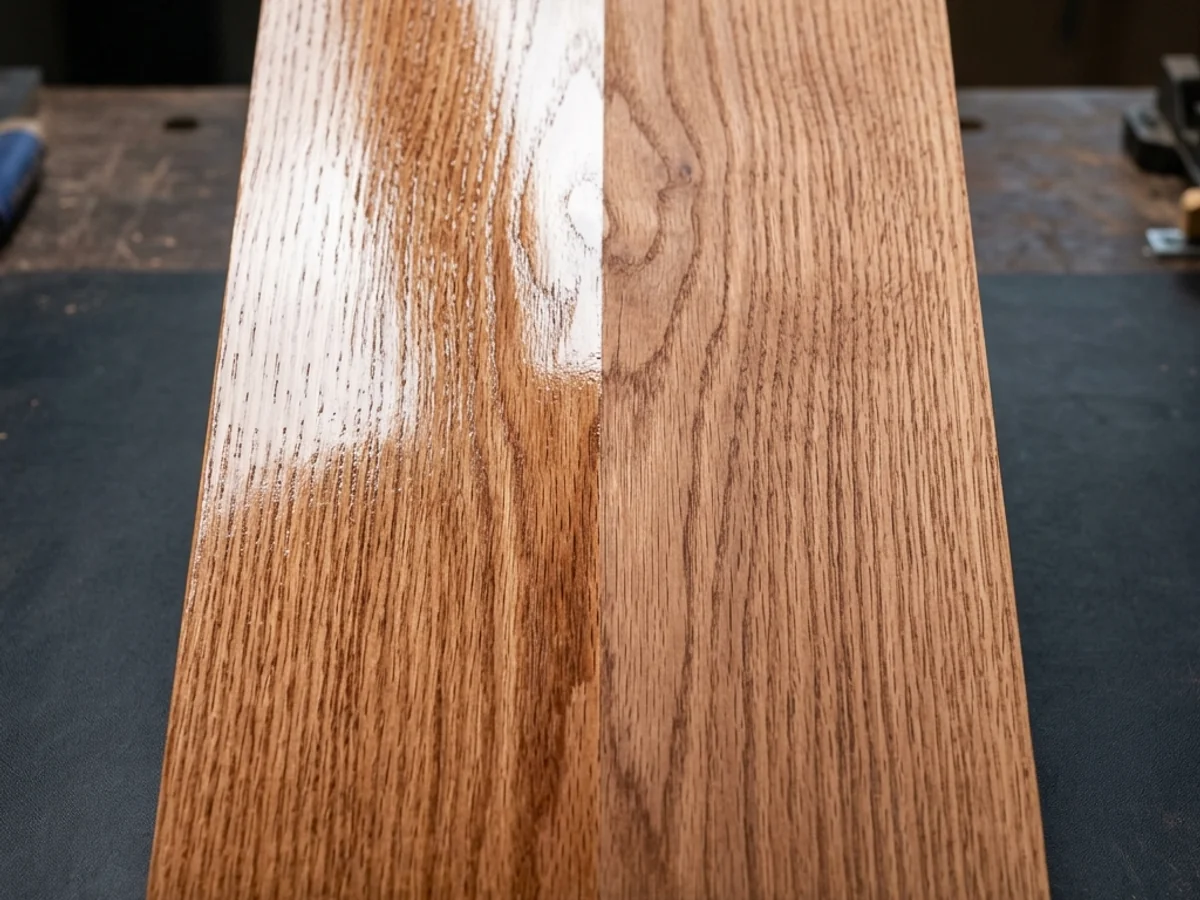
Water-based polyurethane (most common Toronto choice). $4.00 to $6.50 per square foot for a full refinish. Lifespan with typical residential traffic: 10 to 15 years before the next full refinish. Spot repair after damage is difficult — usually requires refinishing an entire room because the new finish does not blend invisibly with aged finish. Total 15-year cost on an 800 square foot living and dining room: $3,200 to $5,200 (one refinish cycle).
Oil-based polyurethane. $3.50 to $5.50 per square foot. Lifespan: 12 to 18 years. Ambers over time, which warms the floor visually but is irreversible. Strong VOC odour during cure makes occupied-home application difficult for 48 to 72 hours. Total 15-year cost: $2,800 to $4,400 (one cycle).
Hardwax oil (penetrating). $5.00 to $8.50 per square foot for initial refinish. Lifespan to next full recoat: 6 to 8 years, but spot repair is genuinely invisible — a damaged section can be re-oiled in an hour without re-doing the room. Total 15-year cost: $7,500 to $13,500 across two cycles, partially offset by simpler spot maintenance. Higher upfront and total cost, but the only finish that supports practical spot repair.
The decision is usually driven by household conditions rather than price. Homes with pets, young children, or high north-side wear at entry zones often benefit from hardwax oil because spot repair is feasible. Homes with low traffic and stable use are typically better served by water-based polyurethane for cost and simplicity.
Heritage Toronto Floors: The Real Premium
Pre-1940 Toronto homes — Cabbagetown, the Annex, Riverdale, Leslieville, Roncesvalles, Forest Hill heritage stock — usually carry original narrow-strip red or white oak floors. These floors carry a refinishing premium of 20 to 40 percent over standard rates, and the premium is real work, not a markup.
Heritage oak comes with consistent issues:
- Surface nails and tacks from layers of carpet tack strip and underlayment installed over decades — every one must be located and removed before sanding, or it destroys the sanding belt and the floor.
- Prior shellac, varnish, or paint layers that require additional sanding passes or chemical stripping to remove cleanly.
- Cupped or crowned boards from a century of seasonal humidity cycling — a flat sand requires aggressive prep that thins the wear layer.
- Gaps between boards that may need filling, leaving as-is, or partial filling depending on aesthetic preference.
- Thin remaining wear layer on floors that have been refinished two or three times already — these floors may have only one refinish left in them before board replacement is required.
A reasonable Toronto heritage refinish quote should walk through each of these conditions during a site assessment. A quote that does not assess for surface nails or remaining wear-layer thickness is at high risk of cost overruns or, worse, sanding through to the tongue and destroying the floor.
Dustless Sanding: When the Premium Is Worth It
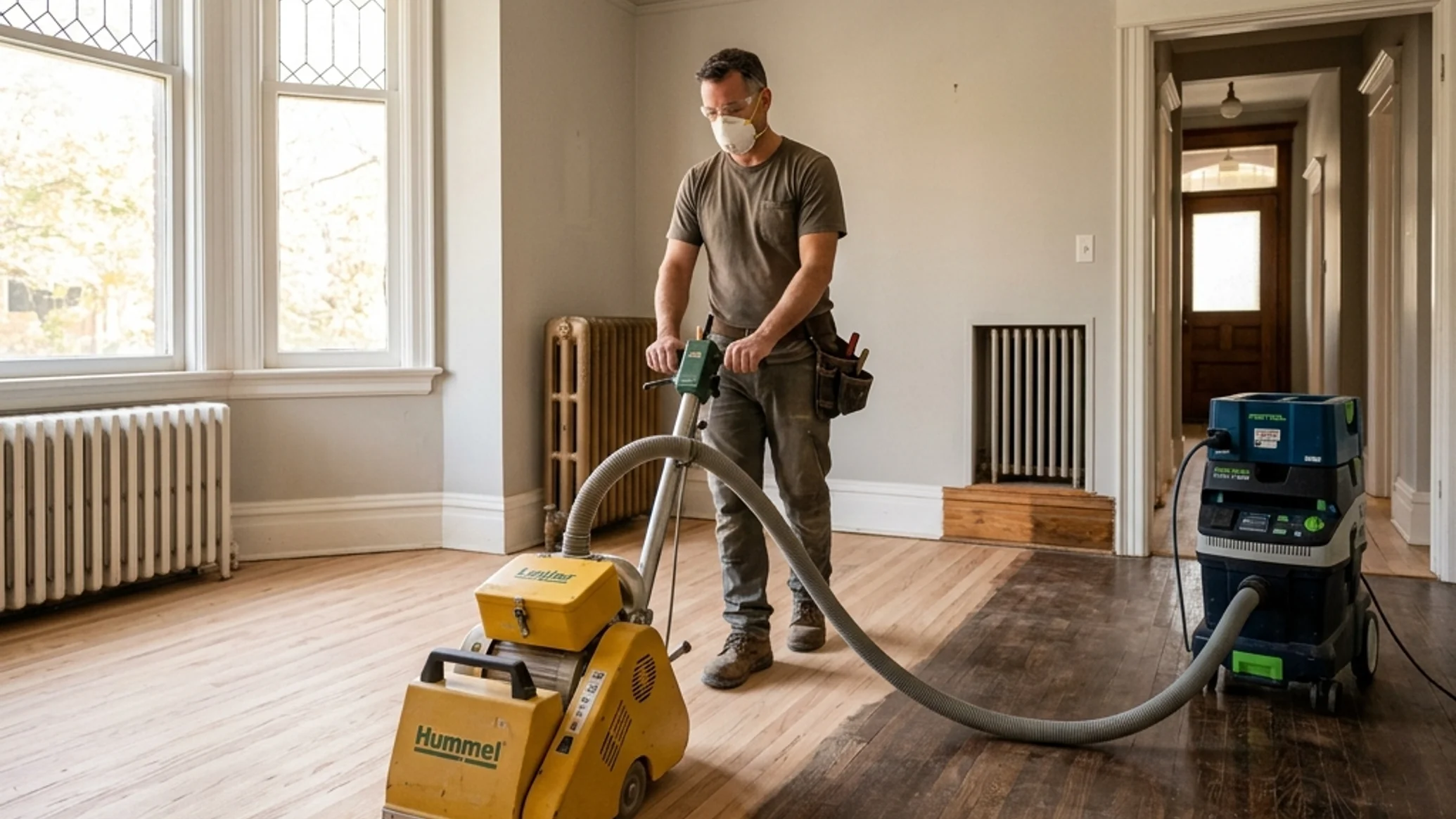
Dustless sanding uses sanders with integrated HEPA-grade vacuum extraction rather than passive dust collection. The premium runs $0.50 to $1.00 per square foot above standard sanding. Actual dust reduction varies by operator and setup — claims of 99 percent dust reduction are realistic with proper equipment and careful technique, but 80 percent reduction is more typical in real-world application.
Dustless sanding is genuinely worth the premium in three scenarios:
- Occupied homes where the refinish must proceed while residents continue living in adjacent rooms. Reduced ambient dust prevents the floor refinish from contaminating the rest of the home.
- Households with respiratory sensitivity — asthma, allergies, post-viral respiratory issues, or chemical sensitivity. The reduced ambient dust during and after the project is medically significant for these households.
- Pet households where pets cannot easily be relocated for the project duration. Reduced dust means lower cleanup risk for pets and less stress on the household.
Dustless sanding is not necessary when the home will be empty during the refinish, the project is short (a single room under 200 square feet), or post-refinish cleanup is straightforward. The premium can be skipped in those cases without consequence.
Reading a Quote: What Should Be Itemized
A defensible hardwood refinishing quote in Toronto in 2026 should itemize the following. If any of these are missing, ask for them in writing before signing:
- Number of sanding passes with target grit progression (typical: 36-grit, 60-grit, 80-grit, 100-grit screen — four passes for damaged floors, three for standard refinish).
- Edge sanding as a line item — edge sanders run different machines and add labour.
- Finish system specification: exact product type (water-based polyurethane, oil-based polyurethane, hardwax oil) and number of coats (three is standard, four for high-traffic).
- Stain step as a separate line item with specific stain colour reference.
- Dust containment method (standard, HEPA-vac assisted, or fully dustless).
- Closet, stair, and transition treatment — included or quoted separately.
- Furniture moving — included or homeowner responsibility.
- Baseboard and quarter-round treatment — masked off, removed and reinstalled, or replaced.
- Cleanup and waste removal at project end.
- Written workmanship warranty with specific duration. Our standard hardwood refinishing work carries a 3-year written workmanship warranty.
The single biggest red flag on a hardwood refinishing quote is a single-line price with no breakdown. The variance in this category is too large to be served by an undocumented number.
Typical Toronto Project Timeline
A standard Toronto residential refinish on a 600 to 1,000 square foot area runs roughly one calendar week, with a second week of restricted use before the floor is fully cured.
- Day 1: Furniture removal, baseboard masking or removal, dust containment setup.
- Day 2 to 3: Sanding (three to four passes plus edge work).
- Day 3 to 4: Stain application if part of the scope. Add 24 hours dry time.
- Day 4 to 6: Finish coat application — three coats with 2 to 4 hour dry between coats for water-based, 12 to 24 hours for oil-based.
- Day 7 to 10: Final cure. Sock-foot traffic allowed at 24 hours, light shoe traffic at 48 hours, furniture replacement at 5 to 7 days, area rugs at 14 days, full cure at 21 to 30 days.
Heritage refinishes, stained floors, and projects with significant repair work add 2 to 4 days. Occupied-home projects with isolation by floor or zone typically take 50 percent longer because work zones cannot be combined.
We provide free on-site assessments for hardwood refinishing in Toronto and the GTA — pricing on this scale of work cannot be quoted accurately by phone or photo without inspecting the floor in person. A 20-minute site visit usually resolves all the variables above and produces a quote with the line items shown.
Frequently Asked Questions
How much does it cost to refinish hardwood floors per square foot in Toronto?
Standard hardwood floor refinishing in Toronto in 2026 runs $4.00 to $6.00 per square foot for a basic 3-pass sand and 3-coat water-based polyurethane finish. Adding a stain step brings the range to $5.00 to $7.50 per square foot. Heritage homes or floors needing significant repair work run $6.00 to $9.00 per square foot. Hardwax oil refinishes cost $5.50 to $8.50 per square foot but carry different long-term maintenance economics. Small jobs under 300 square feet typically have a project minimum that raises the effective rate, and jobs over 1,500 square feet usually drop $0.50 to $1.00 per square foot below the standard range.
Is dustless sanding worth the extra cost?
Dustless sanding adds $0.50 to $1.00 per square foot to the project cost and is genuinely worth it in three scenarios: occupied homes where the refinish must proceed with residents in adjacent rooms, households with respiratory sensitivity (asthma, allergies, chemical sensitivity), and homes with pets that cannot easily be relocated. In a vacant home with a single short refinish project, the premium is optional and can be skipped without affecting finish quality.
How long do refinished hardwood floors last in Toronto?
Water-based polyurethane refinishes typically last 10 to 15 years before the next full refinish under normal Toronto residential traffic. Oil-based polyurethane lasts 12 to 18 years but ambers over time and carries longer cure odour. Hardwax oil requires a full recoat every 6 to 8 years but supports invisible spot repair between cycles. Heritage floors that have already been refinished multiple times may have only one more refinish cycle remaining before board replacement becomes necessary — a site assessment can measure remaining wear-layer thickness and give a defensible answer.
Can I refinish hardwood floors with water damage or pet stains?
Often yes, but the answer depends on how deep the staining and damage have penetrated. Surface water rings and shallow pet stains usually sand out cleanly within the standard refinish process. Deep urine staining that has penetrated the wood fibre may remain as a shadow even after deep sanding — full board replacement is the only reliable removal for that condition. Structural water damage that has cupped or warped boards requires individual board replacement before refinishing can proceed. A site assessment with moisture readings and stain depth probes is the only way to give a confident answer; we offer this assessment at no charge for Toronto and GTA properties.
Get Your Free Quote
Tell us about your project — we get back within 1 business day with honest pricing.