
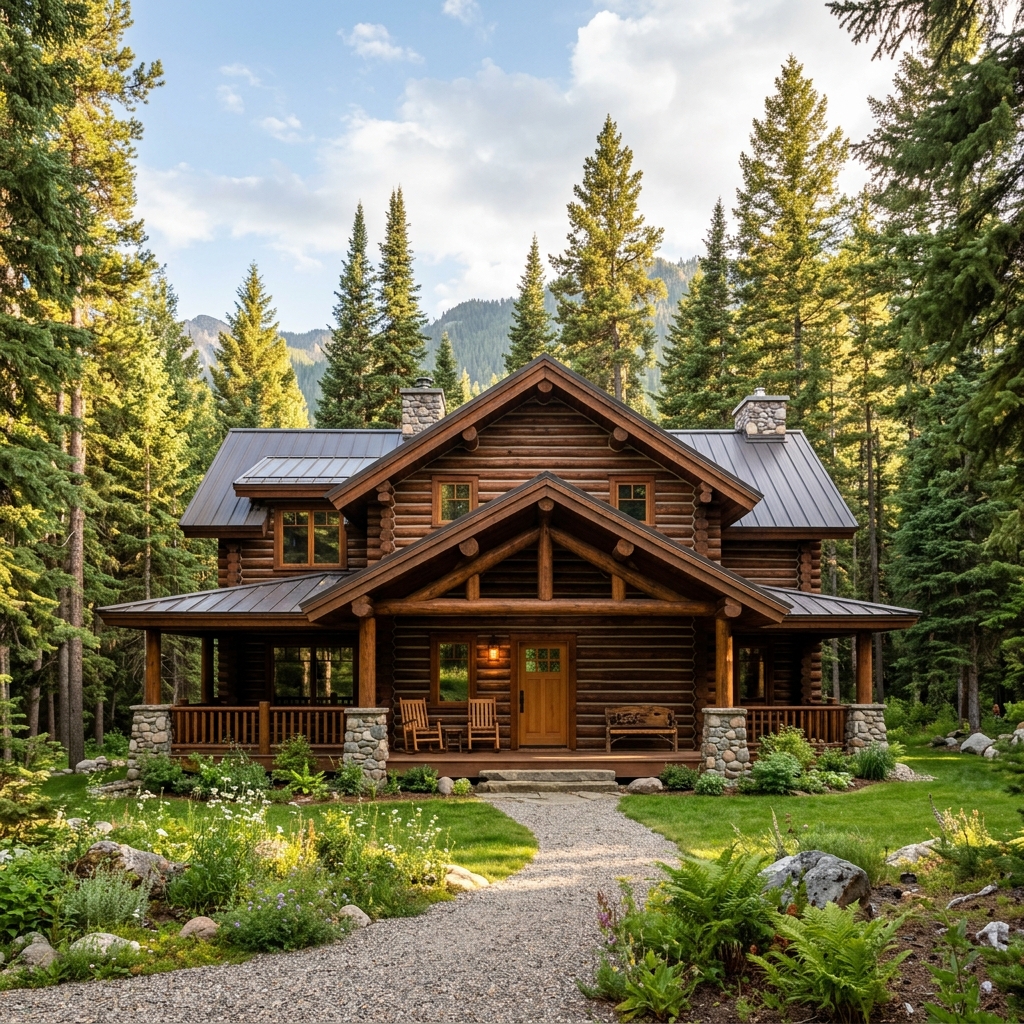
Search for log home restoration pricing in Ontario and most of what you find is generic deck-staining content with the word "log" inserted. The reality is that log home work is a specialty discipline with different equipment, different chemistry, and different crew skills. A 1,500 square foot log home full restoration is not three times more expensive than a 500 square foot cedar deck — it is six to eight times more expensive, and the reasons matter if you want to evaluate quotes intelligently. This guide breaks down 2026 Ontario pricing for log home restoration, the cost variables that drive the spread, and where homeowners overspend or underspend.
Why Log Home Pricing Differs from Deck Work
The first thing log home owners discover when collecting quotes is that the pricing model is completely different from what they would pay to restore a deck of equivalent square footage. Three structural reasons drive this.
Specialty equipment that most contractors do not own. Corn-cob and walnut-shell media-blasting equipment costs tens of thousands of dollars and requires specific certification to operate safely on aged softwood. Chemical-strip work uses standard equipment any contractor owns. The capital cost of media-blast specialty divides over far fewer projects per year, raising per-project equipment cost.
Multi-storey crew safety requirements. Most log homes are two or three storeys with steep gables and complex rooflines. Safe access requires scaffold setup, harness systems, and crew-of-four minimum on most jobs versus the crew-of-two adequate for ground-level deck work. Labour scales with crew size and setup time.
Specialty product expertise. Log stains require breathability properties (allowing moisture vapour to escape), thermal-flexibility properties (moving with seasonal log expansion), and biocide loading appropriate for the larger thermal-mass-driven moisture cycles inside log walls. The products are more expensive per litre and require trained application technique.
The Real 2026 Cost Range
For honest planning purposes, here is what Ontario log home owners are actually paying for full exterior restoration in 2026. These ranges assume structurally sound logs without major rot, joist failure, or sill-log replacement requirements.
- Small log home or cabin (under 1,200 sq ft): $14,000 to $24,000 for full restoration including media blasting, chinking inspection, sill assessment, and two-coat premium re-staining
- Standard log home (1,200 to 1,800 sq ft): $18,000 to $32,000
- Large log home (1,800 to 2,800 sq ft): $28,000 to $48,000
- Estate-scale log home (2,800 to 4,500 sq ft): $42,000 to $75,000+
- Chinking-only repair (no full restoration): $3,500 to $14,000 depending on home size and failure rate
- Sill-log replacement (additional, when needed): $8,000 to $25,000+ depending on number of compromised logs and access difficulty
What you should not see in 2026 Ontario log home pricing: anything under roughly $10,000 for a real full-exterior restoration. Quotes below that range have either omitted media blasting (substituting cheap chemical stripping that damages aged softwood), skipped chinking inspection, or quoted topcoat-only without addressing the prep that determines actual finish lifespan. The math works out cheaper in year one and dramatically more expensive over a ten-year window.
Media Blasting vs Chemical Stripping: Cost Implications
Most lower-priced log home quotes default to chemical stripping. The cost savings are real on the contractor side and partially passed through to the homeowner — typically 15 to 25 percent below media-blast pricing for equivalent home size. The question is whether that saving is real.
For pressure-treated or recently-built log structures, chemical stripping works adequately. For aged white pine, eastern white cedar, and other softwood species common to Kettleby, Schomberg, Caledon, and Muskoka heritage properties, chemical stripping causes three problems: it raises wood grain (causing the next stain coat to absorb unevenly), it opens the protective lignin layer (reducing the next finish lifespan by typically 20 to 30 percent), and it requires harsh-chemistry runoff capture on rural properties without municipal drainage. For aged heritage softwood, the apparent saving on the strip phase is fully consumed by reduced finish lifespan and additional prep on the next restoration cycle.
Chinking Repair: The Hidden Major Line Item
Chinking — the flexible sealant between log courses — is the single most commonly underestimated line item in log home quotes. Failed chinking allows winter air infiltration (raising heating bills by 15 to 30 percent), enables liquid moisture penetration into log interiors during summer rains, and creates pest entry points that can compromise structural logs over multiple seasons.
A typical 1,500 sq ft Ontario log home has between 800 and 1,400 linear feet of chinked joints. Failure rates of 15 to 30 percent are common on log homes that have not received chinking attention in over a decade. Chinking replacement materials run $35 to $65 per linear foot installed for premium two-component flexible systems with proper backer rod. On a home with 25 percent chinking failure across 1,200 linear feet, that is $10,500 to $19,500 just for chinking — often the largest single line item on the full restoration quote.
Quotes that do not break out chinking as a separate line item are almost always either guessing or planning to discover the issue mid-project as a change-order. Ask for itemized chinking inspection results before signing.
Premium Stain Application Costs
Log home stains differ from deck stains in three ways that affect cost: they must be breathable (allowing internal log moisture to escape), they must be flexible (moving with seasonal log expansion of up to half an inch on large logs), and they must carry biocide loading sufficient for the higher thermal-mass moisture cycles inside log walls. Premium contractor-grade log stains run $90 to $140 per gallon retail equivalent — two to three times the cost of standard deck stains.
Application takes longer too. Two coats applied wet-on-tacky (the technique that maximizes inter-coat adhesion) requires careful timing and crew coordination. A 1,500 sq ft log home typically takes a four-person crew four to six working days for the application phase alone, after the strip and chinking phases are complete.
When Replacement Is the Right Call (Rare)
Log home replacement is dramatically more expensive than restoration — typically four to seven times the cost on a per-square-foot basis. A new custom log home in Ontario starts around $400 to $600 per square foot turnkey. Restoring an existing log home runs $12 to $30 per square foot for full exterior work.
Replacement only makes sense when structural compromise is severe enough that restoration cannot deliver acceptable service life. Common indicators: more than 30 percent of sill logs showing rot, foundation failure that has shifted log courses, or rot extending into structural posts and beams. For surface-level deterioration — failed finish, grey oxidation, embedded mould, chinking failure — restoration delivers the same visual outcome at fifteen to twenty percent of replacement cost.
The King City and Caledon Premium
Log home work in King Township and the surrounding Caledon, Aurora, and northern Vaughan rural areas runs slightly above pricing in more accessible regions. The premium reflects logistics rather than craftsmanship — remote rural properties require additional crew transport time, specialty equipment mobilization across longer distances, and on-site logistics for crews working multi-day jobs without nearby supply or accommodation infrastructure. The typical regional premium runs five to fifteen percent versus equivalent work in more accessible markets like the immediate GTA suburbs. For genuinely remote Muskoka and cottage country properties, the premium can run twenty to thirty percent.
When to Schedule for Best Pricing
Log home season runs from late April through October in Ontario, with the strongest pricing windows in two periods:
- Late April through late May: contractors are mobilizing for the season and have flexible booking dates. Expect 5 to 10 percent better pricing on multi-week estate jobs.
- Late September through mid-October: after Labour Day demand drops and contractors are willing to discount to fill the final weeks of the application window.
- Peak premium (June through August): rack-rate pricing and limited availability on multi-week estate jobs.
Multi-year log home maintenance plans (committing to the property for the next two restoration cycles) typically secure 8 to 15 percent better pricing on each cycle. Most professional contractors offer this kind of relationship pricing for repeat estate clients.
Frequently Asked Questions
Why is log home restoration so much more expensive than deck restoration?
Specialty equipment most contractors do not own (media-blasting systems), larger crew sizes for safe multi-storey access, and specialty product expertise (breathable, flexible log stains with high biocide loading). On a per-square-foot basis log home work runs three to five times the cost of equivalent deck work — and the reasons are real, not contractor markup.
How long does a properly restored log home last before the next major restoration?
With premium products applied over thorough preparation, eight to ten years on most Ontario log homes before another full strip-and-restain cycle. Annual or biennial inspection and touch-up maintenance can extend that to twelve to fifteen years on properties that get regular attention rather than sit until visible failure forces emergency work.
Should I get media blasting or chemical stripping for my aged log home?
For aged softwood (white pine, eastern white cedar, common Ontario species), media blasting almost always wins on long-term cost despite higher upfront pricing. Chemical stripping reduces next-finish lifespan by 20 to 30 percent on these species, fully consuming the apparent saving by the next restoration cycle. For newer pressure-treated log structures the calculation is closer; both methods work adequately.
How do I know if my chinking needs replacement or just touch-up?
Visual inspection during a free assessment will identify failure patterns. Indicators of widespread failure: cracking across more than 15 percent of joint length, separation from log surfaces (called three-point adhesion failure), and any sign of water staining on interior log walls below joints. Touch-up is appropriate when failures are localized to under 10 percent of total joint length and limited to UV-exposed elevations.
Can I get a meaningful quote without an on-site visit?
For log home work, no — the variables are too large. Photos help us give a planning estimate but the actual quote requires log-by-log inspection for sill condition, chinking failure rate, and rot probing on suspect areas. Any contractor giving you a firm log home quote without a site visit is guessing at numbers that will become change-orders mid-project.
Get Your Free Quote
Tell us about your project — we get back within 1 business day with honest pricing.