
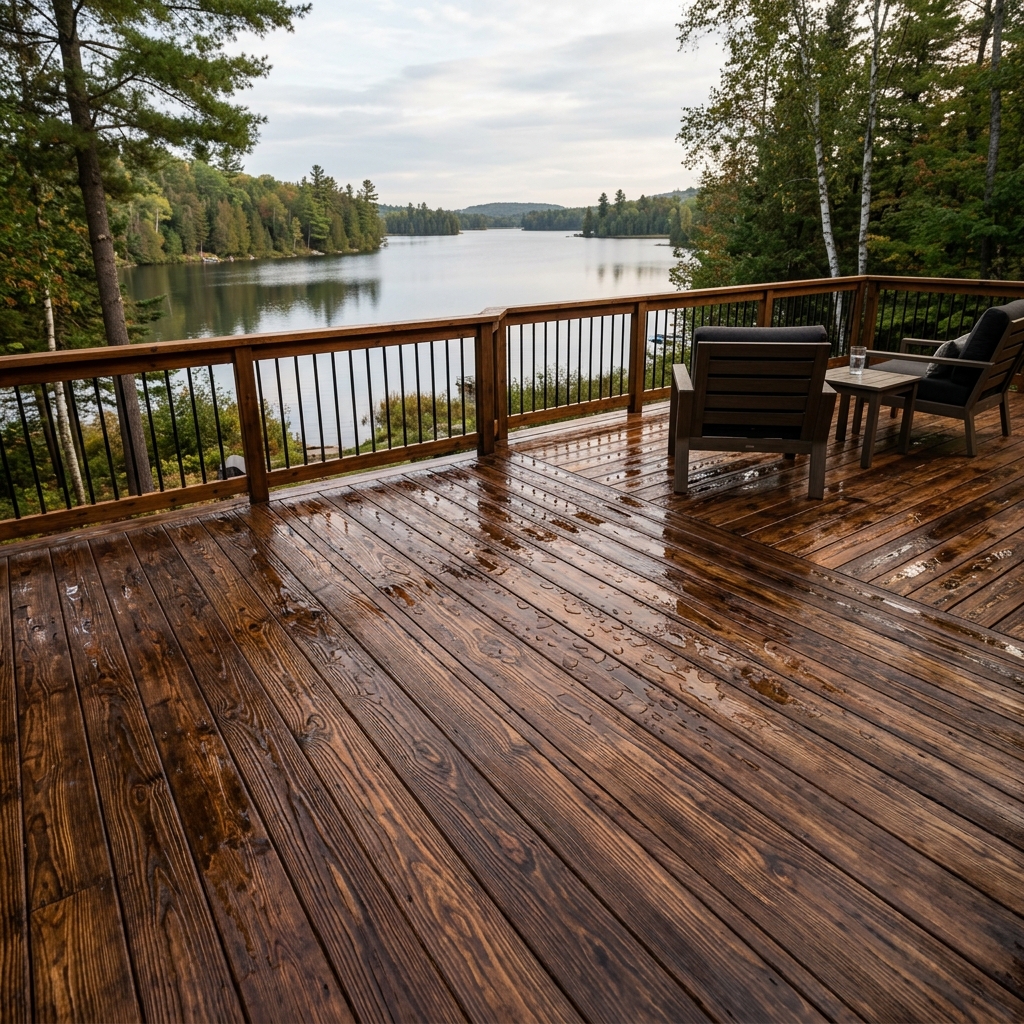
Walk into any GTA hardware store and the deck stain aisle promises five-year, eight-year, even ten-year protection. For a deck twenty kilometres inland those numbers might be honest. For a deck within a kilometre of Lake Ontario they are fiction. Lake-effect humidity, the salt and mineral deposits carried in lakeside air, and the dense biological growth these conditions produce destroy standard stains in a single season. This guide reviews the four contractor-grade penetrating stains that genuinely survive the Lake Ontario shoreline climate, when each makes sense, and which popular brands homeowners should walk past.
Why Lake-Effect Climates Destroy Standard Stains
The shoreline of Lake Ontario from Burlington through Toronto creates a micro-climate fundamentally different from inland GTA. Three conditions interact to dismantle stain finishes far faster than rated lifespans suggest.
Persistent ambient humidity. Lake-effect humidity keeps relative moisture high around shoreline decks for weeks at a time during summer. Penetrating stains depend on a dry-wet-dry cycle to fully cure. Constant ambient moisture interrupts the cure, leaving the finish vulnerable to mould, mildew, and surface failure within months instead of years.
Salt and mineral deposition. Wind off the lake carries microscopic salt and mineral particles inland for roughly a kilometre. These particles deposit on every horizontal wood surface, attract more moisture, and chemically react with stain binders. Standard urethane-modified oils degrade in this environment far faster than their dry-climate ratings suggest.
Aggressive biological growth. The combination of warmth, humidity, and organic matter from lakeside vegetation produces mould, mildew, and algae colonization on a scale rarely seen inland. Stains without biocide additives provide no defence against this growth.
The result: a stain rated for five years inland will typically deliver eighteen months of acceptable performance within a kilometre of Lake Ontario. The product was not lying. The conditions were just outside its design envelope.
The Three Product Categories That Survive
For Lake Ontario shoreline decks, only three product categories deliver genuinely useful service life:
- Penetrating oil-based stains with high biocide loading — these soak into the wood and remain flexible as the wood expands and contracts. They cannot peel because there is no surface film to peel.
- Penetrating water-based stains with hybrid resin technology — newer formulations that perform comparably to oil-based and dry faster, useful when humidity windows are short.
- Hardwax oils for premium hardwood decks (ipe, garapa, mahogany) — these are dramatically more expensive but the only reasonable choice for tropical hardwood lakeside decks.
Notably absent from this list: solid stains, paints, and any film-forming finish. Film-formers fail in lakeside conditions for the same reason they fail anywhere — they trap moisture against the wood — but they fail much faster here.
Non-Drying Penetrating Oil Stains
Non-drying penetrating oils are the category we specify most often for lakeside Oakville and Mississauga cedar decks. They never form a hard film on the wood surface and therefore cannot peel. Multiple coats can be applied years apart without stripping the previous finish.
Strengths: outstanding mildewcide loading, deep penetration, repels water aggressively, available in semi-transparent colours that highlight cedar grain rather than masking it. Single-coat application is possible on porous wood, two coats on tighter cedar.
Weaknesses: requires a slightly longer dry window between coats. Application during humid weather is harder than with film-forming alternatives. Not ideal for already-painted decks or decks with previous solid stain (those need stripping first).
Best for: cedar and pressure-treated decks within 2 km of Lake Ontario. Eastlake, Bronte, Lakeview Mississauga, Port Credit lakeside properties.
EPA-Registered Preservative Stains
This category covers stains where the biocide is registered as a wood preservative, not just a colorant additive. They are among the more aggressive options available for fungal and mould resistance and are typically sourced through certified contractor channels rather than retail.
Strengths: excellent fungal protection, available in transparent through semi-solid colours, strong UV inhibitors, performs well on previously stained surfaces.
Weaknesses: EPA-registered status restricts shipping into some Canadian provinces; we source through certified contractor channels. Stronger odour during application than other categories.
Best for: heavily shaded decks where mould is the primary failure mode. Old Oakville heritage decks under mature canopy, Toronto Beaches lots with limited sun.
Zinc Nano-Particle UV-Protective Stains
Stains using zinc nano-particle technology for UV protection represent one of the more advanced approaches in current penetrating stain formulations. They are typically water-based with hybrid resin technology.
Strengths: exceptional UV resistance, water-based formulation cleans up with water, low VOC, excellent on south-facing exposed decks, applies well in shorter weather windows than oil-based alternatives.
Weaknesses: mildew resistance is good but not as aggressive as the non-drying oil and EPA-registered preservative categories above. On heavily shaded lakeside decks the UV advantage is wasted while the mildewcide load is the limiting factor.
Best for: south-facing exposed lakefront decks where solar UV is the primary challenge — particularly properties with unobstructed lake views.
Tung Oil Hardwood Finishes
Tung-oil-based finishes were originally formulated for tropical hardwoods but are widely used on premium cedar. They produce a rich, warm appearance unmatched by other categories.
Strengths: rich, warm finish that ages gracefully, excellent on ipe, garapa, mahogany, and high-end cedar, deeply nourishes wood fibers, easy to maintain with annual reapplication.
Weaknesses: shorter overall lifespan than the non-drying oil and EPA-registered preservative categories — typically 18 to 30 months between recoats on lakeside decks. Pricing per square foot is higher because reapplication is more frequent.
Best for: premium hardwood decks where appearance and feel matter more than maintenance interval. Old Oakville custom builds, high-end Eastlake properties with ipe or mahogany.
What to Avoid for Lakeside Decks
The following products are widely sold and widely fail in Lake Ontario shoreline conditions:
- Big-box solid stains and paints. Film-formers trap moisture, peel within one to two seasons in lakeside humidity, and require expensive stripping to remove before any penetrating product can be applied.
- Generic "deck and fence" hardware-store stains. Inadequate biocide loading for lakeside biological growth. Performance often falls within a single year.
- Oil-based stains older than 18 months in the can. Modern environmental regulations have changed oil chemistry; older inventory at clearance pricing is rarely worth the savings.
- Self-described "ten-year" stains. No exterior wood stain delivers ten years of service in a lakeside climate, regardless of label claims. Treat the rating as a marketing number, not a planning number.
Application Notes for Lake Ontario Properties
Even the best stain fails if applied wrong. For Lake Ontario shoreline decks the application protocol matters more than for inland projects.
Moisture content matters more than weather forecast. A wood moisture meter should read under 15 percent before any stain goes down. In lakeside conditions that may take 48 to 72 hours after the last rain rather than the 24 hours typical inland.
Two coats is not optional. Single-coat application on lakeside decks delivers half the rated lifespan. The first coat is the wood-feeding coat; the second coat carries the UV inhibitors and surface-level biocide that does most of the protective work.
Apply in the right humidity window. Relative humidity above 70 percent at the time of application slows curing dramatically. Mid-morning through mid-afternoon during stable weather is the practical sweet spot.
Salt-deposit rinse for properties within 500m of the lake. Standard cleaning leaves invisible mineral deposits on the wood. A dedicated mineral-stripping rinse using oxalic acid or commercial brightener neutralizes these deposits before staining.
Color Choice and Solar Heat
Lake Ontario shoreline decks face a counterintuitive heat challenge: bright sun reflects off the water and amplifies surface heating. Dark stains on south-facing lakeside decks reach surface temperatures 15 to 25 percent higher than equivalently exposed inland decks.
Practical implications:
- Avoid full-saturation dark colours on south-facing lake-view decks. Surface heat accelerates UV degradation and is uncomfortable underfoot in July and August.
- Semi-transparent finishes in mid-tone browns and weathered greys are forgiving choices that highlight cedar grain without absorbing extreme solar heat.
- For premium hardwood decks (ipe, garapa) the natural colour is usually the best choice — penetrating oils that enhance rather than dye.
Frequently Asked Questions
Is there a single best deck stain for all Lake Ontario shoreline decks?
No — the right category depends on wood species, sun exposure, and how heavily shaded the deck is. Non-drying penetrating oils work for the broadest range of cedar lakeside decks. Zinc nano-particle UV-protective stains win on south-facing exposed lots. EPA-registered preservative stains dominate on heavily shaded mould-prone properties. Tung-oil-based hardwood finishes are the right answer for premium hardwoods like ipe, garapa, and mahogany.
Can I use a stain rated for inland conditions if my deck is just a few blocks from the lake?
You can, but expect 30 to 50 percent shorter lifespan than the rating suggests. The salt and humidity gradient drops off rapidly past about a kilometre from the shore — properties further inland do not need full marine-grade specification, but properties within roughly 500 metres of Lake Ontario benefit substantially from the upgrade.
How much more do marine-grade stains cost?
Per litre, two to three times more than hardware-store equivalents — roughly $90 to $130 per gallon retail versus $35 to $50. On a typical 600 square foot deck the difference in product cost is around $200 to $400. The labour cost of applying it is identical, so the total project premium is modest relative to the lifespan gain.
Can I apply marine-grade stain over an existing finish, or do I need to strip first?
Penetrating stains can be reapplied over previous penetrating stains in good condition after a thorough clean and brighten. They cannot be applied over solid stains, paints, or any film-forming finish — those must be stripped first, which adds significantly to project cost. If you do not know what was previously applied, an adhesion test will tell us within 30 minutes.
Do these products work for fence staining as well as deck staining?
Yes, all four products perform well on fences. Vertical surfaces shed water faster than horizontal deck surfaces, so fence staining tends to deliver longer service life than deck staining with the same product. The marine-grade upgrade matters less for fences than for decks because of this geometry advantage.
Get Your Free Quote
Tell us about your project — we get back within 1 business day with honest pricing.