
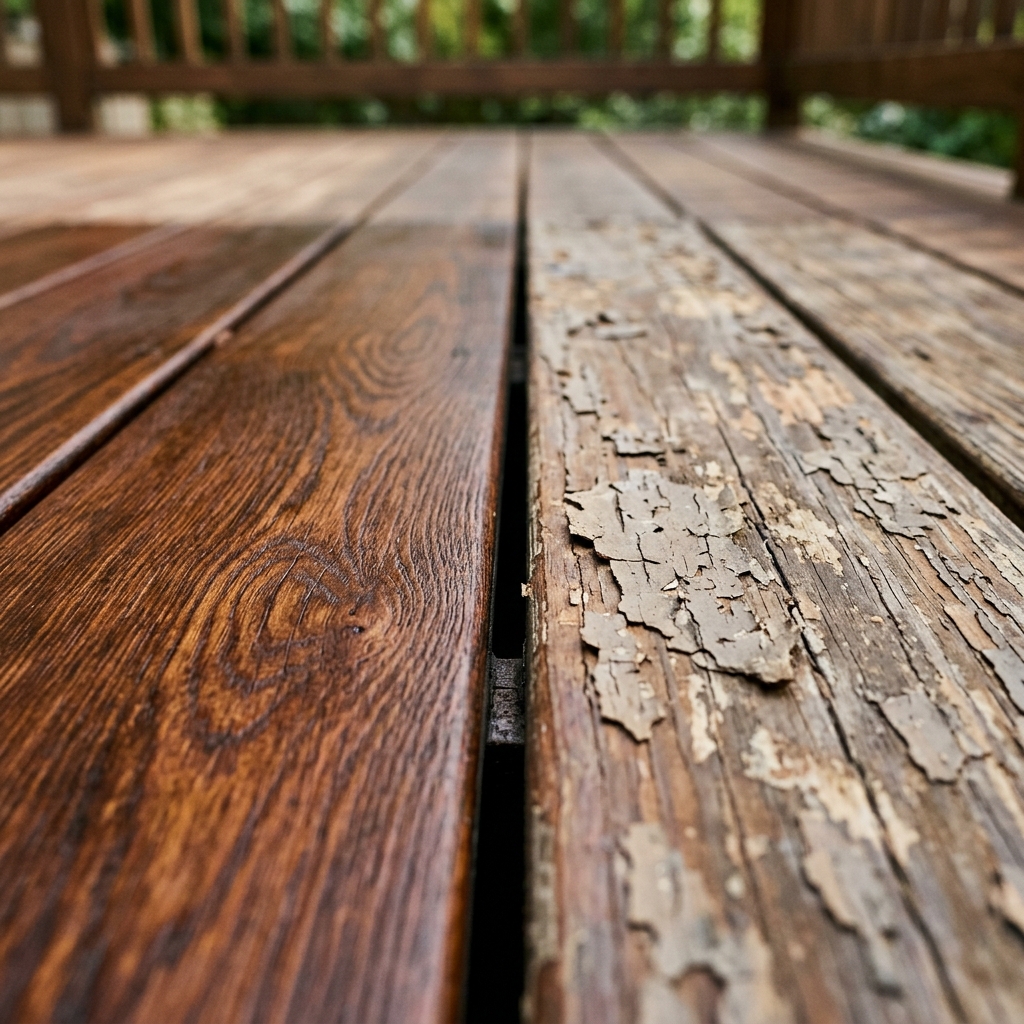
The product brand on the bottle matters less than most homeowners assume. The category the product belongs to matters more than they realize. Every exterior wood finish is either film-forming (creating a layer on top of the wood) or penetrating (soaking into wood fibres). Failure mode, lifespan, repair complexity, aesthetic, and ten-year ownership cost flow directly from this category choice. This guide gives you the framework to evaluate any finish product you encounter — past, present, or future — by asking the only question that genuinely matters about it.
The Fundamental Difference
Every wood finish belongs to one of two categories. The distinction is not marketing — it is physical chemistry, and it determines almost everything about how the finish performs.
Film-forming finishes cure into a hard layer on top of the wood. The wood is sealed underneath; the finish is what the world touches. The finish protects the wood by physically separating it from the environment.
Penetrating finishes soak into wood fibres and cure within them. There is no surface film; the wood itself is what the world touches. The finish protects the wood by treating it from within rather than coating it from above.
Once you understand which category a product belongs to, almost everything else about its performance becomes predictable.
The Film-Forming Family
Film-forming finishes include:
- All paints (latex, oil-based, enamel)
- Solid colour stains
- Varnishes (marine spar, polyurethane varnish, lacquer)
- All polyurethanes (water-based and oil-based, in any sheen)
- Aluminum oxide-fortified factory finishes on prefinished hardwood
- Epoxy floor coatings
Common characteristics:
- Hard, smooth surface that is what the world contacts
- Excellent water resistance — the surface is impermeable to liquid for the life of the finish
- Predictable cure timeline measured in hours or days
- Visible film thickness (1 to 5 mils typical)
- Failure mode is sudden — peeling, cracking, delamination
- Spot repair difficult or impossible — failure typically requires full strip and re-application
The Penetrating Family
Penetrating finishes include:
- All semi-transparent stains (oil-based and water-based)
- Non-drying penetrating oils
- Tung-oil-based finishes
- Hardwax oils
- EPA-registered preservative stains
- Linseed oil and traditional oil finishes
Common characteristics:
- Wood surface remains the contact surface — wood feel preserved
- Lower water resistance than film-forming — liquid penetration possible if standing water dwells too long
- Variable cure timeline depending on absorption — sometimes days for full cure
- No visible film thickness — appearance shows wood character
- Failure mode is gradual — fade, dry-out, loss of water beading
- Spot repair straightforward — damaged areas can be refreshed locally without affecting surrounding wood
Lifespan and Failure Modes Compared
The two categories fail in fundamentally different ways, and understanding the difference is critical for predicting maintenance schedules.
Film-forming failure is binary and obvious. The film is intact, then it is not. Peeling and cracking begin at edges, transitions, end-grain cuts, or wherever the wood beneath has expanded or contracted enough to break the finish bond. Once peeling starts, it accelerates rapidly because each peeled section exposes wood that absorbs moisture and accelerates further failure.
Penetrating failure is gradual and continuous. Water beading on the surface decreases over years rather than ending in a single season. Colour pigment fades. Surface protection degrades but rarely fails catastrophically. The signal that it is time to recoat is loss of water beading rather than visible damage.
Typical lifespan ranges in the GTA climate:
- Film-forming on horizontal wood surfaces (decks): 2 to 4 years before peeling
- Film-forming on vertical wood surfaces (siding): 7 to 12 years
- Film-forming on interior floors (polyurethane): 8 to 12 years before visible wear-through
- Penetrating on horizontal exterior wood: 3 to 6 years between recoats (no peeling between cycles)
- Penetrating on vertical exterior wood: 5 to 10 years between recoats
- Penetrating on interior floors (hardwax oil): indefinite with annual or biennial maintenance reapplication
Repair Complexity Compared
This is where the practical gap between the two categories becomes most consequential.
Film-forming repair: a damaged area requires stripping the existing film, preparing the underlying wood, and re-applying the finish. The repair is visible against the surrounding aged film for years afterward because the new application sits at slightly different sheen, colour, and surface texture than the weathered original. Most film-forming damage is addressed by full re-application rather than spot repair.
Penetrating repair: a damaged area can be cleaned, lightly sanded if needed, and re-stained or re-oiled locally. The repair blends into surrounding wood within months as ambient weathering equalizes the colour. Spot repair is genuinely simple, fast, and inexpensive.
Practical implication: a deck that gets a barbecue grease stain in year three is a $200-to-$500 spot repair on penetrating finish and a $3,000-to-$6,000 full deck strip-and-refinish on film-forming finish.
Aesthetic Differences
The aesthetic gap between film-forming and penetrating is genuine but a matter of preference rather than objective superiority.
Film-forming aesthetic shows finish character rather than wood character. Smooth, uniform surface. Strong colour saturation possible. Visible film thickness in raking light. Some homeowners specifically prefer the "finished" look over wood character. Solid colour stains and paints belong here.
Penetrating aesthetic shows wood character. Grain pattern, board variation, knot detail visible. Colour shows through pigment rather than masking the wood. Surface feels like wood rather than like coated wood. Most homeowners specifying premium hardwood (cedar, ipe, walnut) want this aesthetic because the material itself is the design feature.
10-Year Ownership Cost Math
Honest 10-year cost projections for a typical 600 square foot exterior cedar deck in the GTA:
Film-forming maintenance plan (solid stain or paint):
- Year 0: Initial application $3,400 to $5,800
- Year 2-3: Strip and re-apply (peeling) $4,200 to $7,000
- Year 4-5: Strip and re-apply $4,200 to $7,000
- Year 6-7: Strip and re-apply $4,500 to $7,500
- Year 8-9: Strip and re-apply $4,500 to $7,500
- 10-year total: $20,800 to $34,800
Penetrating maintenance plan (semi-transparent stain or oil):
- Year 0: Initial application $3,200 to $5,500
- Year 4-5: Cleaning + recoat $2,400 to $4,200
- Year 9-10: Cleaning + recoat $2,400 to $4,200
- 10-year total: $8,000 to $13,900
The 10-year cost ratio is approximately 2.5:1 in favour of penetrating finishes. The math is similar across nearly all exterior wood applications. For interior hardwood floors, the math is different (polyurethane often wins despite being film-forming because interior conditions do not produce the dramatic peeling failures that exterior conditions do) — but for exterior wood, penetrating wins on cost in nearly every realistic scenario.
Which Family Works for Which Application
Both categories have legitimate applications. The decision matrix:
Use film-forming when:
- Interior hardwood floors with high traffic (polyurethane is the right answer)
- Exterior wood that needs uniform colour for design coherence with painted house exterior
- Wood surfaces with extensive damage that no penetrating finish can hide
- Vertical exterior wood (siding, fences) where lifespan economics favour film-forming due to better water shed off vertical surfaces
- High-traffic interior commercial-grade applications
Use penetrating when:
- Exterior horizontal wood surfaces (decks, exterior stairs)
- Heritage cedar that needs long-term preservation
- Premium hardwood (ipe, garapa, mahogany) that has natural beauty worth showing
- Wood surfaces where wood feel and authentic aesthetic matter
- Owners who value spot-repair capability and gradual aging over film durability
Frequently Asked Questions
Is one category objectively better than the other?
No — they have different applications. For interior hardwood floors with kids and pets, polyurethane (film-forming) is generally the right answer. For exterior cedar decks, semi-transparent stain (penetrating) is generally the right answer. The mistake is using the wrong category for the wrong application — film-forming on cedar decks or hardwax oil on a busy commercial-grade kitchen floor will both fail prematurely because the application does not match the category strengths.
How can I tell which category a product belongs to without reading the technical data sheet?
Three quick tests. First, the label: words like "polyurethane," "varnish," "paint," "lacquer," or "solid stain" indicate film-forming; words like "oil," "penetrating," "semi-transparent," or "wax" indicate penetrating. Second, the description of how to apply: products that describe distinct coats with sanding between them are usually film-forming; products that describe wiping on excess after a dwell period are usually penetrating. Third, the cure time: hours to a few days is typical of film-forming; days to weeks is typical of penetrating.
Can I switch a deck from film-forming to penetrating finish?
Yes, but it requires complete stripping back to bare wood before any penetrating finish will properly adhere. The strip is expensive (typically $1,500 to $4,000 on a typical residential deck) and damages cedar fibres in the process. The decision becomes economic: deck early in its life with substantial remaining service life, the switch is worthwhile because you avoid decades of escalating film-forming maintenance. Deck late in its life, sometimes continuing with film-forming until eventual replacement is more economical than the strip cost.
Why do most contractors default to film-forming on decks despite the lifespan disadvantage?
Three reasons. First, film-forming is more familiar to most general contractors who do paint and trim work in addition to deck work — the application technique is similar to painting. Second, film-forming hides preparation shortcuts that would be visible under penetrating finish, allowing lower-quality contractors to deliver acceptable-looking initial results from inadequate prep. Third, film-forming generates more repeat business because the failure mode requires full strip-and-refinish rather than the simple recoat that penetrating finishes accept. Specialty wood-restoration contractors generally prefer penetrating finishes because the long-term outcomes for the customer are better.
Are there exceptions to the rule that penetrating wins on exterior wood?
Yes. Severely damaged cedar that no penetrating finish can hide may require solid stain to deliver acceptable appearance. Vertical exterior surfaces (fences, siding) accept film-forming finishes better than horizontal surfaces because water sheds off rather than dwelling on the surface. Exterior wood adjacent to swimming pools or hot tubs sometimes benefits from film-forming finishes that better resist chlorinated water. And some exterior projects with strict colour-match requirements to painted trim or siding require film-forming finish to achieve uniform appearance. These exceptions are real but uncommon.
Get Your Free Quote
Tell us about your project — we get back within 1 business day with honest pricing.