
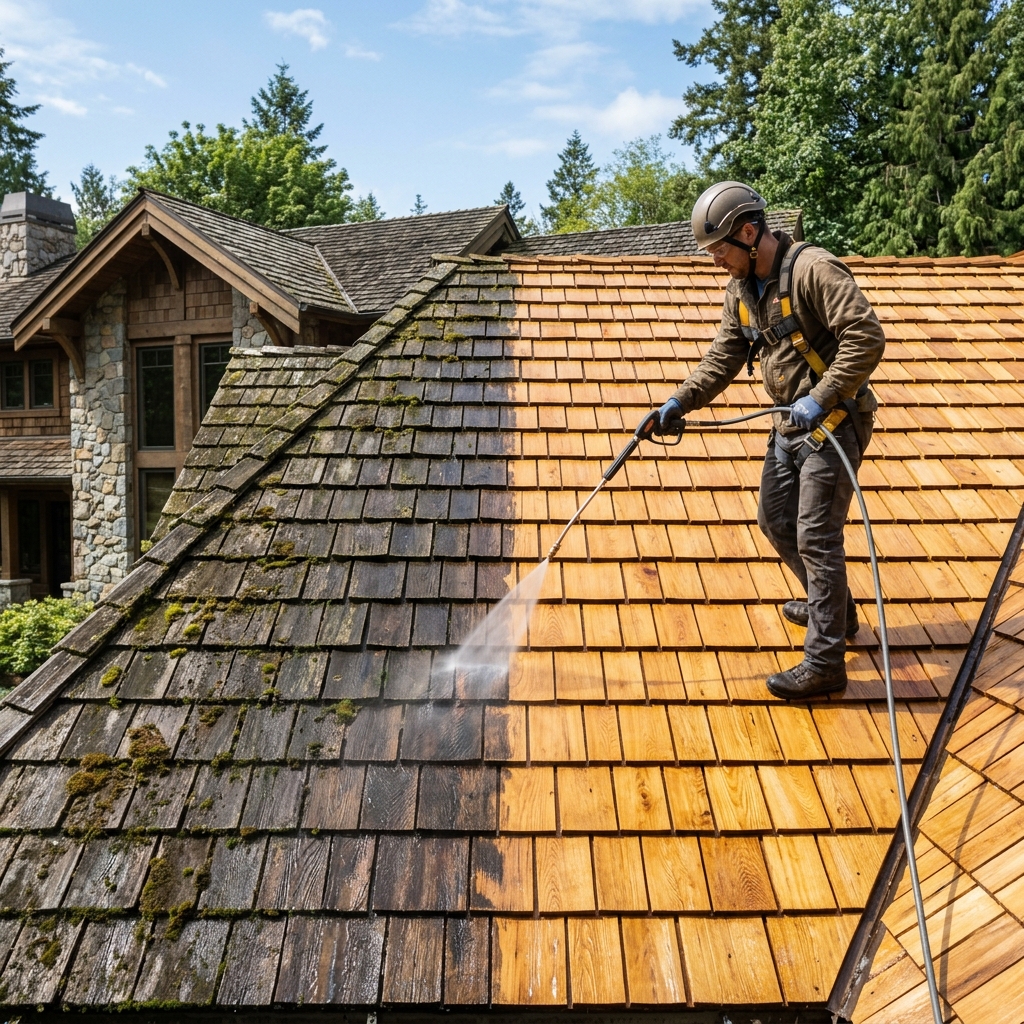
A cedar shake roof is one of the most expensive exterior features a GTA home can have, and one of the most commonly mismanaged. The single most consequential mistake homeowners make is choosing the cheaper cleaning option without understanding what it actually does. Power washing strips loose cedar fibres and takes three to five years off the roof per cleaning. Soft washing achieves the same visual outcome through chemistry rather than pressure, with no lifespan cost. The pricing premium for soft washing is small; the lifespan economics are not close. This guide explains exactly what each method does, why the gap is real, and how to identify a contractor doing it correctly.
Why This Decision Matters More Than Any Other
Cedar roof replacement in the GTA in 2026 runs $35,000 to $55,000 for a typical 2,500 square foot roof. Cedar roof cleaning runs $3,000 to $5,500 for the same roof. The maintenance economics are extremely favourable when done correctly — and extremely unfavourable when done incorrectly.
The single decision that determines whether maintenance helps or hurts is the choice between power washing and soft washing. This decision is not equivalent to choosing between a slightly faster service and a slightly slower one. It is the decision between cleaning that adds years to the roof and cleaning that takes years off.
Most homeowners do not understand the gap because the visual outcome immediately after cleaning is similar. A roof that has been pressure-washed and a roof that has been soft-washed both look dramatically better than the dirty roof that came before. The damage difference becomes visible only over the next several years.
What Pressure Washing Actually Does to Cedar
Cedar shingles are softwood with surface fibres that protect the structural wood underneath. Those fibres include both the original cedar wood structure and the protective lignin layer that gives cedar its weather resistance. Both are critically important.
Pressure washing at the PSI levels typically used by contractors (1,500 to 3,000 PSI) physically strips loose fibres and surface lignin from cedar shingles. The visible evidence is often on the ground after the work — a layer of cedar dust and shingle debris that homeowners assume came from the dirty roof but actually came from the now-permanently-damaged cedar surface.
The damage is not cosmetic. The lignin layer specifically resists UV degradation and moisture penetration. Once stripped, the underlying wood is exposed to weathering at accelerated rates. The shingle continues to function but its remaining service life is permanently reduced.
The typical lifespan cost: three to five years per pressure-washing cycle on cedar roofs. A homeowner who pressure-washes their thirty-year cedar roof every five years is converting a thirty-year roof into an eighteen-to-twenty-year roof.
What Soft Washing Actually Does
Soft washing inverts the cleaning approach. Instead of using high pressure to physically strip biological growth and dirt from the roof, soft washing uses biocide chemistry to kill organic growth at the cellular level, then uses calibrated low pressure (typically under 500 PSI) to rinse dead organic matter from the surface.
The chemistry does the work. The pressure does only what is necessary to flush the dead matter — which is far less than the pressure required to physically strip living biological growth.
The result is a roof visually similar to one that has been pressure-washed but with the cedar surface intact. The lignin layer is preserved. The fibre structure is preserved. The shingle service life is extended rather than reduced.
The Biocide Chemistry Difference
Soft washing relies on biocide chemistry that kills moss, algae, lichen, and fungal colonization at the cellular level rather than removing it physically. The standard soft-wash chemistry includes:
- Sodium hypochlorite-based biocides (similar in chemistry to household bleach but at concentrations and surfactant blends specifically formulated for roof application)
- Surfactants that allow the biocide to penetrate biological growth rather than running off
- Optional mildewcide additives for properties with persistent fungal issues
- pH-balancing rinse compounds that neutralize residual biocide
The chemistry is environmentally aware — properly diluted soft-wash solutions break down within hours of application and do not persist in soil or runoff. Properly executed soft washing on residential roofs has a lower environmental impact than equivalent pressure washing because the lower water volume reduces runoff into landscaping and storm drains.
Cost Comparison: The Premium Is Small
The pricing premium for soft washing over pressure washing on cedar roofs is real but modest:
- Pressure washing typical 2,500 sq ft cedar roof: $1,800 to $3,000
- Soft washing same roof with biocide pre-treatment: $2,400 to $4,000
- Premium for soft washing: typically $600 to $1,000 on a typical residential roof
The premium reflects the cost of biocide chemistry, the additional crew time for proper application and dwell, and the equipment cost differential (soft-wash equipment specifically calibrated for low-pressure application versus general-purpose pressure washing equipment).
For context: the lifespan cost of one pressure-washing event is typically three to five years off a thirty-year roof, which means roughly $4,000 to $7,000 in present-value lost roof life. The soft-washing premium of $600 to $1,000 saves $4,000 to $7,000 in lifespan cost. The economics are not close.
Lifespan Impact: Specific Years Lost
Honest expectations for cedar roof lifespan in GTA conditions under different cleaning regimes:
Maintained with soft washing every 5-7 years:
- Premium cedar shake roof: 30 to 40 years to end of useful life
- Standard cedar shingle roof: 25 to 35 years
Maintained with pressure washing every 5-7 years:
- Premium cedar shake roof: 18 to 25 years
- Standard cedar shingle roof: 15 to 20 years
Neglected (no professional cleaning):
- Premium cedar shake roof: 15 to 22 years (premature failure due to embedded biological growth)
- Standard cedar shingle roof: 12 to 18 years
Pressure washing produces lifespan results closer to neglect than to soft washing. Properly maintained cedar roofs deliver dramatically more value than improperly maintained or neglected ones.
When Pressure Washing Is Appropriate (Rarely on Roofs)
Pressure washing is the right approach for some surfaces — but cedar roofs are not on that list. Surfaces where pressure washing works well:
- Concrete driveways, patios, and walkways (the substrate is hard enough not to be damaged by pressure)
- Brick and stone surfaces (within calibrated PSI ranges)
- Modern composite decking (which is engineered for higher-pressure cleaning)
- Vinyl siding (at calibrated low-end pressure ranges)
- Equipment, machinery, and industrial surfaces
Surfaces where pressure washing is inappropriate include cedar roofs, cedar siding, cedar fences, all painted wood surfaces, asphalt shingle roofs, and any historic or heritage construction. For all of these surfaces, soft washing or chemical-only cleaning is the right approach.
How to Identify a Contractor Doing It Right
Five questions that quickly separate contractors who actually understand cedar roof cleaning from those who default to pressure washing for speed:
- What PSI will you use on my cedar roof? Correct answer: under 500 PSI for the rinse phase, with biocide chemistry doing the cleaning work. Wrong answer: anything above 500 PSI applied to cedar shingles.
- Will you apply biocide pre-treatment before any rinsing? Correct answer: yes, typically with a 30-to-90-minute dwell time before the rinse phase begins. Wrong answer: skipping pre-treatment and relying on pressure to clean.
- What chemistry do you use for biocide pre-treatment? Correct answer: discusses sodium hypochlorite-based formulations with appropriate surfactants and mildewcide additives. Wrong answer: vague references to "cleaning solution" without chemistry detail.
- How do you handle runoff into landscaping? Correct answer: pre-rinses landscaping, covers sensitive plants, post-rinses to dilute any biocide that reaches soil. Wrong answer: dismisses runoff as "not really an issue."
- Can you show me cedar roof cleaning projects from 5+ years ago that still look good? Correct answer: provides addresses or before-and-after-and-now photographs. Wrong answer: only recent project photos showing immediate post-cleaning results.
Frequently Asked Questions
My contractor says they will use "low pressure" on my cedar roof. Is that the same as soft washing?
Not necessarily. "Low pressure" is a vague term that contractors use to mean different things. Genuine soft washing operates under 500 PSI with biocide chemistry doing the cleaning work. "Low pressure" pressure washing is often 800 to 1,200 PSI, which is enough to damage cedar shingles. Always ask for the specific PSI being used and whether biocide pre-treatment is included.
Will soft washing remove all the moss and algae from my cedar roof?
Yes, properly executed soft washing removes biological growth as effectively as pressure washing — sometimes more effectively because the biocide kills growth at the cellular level rather than just removing surface layer. The biological growth that returns within a few years after pressure washing typically takes longer to return after soft washing because the root colonization has been killed rather than just stripped from the surface.
Can I tell if my cedar roof has been pressure-washed in the past?
Yes, often. Visual cues include unusually weathered appearance for the apparent age of the roof, premature thinning of shingle profiles, raised wood grain on individual shingles, and accelerated greying. A professional inspection can usually identify pressure-wash damage history within a few minutes of arriving on site, which informs the cleaning approach for the current cycle.
How long does soft washing take compared to pressure washing?
Soft washing typically takes 25 to 40 percent longer than equivalent pressure washing on the same roof. The additional time covers biocide pre-treatment dwell, more careful low-pressure rinse work, and the post-rinse landscape protection that proper soft washing requires. The total project still typically completes within a single day for residential cedar roofs.
How often should I have my cedar roof cleaned in the GTA?
Every five to seven years for roofs under mature tree canopy, properties along Lake Ontario, and properties in heritage neighbourhoods with persistent shade. Every seven to ten years for sunnier exposed roofs in newer subdivisions. Annual visual inspection from ground level catches issues that justify earlier intervention. Skip a cleaning cycle and the next one is harder, more expensive, and may not fully recover the roof.
Get Your Free Quote
Tell us about your project — we get back within 1 business day with honest pricing.