
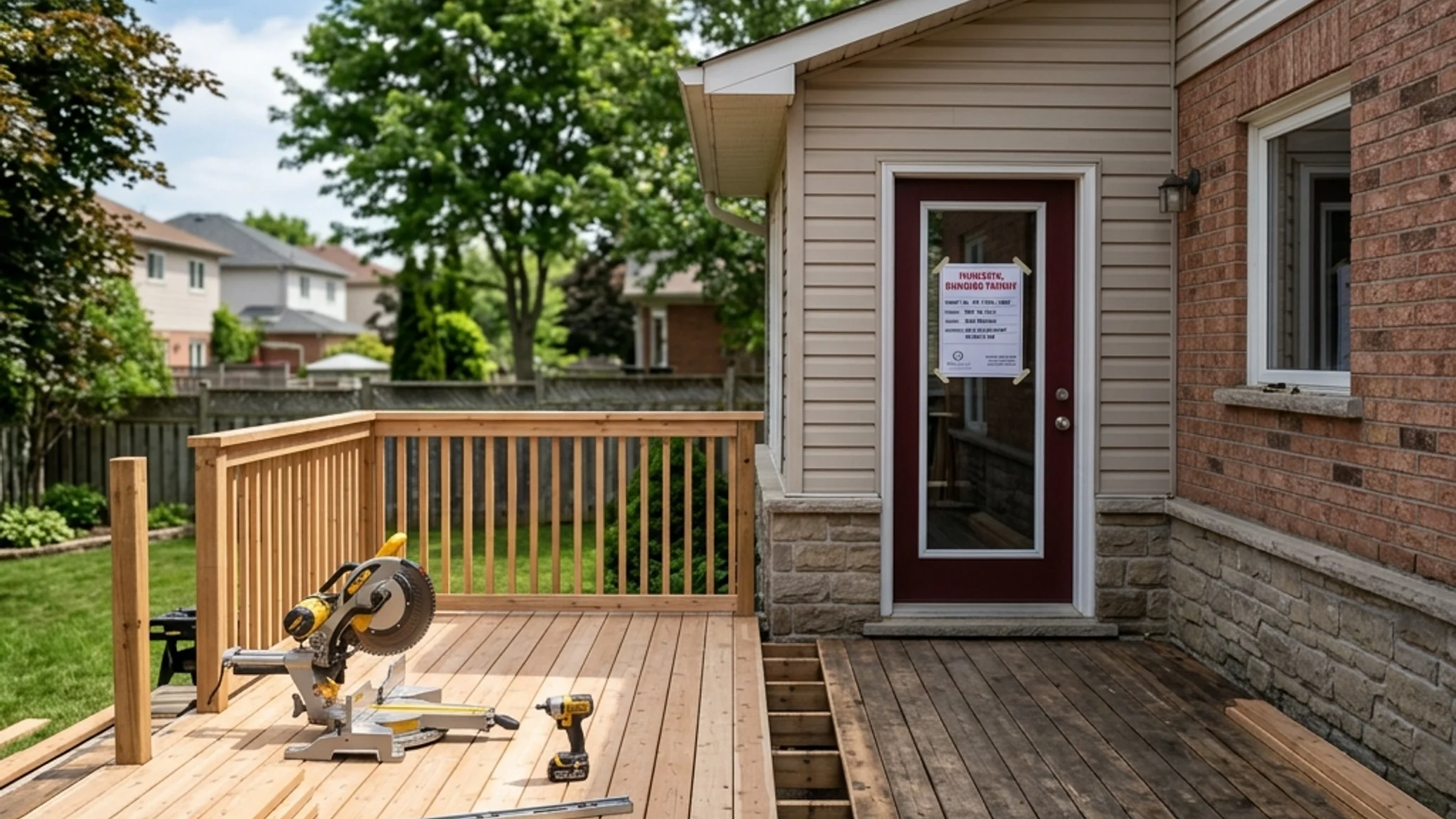
Most homeowners assume a deck permit is required for any deck work. Most contractors do nothing to correct that assumption. The reality is more useful: refinishing and staining your deck never requires a permit anywhere in the GTA, replacing damaged boards usually does not, and structural changes always do. The line between cosmetic restoration and structural restoration is where most of the confusion lives — and where the wrong answer can cost you a sale years later if a home inspector flags unpermitted work. This guide covers the actual rules in Toronto and the five largest GTA municipalities, the fence height bylaws that come up alongside deck projects, and the resale risk if you do structural work without a permit.
The Quick Answer
For restoration work on existing residential decks across the GTA, the rule of thumb is simple:
- Cleaning, stripping, staining, sealing: never requires a permit.
- Replacing damaged decking boards on existing framing: generally no permit required if the structure is unchanged.
- Replacing joists, beams, posts, or footings: permit required everywhere in the GTA, no exceptions.
- Adding deck area, changing height, building new attached deck: always permit required.
- Adding a hot tub or pool deck: permit required, plus potential pool enclosure requirements.
The Ontario Building Code (OBC) is the source document; municipalities add local thresholds on top. The most common GTA threshold is that any deck attached to a house with a walking surface more than 600mm above grade requires a permit for new construction. Restoration of an existing permitted deck is typically exempt as long as no structural elements change.
When Restoration Triggers a Permit
The line is structural vs cosmetic. Cosmetic work — strip, sand, stain, seal, replace surface boards on existing framing — does not require a permit. Structural work — touching the framing, footings, or geometry — does.
Specific gray areas worth knowing:
Board replacement. Replacing weather-damaged decking boards on intact joists is treated as maintenance. Replacing more than 30 to 50 percent of decking boards at once may attract permit-office attention in some municipalities; if you are doing a near-complete board replacement, it is worth a 5-minute phone call to the local building department to confirm.
Joist sistering or replacement. Adding a sister joist or replacing a single rotted joist is structural and technically requires a permit. In practice, single-joist repairs are usually done as routine maintenance without permit involvement; full joist-system replacement always requires one.
Railing replacement. Railings are part of fall-protection regulations under the OBC. Replacing a railing with an equivalent-height, equivalent-construction railing is maintenance. Replacing it with a different design — different height, different baluster spacing, glass panel inserts — requires a permit because the change must meet current code.
Stairs replacement. Same as railings — replacing in-kind is maintenance, redesigning is permit-required.
If your restoration project includes any of the gray-area work, a quick call to the local building department before starting saves you from finding out later.
Toronto-Specific Rules
The City of Toronto follows the Ontario Building Code as adopted by Toronto Municipal Code Chapter 363 (Building Construction and Demolition). For decks:
- Permit required: any new deck attached to a single-family or semi-detached home with a walking surface higher than 600mm above grade.
- Permit required: any deck — attached or freestanding — with an area greater than 10 square metres.
- Restoration exempt: staining, sealing, surface board replacement on existing permitted decks.
- Heritage districts: additional approvals may apply in designated Heritage Conservation Districts (Cabbagetown, the Annex, Riverdale, parts of Yorkville, etc.). Restoration of original heritage features usually proceeds without separate heritage permits if the work uses original materials and methods, but adding new features can trigger Heritage Preservation Services review.
Toronto Building also enforces lot-coverage and zoning bylaws that intersect with deck construction. A restoration project that does not change geometry will not run into these, but any expansion will.
Mississauga, Brampton, Vaughan
All three follow the OBC framework with similar thresholds.
Mississauga. Permit required for decks above 600mm walking-surface height or larger than 10 square metres. Restoration of existing permitted decks does not require a permit. Mississauga has additional rules near the lakeshore and in conservation areas (Credit Valley Conservation jurisdiction) that affect new construction; restoration is generally outside that scope.
Brampton. Same OBC thresholds. Brampton has been actively enforcing on unpermitted deck additions in older subdivisions when sales transactions surface them at title search; restoration work is not the target of this enforcement, but unpermitted structural work from a previous owner can become your problem.
Vaughan. Same thresholds, with additional caution for properties bordering the Oak Ridges Moraine where conservation authority approvals may be triggered for any structural work, even restoration that involves footings.
Markham and Oakville
Markham. OBC thresholds apply. Markham has additional ravine and conservation considerations for properties near the Rouge River system; structural work on a deck near a ravine should be confirmed with the Toronto and Region Conservation Authority (TRCA) before proceeding.
Oakville. OBC thresholds plus more active heritage enforcement in Old Oakville and the lakeshore heritage district. Heritage homes in these zones typically require a Heritage Permit for any visible structural change, including a railing redesign. Restoration in original materials is usually unaffected. Lakefront properties also fall under Conservation Halton jurisdiction for work near the shoreline.
Fence Height Bylaws Across the GTA
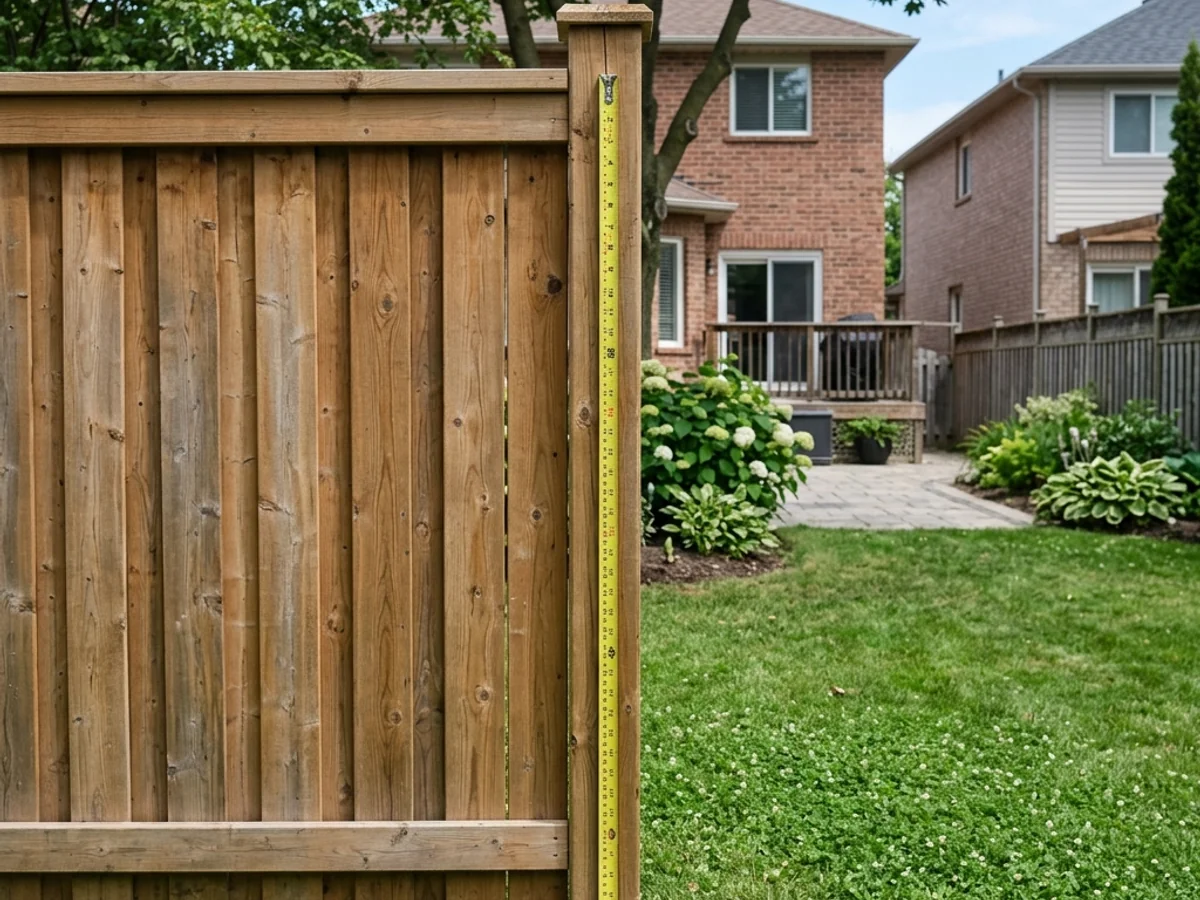
Fence work usually does not require a building permit, but every GTA municipality has a fence bylaw governing height and (in some cases) materials.
- Toronto: front yard fences maximum 1.2m; rear and side yard fences maximum 2.0m. Pool enclosures must meet provincial pool safety standards (1.5m minimum with self-closing, self-latching gate).
- Mississauga: front yard 0.9m on corner lots, 1.2m elsewhere; rear yard 2.0m.
- Brampton: front yard 1.0m; rear yard 2.0m.
- Vaughan: front yard 1.0m; rear and side yard 2.0m.
- Markham: front yard 1.0m; rear and side yard 1.83m (6 feet).
- Oakville: front yard 0.9m; rear and side yard 2.0m. Heritage districts may impose lower limits.
Restaining or repairing an existing fence at any height is not permit-relevant — bylaws govern construction and replacement, not maintenance. Replacing a fence with one of equivalent height is also typically exempt; building taller than your municipality allows requires a variance application.
The Pre-Sale Risk of Unpermitted Work
Unpermitted structural deck work becomes a problem at one specific moment: when the property is being sold and the buyer inspector or lawyer surfaces it. The two most common consequences:
- Sale delays. The buyer lawyer requests confirmation that all structural work was permitted. If a deck addition or major rebuild is not on title and is visibly newer than the home, you will be asked to produce documentation. Without it, closing is delayed while you apply for a retroactive permit (sometimes called an as-built permit). Process time runs 4 to 12 weeks depending on municipality.
- Price reductions. Buyers may reduce their offer to account for the risk and the retroactive permit cost. Typical reduction: $5,000 to $15,000 on a single-family home with a deck issue.
If you are buying a home with an obvious deck addition that does not match the home age, ask your lawyer to confirm permits during the conditional period. If you are selling, disclose what you know. Both sides come out better than discovering the issue at the closing table.
Restoration work — staining, sealing, board replacement on existing framing — does not create this risk because it never requires a permit. The risk is specifically about additions, height changes, and structural rebuilds without proper permitting.
All municipal bylaws and thresholds in this guide are current as of mid-2026. Bylaws and permit thresholds change; before starting any project with permit implications, confirm directly with the local building department.
Frequently Asked Questions
Do I need a permit to stain or restain my deck in Toronto?
No. Cleaning, stripping, staining, sealing, and surface board replacement on an existing permitted deck do not require a building permit anywhere in the GTA. Toronto and all other GTA municipalities exempt cosmetic restoration work from permit requirements. The permit rules apply to new construction, structural changes (joists, posts, footings), or expanding the deck area.
What deck repairs require a permit in Ontario?
Structural repairs require a permit: replacing or sistering joists, replacing beams, replacing posts or footings, replacing or redesigning the railing system, and replacing or redesigning stairs. Surface decking board replacement on intact framing is treated as maintenance and does not require a permit. The line is structural vs cosmetic; if the work touches the framing or geometry, expect a permit requirement.
How tall can my fence be in Toronto without a permit?
Toronto fence bylaw allows up to 1.2 metres in the front yard and 2.0 metres in the rear and side yards without a permit or variance. Pool enclosures must meet provincial pool safety standards (1.5 metre minimum height with a self-closing, self-latching gate). Building taller than the rear-yard maximum requires a variance application through the Committee of Adjustment. Restoring or restaining an existing fence at any height is not regulated by the bylaw.
What happens if I do unpermitted deck work and try to sell my home later?
Unpermitted structural deck work is the most common reason for sale delays involving deck issues. Buyers typically discover it during the conditional period when the home inspector flags work that does not appear on title. The seller is asked to obtain a retroactive permit before closing — a 4 to 12 week process — or face a price reduction (typically $5,000 to $15,000) to compensate the buyer for the risk and remediation cost. The cleanest answer is to permit any structural work at the time it is done. Restoration work does not create this risk because it never requires a permit.
Get Your Free Quote
Tell us about your project — we get back within 1 business day with honest pricing.