
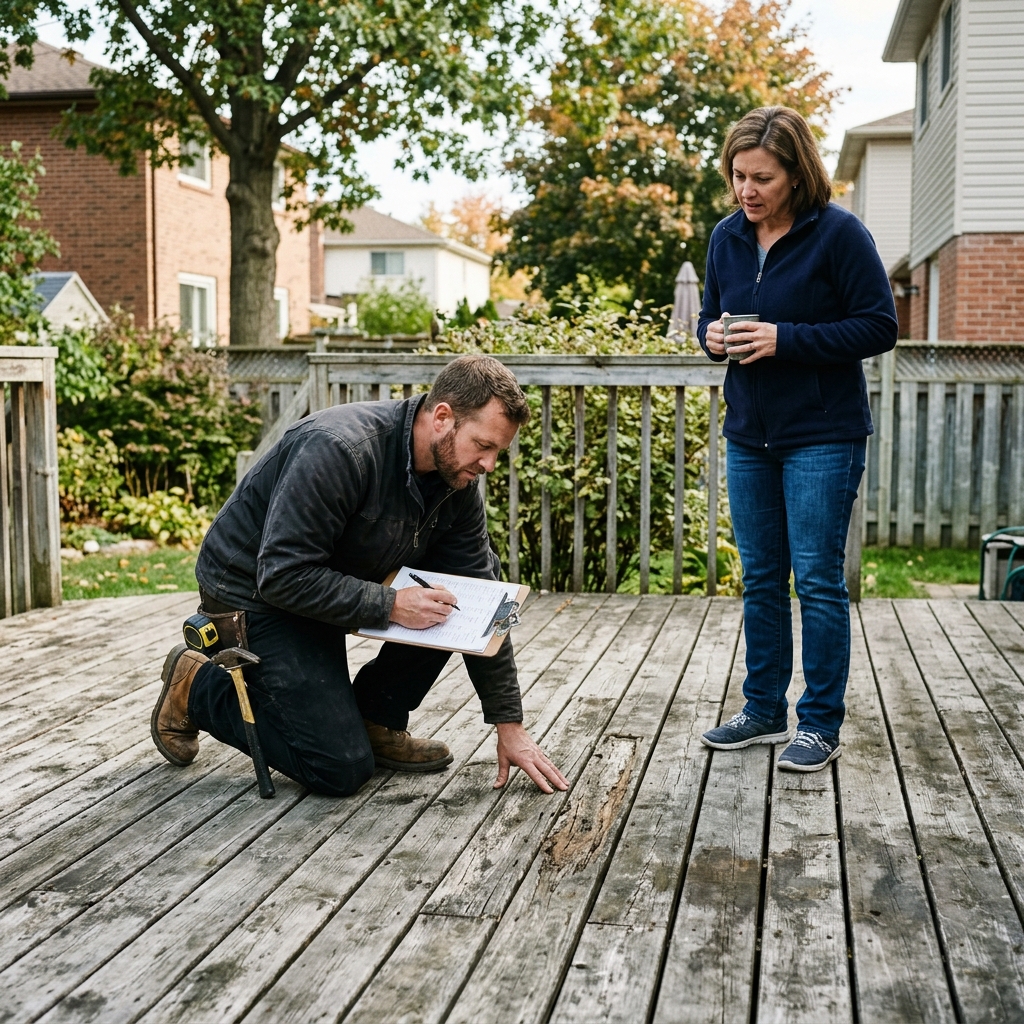
Search "deck staining cost Toronto" and you'll find everything from $3 a square foot to $12. That range isn't error — it reflects the genuine complexity of pricing exterior wood work. A freshly built deck with sound boards is a very different job from a decade-old cedar deck with peeling solid stain, cupped boards, and a full railing system. This guide breaks down every factor that moves the price, what a legitimate quote should include, and the red flags that explain why the cheapest option almost never stays cheap.
Why No One Can Quote You Over the Phone
If a deck staining company gives you a firm price before seeing your deck, that is a warning sign — not a convenience. The final cost of any wood restoration project is determined by what is actually in front of the technician on day one, not by a square footage formula.
Square footage is a starting point. It tells you roughly how much product is needed. It does not tell you anything about the condition of the wood, what finish is already on it, how much prep is required, or how complex the structure is. Those variables are where most of the cost actually lives.
This guide walks through every factor that moves the price so you know what to ask for and how to compare quotes fairly.
Factor 1: Current Condition of Your Wood
This is the single biggest cost driver. A deck that has been cleaned and re-stained every three years is dramatically cheaper to service than one that has been neglected for a decade.
What adds cost:
- Heavy greying and oxidation — requires a chemical brightener treatment before any stain can adhere properly to the wood surface
- Black mold or mildew embedded in the grain — requires extended dwell time with a commercial-grade mildewcide, often two rounds of treatment
- Board-level damage — cupped, split, or rotting boards need replacing before any finish is applied; the cost of new lumber and labour is additional
- End grain that has absorbed moisture — needs a conditioning primer or extra coats at every exposed cut to prevent future rot infiltration
What keeps cost down:
- Wood last cleaned and stained two to three years ago with no major weathering
- No visible mold, significant greying, or surface oxidation
- Boards that are flat, tight, and structurally sound throughout
Factor 2: What's Already on the Wood
Not all existing finishes behave the same way when it is time to recoat. The type of product previously applied changes the entire preparation approach.
- Transparent or semi-transparent stains that have worn naturally are the easiest scenario. The surface accepts new stain with minimal preparation beyond a thorough clean and brighten
- Semi-solid stains in reasonable condition can often be recoated directly after cleaning, depending on adhesion testing on-site
- Solid stains or opaque paints are the most labour-intensive. Once a film-forming coating is applied, it must be stripped completely before any penetrating stain can be used. Chemical stripping and mechanical sanding add significant time and cost
- Unknown finish history — if you cannot confirm what was applied previously, a blotch test and possibly a full strip is the safe approach
The professional standard for outdoor wood in Ontario is a penetrating oil-based stain. It nourishes wood from within rather than sitting on top. If your deck was painted or covered in a film-forming finish at any point, budget for stripping as part of your restoration cost.
Factor 3: Scope of Prep Work
Professional staining is roughly 60% preparation and 40% product application. The prep phase is where most of the labour cost lives — and it is also the phase most commonly skipped by low-cost operators.
A proper prep sequence for most GTA decks includes:
- Power washing or soft washing to remove loose debris, surface mold, and environmental contaminants
- Chemical brightening to restore the wood's natural pH and open the grain for maximum stain penetration
- Sanding of problem areas — splinters, rough patches, raised grain from washing, and worn edges
- Minor board repairs: driving in popped nails, countersinking screws, replacing boards beyond surface restoration
- Masking and protecting adjacent surfaces — the home's siding, windows, landscaping, and hardscape
A deck that skips most of this sequence can be stained more cheaply in the short term. The stain will fail within one season, and re-stripping a failed finish costs more than doing the prep correctly the first time. You pay twice in two years instead of once over four.
Factor 4: Stain Product Tier
There is a meaningful performance difference between what is available at a big-box retailer and what a professional restoration company applies.
Contractor-grade penetrating oil-based stains cost three to four times more per litre than hardware-store alternatives. They penetrate deeper into the wood fiber, repel water far more aggressively, and resist UV degradation significantly longer. Applied correctly over prepared wood, they last three to five years in the GTA climate. The big-box equivalent often needs attention within 18 months.
A legitimate company will tell you exactly which product they are applying and why. If a quote does not mention the stain brand or formulation type, ask directly. "Stain" is not a specification.
Factor 5: Deck Complexity and Scope
The footprint of the deck boards is a starting point. The actual scope of work is determined by everything attached to those boards.
- Railings and spindles — a full railing system on a 400 sq ft deck can add 30 to 50% to the total labour time. Each spindle is a surface that needs cleaning, prep, and two coats on all sides
- Stairs — every stringer, tread riser, and exposed end grain requires individual attention
- Built-in benches or planters — more surfaces, more edges, more masking, more coats
- Second-storey or elevated decks — require ladder or scaffold setup and add safety time; the underside of a raised deck is also a visible surface
- Fascia and skirt boards — frequently omitted from cheap quotes and the first thing neighbours see from the yard
- Hot tub surrounds or pool decking — require specialized waterproof formulations and careful masking around equipment
What a Legitimate Quote Should Include
A professional, itemized quote should specify the following without you having to ask:
- Preparation scope — power washing, brightening, sanding, minor repairs, and what is excluded
- Exact stain product name, formulation type, and number of coats
- Whether railings, stairs, and fascia are included or priced separately
- Whether any board replacement is included and at what rate for additional boards
- Labour warranty — most reputable companies in Ontario offer one to two years
- Proof of liability insurance and a WSIB certificate of clearance
When comparing two quotes where one is significantly lower, the most common explanations are: prep work was omitted, a cheaper product is specified, or the scope excludes railings and stairs. Ask which of the three explains the gap and you will have your answer.
Red Flags in a Low Quote
- No mention of cleaning or prep — they plan to stain over dirty, unprepped wood
- One coat only — virtually all penetrating stains require two coats to achieve their rated durability
- Quote delivered over the phone without seeing the deck
- No product name or brand mentioned anywhere in the quote
- No proof of liability insurance or WSIB coverage
- Cash-only payment, full amount required upfront before work begins
The cheapest deck staining quote rarely produces the cheapest outcome. Stain applied over inadequately prepped wood peels and fails within 12 to 18 months. Re-stripping a failed finish is labour-intensive and expensive — easily more than the savings on the original quote.
Frequently Asked Questions
Can you give me a rough price range over the phone?
We can give you a ballpark estimate after asking a few specific questions about your deck's condition, approximate size, whether it has railings, and when it was last stained. We always confirm with an on-site assessment before any work begins and before any payment is required.
Why is one contractor quoting me half of what another one is?
Almost always it comes down to prep scope or product quality. Ask each contractor what stain brand they are using and whether cleaning, chemical brightening, and railings are included in the price. The numbers converge quickly once you are comparing equivalent scopes of work.
Does cedar cost more to stain than pressure-treated pine?
Not inherently — condition drives cost more than species. Cedar typically needs brightening to restore its natural oil balance before staining. New pressure-treated pine requires a 12-month dry-out period before it can properly accept its first stain application. Neither is categorically more expensive; it depends on the specific job.
How can I get the most accurate quote?
Send us three or four photos of your deck from different angles — including railings, stairs, and any visible damage — along with an approximate date of the last staining. We can usually give a very tight estimate from photos before scheduling the on-site visit.
Get Your Free Quote
Tell us about your project — we get back within 1 business day with honest pricing.