
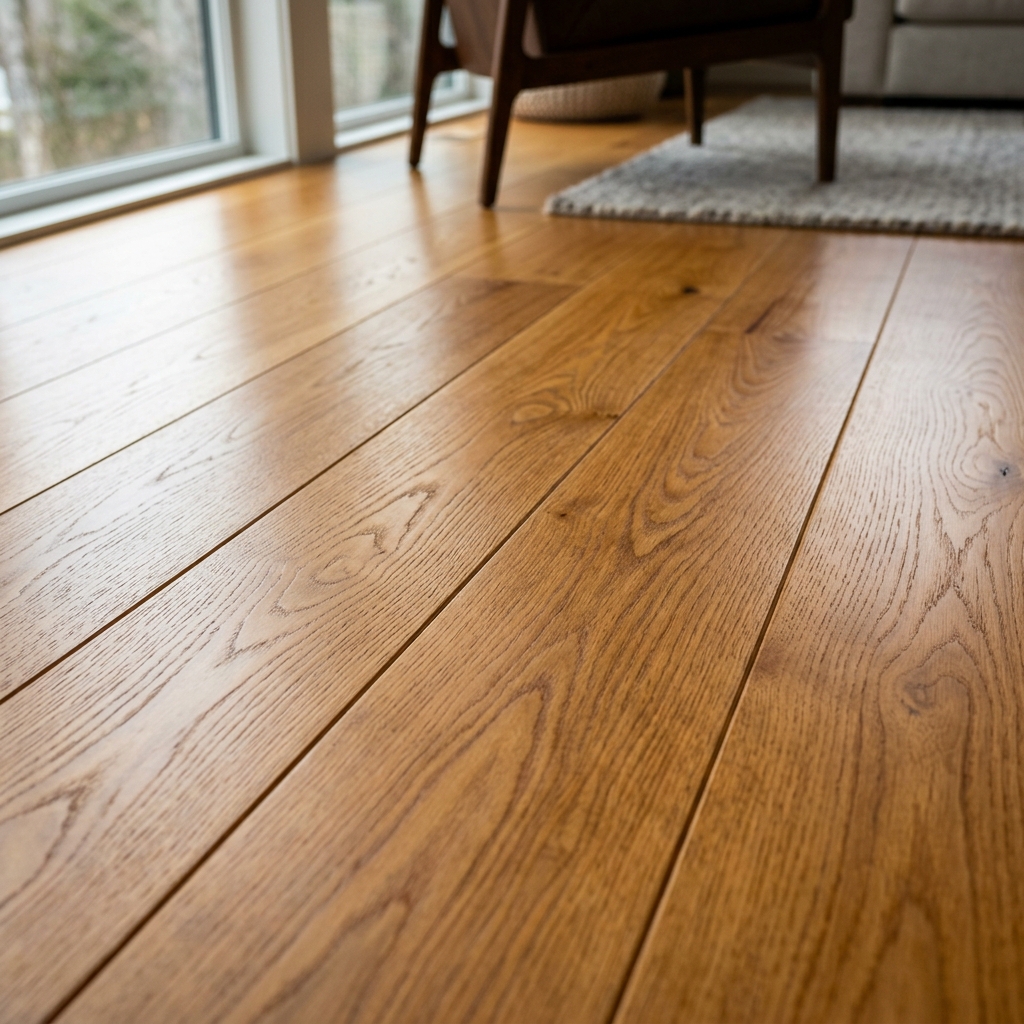
Walk into any flooring retailer and the conversation centres on stain colour. The question that matters more — and that almost no homeowner gets a clear answer to — is which finish category goes over the stain. Polyurethane and hardwax oil are the two dominant options in the GTA market, and they are fundamentally different in nearly every way that matters: appearance, daily maintenance, repair complexity, lifespan, environmental profile, and total ownership cost. This guide gives you the honest comparison most flooring conversations skip past.
The Fundamental Difference Between Categories
Polyurethane and hardwax oil belong to two fundamentally different finish philosophies. Understanding the philosophy explains everything else about how they perform.
Polyurethane is a film-forming finish. The product cures into a hard plastic-like layer that sits on top of the wood surface. The wood is sealed underneath; you walk on the polyurethane film, not on the wood itself. Damage to the film is damage to the protective layer.
Hardwax oil is a penetrating finish. The product soaks into the wood fibres and cures within them rather than on top. There is no film; you walk on the wood itself, with the oil-and-wax matrix providing protection from within. Damage to the surface is damage to the wood, but repair affects only the damaged area rather than the whole floor.
Every other difference between the two finish categories flows from this fundamental distinction.
Polyurethane: Strengths, Weaknesses, When It Wins
Polyurethane has been the dominant residential hardwood finish in North America for the past five decades. It earned that position through real strengths.
Strengths:
- Outstanding water resistance — the surface film does not allow liquid penetration into the wood
- Highly durable against household chemicals, food spills, pet accidents
- Available in matte, satin, semi-gloss, and high-gloss sheens to match design preference
- Predictable, well-understood application by virtually all hardwood professionals
- Cost-effective per square foot in initial application
- Modern water-based formulations cure quickly (24 to 48 hours to light traffic)
Weaknesses:
- Spot repair is essentially impossible — damage to the film requires re-finishing the entire affected board run or full room sand-and-refinish
- Visible wear patterns develop in high-traffic zones (entryways, in front of kitchen sinks) requiring full refinishing every 7 to 12 years
- Plastic-like appearance under raking light reveals the film layer, particularly in glossier sheens
- Off-gassing during cure is significant for oil-based formulations; lower for water-based but still meaningful for sensitive occupants
- Eventual film failure is sudden rather than gradual — the floor looks fine until it does not
When polyurethane wins: high-traffic family homes with pets, kitchens, mudrooms, rental properties, busy commercial-grade residential applications, situations where ease of cleaning matters more than appearance refinement.
Hardwax Oil: Strengths, Weaknesses, When It Wins
Hardwax oil has been the dominant European residential finish for centuries and has gained substantial GTA market share over the past decade as wide-plank European-style installations have become common.
Strengths:
- Spot repair is straightforward — damaged areas can be refreshed without affecting surrounding floor
- The wood feel under foot is preserved (you walk on wood, not plastic)
- No visible film layer — appearance shows wood character rather than finish character
- Low VOC, low off-gassing, generally well-tolerated by sensitive occupants
- Renewable indefinitely without sand-and-refinish — annual or biennial reapplication maintains the finish
- Ages gracefully — wear shows as patina rather than as failure
Weaknesses:
- Lower water resistance than polyurethane — standing liquid must be wiped within minutes, not hours
- Requires regular maintenance reapplication (every 12 to 36 months on most installations) versus polyurethane's set-and-forget profile
- Higher initial cost per square foot than polyurethane
- Application requires specific technique that many polyurethane-trained installers do not have
- Less suitable for households with frequent water spills, large pets, heavy commercial-grade traffic
When hardwax oil wins: wide-plank premium installations, formal living areas with moderate traffic, environmentally sensitive households, owners who value wood appearance and feel over plastic-film durability, owners willing to handle modest annual maintenance in exchange for spot-repair capability.
Cost Comparison Over 20-Year Ownership
Initial application cost favours polyurethane by 25 to 50 percent depending on installation type and species. Over twenty-year ownership the math is closer than the initial pricing suggests.
Polyurethane twenty-year cost (1,500 sq ft typical Markham installation):
- Initial finish: $9,000 to $13,500 ($6 to $9 per sq ft)
- First refinish at year 8 to 10: $9,000 to $13,500 (full sand-and-refinish required)
- Second refinish at year 16 to 18: $9,000 to $13,500
- Twenty-year total: $27,000 to $40,500
Hardwax oil twenty-year cost (same 1,500 sq ft installation):
- Initial finish: $13,500 to $19,500 ($9 to $13 per sq ft)
- Spot repairs and maintenance reapplication every 18 to 30 months: $200 to $700 each, roughly 8 to 12 cycles over 20 years
- Estimated maintenance cost: $4,000 to $7,000 cumulatively
- Twenty-year total: $17,500 to $26,500
The ten-year math actually favours hardwax oil despite the higher initial cost, because polyurethane requires full sand-and-refinish events while hardwax oil avoids them. The right choice on cost alone depends on how many full refinish cycles you expect over your ownership horizon.
Maintenance Differences in Daily Use
Daily maintenance differs more than most homeowners expect.
Polyurethane daily maintenance: dry mop or vacuum, occasional damp mop with manufacturer-approved hardwood cleaner. Standing water is fine for short periods. Most household cleaners are tolerated. The film is doing the work.
Hardwax oil daily maintenance: dry mop or vacuum, occasional damp mop with manufacturer-approved hardwax-oil-compatible cleaner only. Standing water must be wiped within minutes. Generic floor cleaners can degrade the oil-wax matrix. Annual or biennial reapplication of refresher product (a 30-minute homeowner DIY task on most installations).
For households comfortable with attentive maintenance, hardwax oil is not a hardship. For households with kids, large pets, and infrequent dedicated cleaning attention, polyurethane is more forgiving.
Repair and Refresh Complexity
This is the single biggest practical difference between the two categories.
Polyurethane repair: a deep gouge, pet-urine stain, or damaged area cannot be repaired without affecting surrounding floor. The standard approach is full sand-and-refinish of the entire room or affected board run. This is expensive ($6 to $9 per square foot) and disruptive (multiple days of room unavailability, off-gassing during cure).
Hardwax oil repair: the same damaged area can be hand-sanded locally, the surrounding wood blended, and hardwax oil applied to the affected area only. The repair is done in hours rather than days, costs $200 to $700 rather than $6,000-$10,000, and produces a result indistinguishable from surrounding floor within 24 hours.
For households planning to live in their floors for decades, hardwax oil's repair capability has substantial practical and financial value. For households planning to renovate or sell within five to seven years, the repair advantage is less material because polyurethane will outlast that horizon without intervention.
Application Method Differences
Polyurethane application is well-understood by virtually all hardwood floor professionals — three coats with light sanding between coats, water-based or oil-based product, predictable cure schedule. Most contractors are competent at polyurethane application.
Hardwax oil application requires specific technique that many polyurethane-trained installers do not have. The product must be applied in thin coats with specific buffing technique to achieve proper penetration without leaving visible streaks or uneven absorption. Hardwax oil applied with polyurethane technique looks adequate immediately but fails prematurely. When sourcing a hardwax oil installation in the GTA, specifically ask whether the installer has hardwax-oil-specific training and recent project experience — not just willingness to apply the product.
Which Is Right for Your Floor Situation
The decision is rarely binary; it usually flows from honest answers to four questions:
- How long do you plan to live with these floors? Under seven years: polyurethane usually wins on initial cost. Over fifteen years: hardwax oil usually wins on lifecycle cost.
- How disruptive is full refinishing for your household? If room unavailability for several days is acceptable: polyurethane works. If avoiding full refinish events matters substantially: hardwax oil wins.
- Do you have kids, large pets, or high-spill kitchen activity? Yes to multiple: polyurethane is more forgiving. Quieter household: hardwax oil works fine.
- How important is wood appearance and feel versus durability? Plastic-film durability priority: polyurethane. Authentic wood character priority: hardwax oil.
For most GTA family homes with kids, pets, and busy lifestyles, polyurethane is the practical answer. For premium installations in formal areas, owners with environmental sensitivities, or properties with wide-plank European-style installations where appearance matters substantially, hardwax oil is the right choice. Mixed approaches (polyurethane on high-traffic kitchen and entryway, hardwax oil on living and dining areas) work well for owners who want the best of both philosophies.
Frequently Asked Questions
Can I switch from polyurethane to hardwax oil on existing floors?
Yes, but it requires full sand-and-refinish to remove the existing polyurethane film entirely before hardwax oil can be applied. The reverse direction (hardwax oil to polyurethane) is also possible but requires careful preparation to ensure the wood is fully cleaned of oil residue before polyurethane can adhere. Both transitions cost the same as a normal refinishing cycle.
Is hardwax oil really more environmentally friendly than polyurethane?
Generally yes — hardwax oils are typically natural-derived (oils and waxes from plant sources) with low or zero VOC emissions during cure. Modern water-based polyurethanes have improved substantially and are far better than oil-based polyurethanes were a decade ago, but hardwax oil remains the lower-impact choice for environmentally sensitive households or owners specifically prioritizing low-VOC interior finishing.
Will hardwax oil really cost less over twenty years?
For most installations, yes — primarily because hardwax oil avoids the full sand-and-refinish events that polyurethane requires every 8 to 12 years. The math depends on your maintenance discipline (skipping maintenance reapplication accelerates failure) and your refinish frequency assumptions. For owners who maintain consistently and stay in their homes long-term, hardwax oil typically wins on lifecycle cost despite the higher initial investment.
My builder installed prefinished hardwood — what finish category is that?
Almost always factory-applied aluminum-oxide-fortified urethane, which is a heavy-duty polyurethane variant. This category is extremely durable but completely inflexible on repair — damage requires full plank replacement or full room sand-and-refinish. Prefinished installations cannot be transitioned to hardwax oil without a full sand-and-refinish to remove the factory urethane layer.
Should I use the same finish across my whole house?
Not necessarily. Many premium installations use polyurethane in high-traffic zones (kitchens, entryways, mudrooms) where durability and water-resistance matter most, and hardwax oil in living and dining areas where appearance and the natural wood feel matter more. The transitions can be handled invisibly at room boundaries by an experienced installer. This mixed approach captures the strengths of both categories.
Get Your Free Quote
Tell us about your project — we get back within 1 business day with honest pricing.