
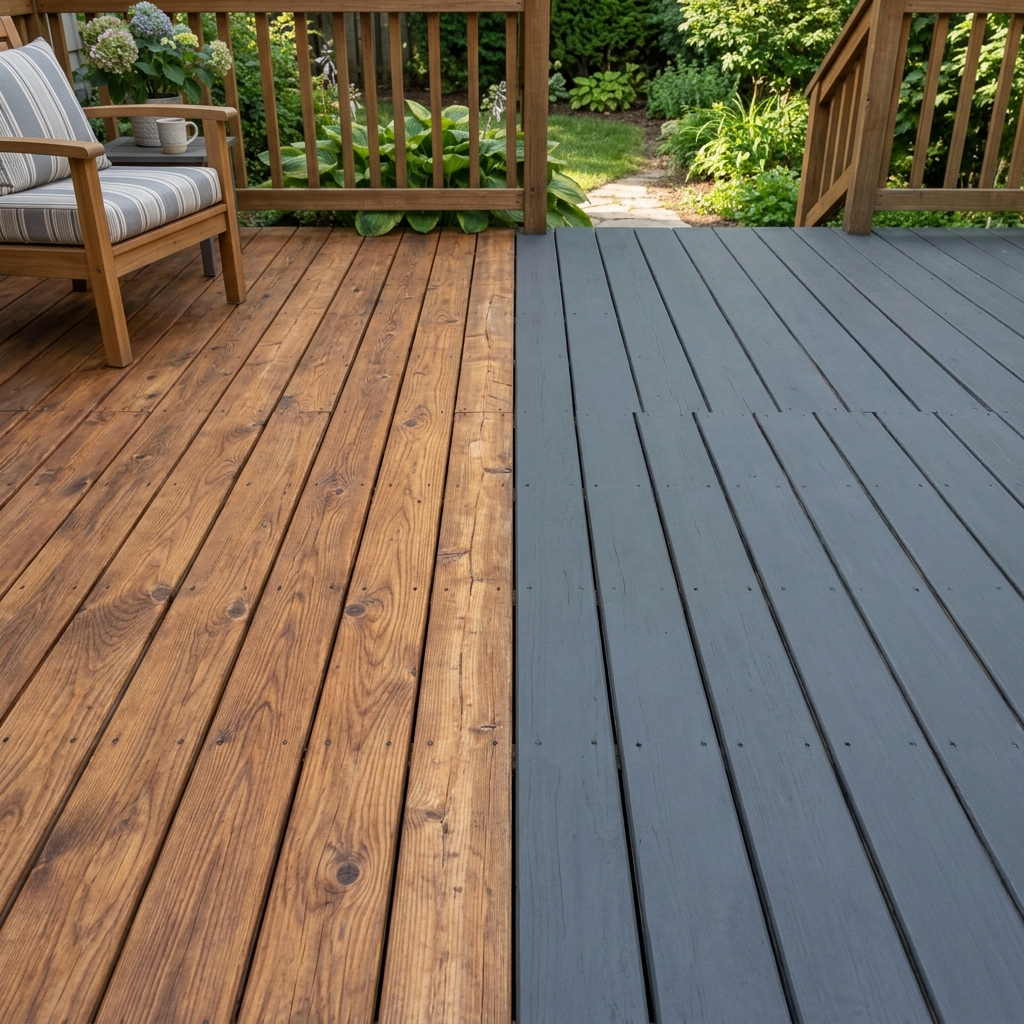
Walk into any GTA hardware store and the staff will recommend solid stain on cedar without hesitation. They are wrong, and the reason matters. Solid stains form a film on top of cedar that traps moisture, peels aggressively in Canadian freeze-thaw cycles, and creates a maintenance burden that compounds with every subsequent cycle. Semi-transparent stains penetrate cedar fibres rather than coating them, never peel, and remain renewable indefinitely. This guide explains exactly why semi-transparent wins on cedar in nearly every scenario, the rare situations where solid stain is the right answer, and the real ten-year cost math behind the decision.
The Fundamental Difference
Solid stain and semi-transparent stain are fundamentally different finish categories despite both being labelled "stain" at the retailer.
Solid stain is a film-forming finish. The product cures into an opaque coloured layer that sits on top of the wood. The wood is sealed underneath; you see the colour of the stain rather than the colour of the wood. Failure modes are peeling and cracking — the film separates from the wood beneath.
Semi-transparent stain is a penetrating finish. The product soaks into wood fibres and cures within them rather than on top. There is no film; you see the wood with colour pigment shown through. Failure modes are gradual fade rather than peeling — the protective compounds wear off but the surface remains intact.
This single difference drives every other comparison between the two categories. On cedar specifically, the difference is more consequential than on most species.
How Each Performs on Cedar Specifically
Cedar has properties that make it exceptionally responsive to penetrating finishes and exceptionally hostile to film-forming finishes.
Cedar absorbs more deeply than denser hardwoods. Penetrating stains soak two to three times deeper into cedar than into denser species, providing genuinely substantial protection that lasts five years on shaded cedar and three to four years on full-sun cedar.
Cedar moves more than dense hardwoods through seasonal cycles. Cedar expands and contracts with humidity changes more than oak, ipe, or pressure-treated lumber. Film-forming finishes that cannot move with the wood crack and peel; penetrating finishes that exist within the wood move with it.
Cedar contains natural oils that extend penetrating-finish life. The cedar oils that give the wood its characteristic smell also feed properly-formulated penetrating stains, extending finish life beyond what the same product would deliver on pressure-treated pine.
Cedar oils interfere with film-forming finish adhesion. The same cedar oils that benefit penetrating finishes prevent film-forming products from bonding properly to the wood. Solid stains on cedar fail at the wood-finish interface, not in the stain layer itself — the bond was never reliable to begin with.
Lifespan Comparison: Real Numbers
Honest expectations for the GTA climate, applied over thorough preparation:
Semi-transparent stain on cedar:
- Shaded north-facing decks: 4 to 6 years between full restoration cycles
- Mixed-exposure decks: 3 to 5 years
- Full south-facing exposed decks: 2 to 4 years
- Annual cleaning between cycles extends each interval by approximately one year
Solid stain on cedar:
- First cycle: 2 to 3 years before visible peeling begins
- Second cycle (after stripping prior failure): 1.5 to 2.5 years before peeling resumes
- Third and subsequent cycles: 1 to 2 years — repeated stripping has progressively damaged the cedar fibre structure
- By the fourth or fifth cycle, the cedar surface is typically too damaged to hold any finish reliably
The lifespan gap is not a small difference; it is a fundamental difference in finish category performance. Semi-transparent on cedar can run indefinitely on the same deck, with each cycle preserving the wood beneath. Solid stain on cedar progressively destroys the wood with each restoration cycle.
Repair Complexity Compared
Spot repair is where the practical gap between the two categories becomes most obvious.
Semi-transparent repair: a damaged area can be cleaned, lightly sanded if needed, and re-stained locally. The repair blends into surrounding wood within a few months as ambient weathering equalizes the colour. Spot repair on semi-transparent finishes is genuinely simple and cheap.
Solid stain repair: a damaged area requires stripping, full prep, and re-application. Spot repair on solid stains is visibly different from surrounding floor for years afterward — the new application sits at slightly different sheen and colour than the weathered surrounding film. Most solid-stain damage is addressed by full deck stripping and refinishing rather than spot repair.
Aesthetic Differences
The aesthetic decision is largely a matter of taste, but the categories produce genuinely different appearances.
Solid stain looks like paint — opaque colour, no visible wood grain, uniform appearance regardless of board variation. Some homeowners prefer this for design coherence with house exterior or for hiding damaged or mismatched cedar boards.
Semi-transparent stain shows wood character — grain pattern, board-to-board variation, knots, and natural cedar colour shifts visible through the colour pigment. Some homeowners prefer this for the authentic wood appearance; some find the variation unwelcome on installations with significant board-to-board mismatch.
Neither aesthetic is right or wrong — but for cedar specifically, the wood character that semi-transparent reveals is generally considered the desirable feature of the material in the first place.
When Solid Stain Wins (Rare on Cedar)
There are narrow situations where solid stain is genuinely the right answer on cedar:
- Cedar with extensive permanent damage that cannot be hidden by any penetrating finish — heavy water staining, deeply embedded paint or chemical residue, severe weathered grey that resists chemical brightening
- Cedar with significant board-to-board colour mismatch from prior partial replacements, where uniform appearance is required and homeowner accepts the maintenance trade-off
- Cedar that has already had multiple solid stain cycles and is now too compromised to properly accept penetrating finish — sometimes the only choice is continuing in the wrong category until eventual deck replacement
- Decorative trim and small accents rather than primary deck surfaces, where uniform colour matters more than longevity
When Semi-Transparent Wins (Most Cedar Situations)
For the vast majority of GTA cedar decks, semi-transparent is the right answer:
- Cedar in good or restorable condition with intact fibre structure
- First-time restoration on cedar that has never received film-forming finish
- Heritage cedar where long-term preservation matters substantially
- Owners planning to live with the deck for the long-term who value lifecycle cost over uniform appearance
- Decks under mature canopy where mould pressure makes peeling failure modes especially destructive
The Film-Formation Problem on Cedar
The single biggest problem with solid stain on cedar is that once it is applied, all future restoration cycles begin with stripping. Each strip cycle damages cedar fibres further. The damage compounds.
A cedar deck with original semi-transparent finish can be restored indefinitely without stripping — each cycle is clean, brighten, and re-stain. A cedar deck with solid stain history requires stripping at every cycle, and each strip removes a fraction of the protective lignin layer that gives cedar its weather resistance. After three or four strip cycles, the cedar surface is too damaged to hold any finish reliably and the deck approaches end of life decades earlier than necessary.
This is the practical case for never starting cedar in a film-forming finish in the first place. Once you commit a cedar deck to solid stain, you are committing to a maintenance trajectory that ends in premature deck replacement.
10-Year Cost Math on a 600 sq ft Cedar Deck
Honest 10-year cost projections for a typical 600 square foot cedar deck in the GTA:
| Year | Semi-Transparent Plan | Solid Stain Plan |
|---|---|---|
| Year 0 | Initial restoration $3,200–$5,500 | Initial restoration $3,400–$5,800 |
| Year 2–3 | — | Strip and re-apply (peeling) $4,200–$7,000 |
| Year 4–5 | Cleaning + recoat $2,400–$4,200 | Strip and re-apply (peeling) $4,200–$7,000 |
| Year 6–7 | — | Strip and re-apply $4,500–$7,500 (escalating cedar damage) |
| Year 8–9 | — | Strip and re-apply $4,500–$7,500 |
| Year 9–10 | Cleaning + recoat $2,400–$4,200 | — |
| 10-year total | $8,000–$13,900 | $20,800–$34,800 |
The 10-year cost gap is roughly two and a half times. Beyond year 10, the cedar deck on solid stain is approaching end of life and requires replacement; the cedar deck on semi-transparent is good for another 10 years on the same maintenance schedule.
Frequently Asked Questions
My contractor recommended solid stain on my cedar deck. Should I get a second opinion?
Strongly recommended. Solid stain on cedar is rarely the right answer in the GTA climate, and contractors who default to it often do so because it hides preparation shortcuts that would be visible under semi-transparent finish. Get a second opinion specifically asking why semi-transparent is not the better choice, and listen carefully to whether the answer addresses cedar-specific properties or just generic stain durability claims.
My deck already has solid stain. Can I switch to semi-transparent?
Yes, but it requires complete stripping back to bare cedar before semi-transparent can be applied. The stripping is expensive and damaging to cedar fibres. The decision becomes economic: if your deck is in early-to-middle life, the switch is worthwhile because you avoid decades of escalating solid-stain maintenance. If your deck is late in life, sometimes continuing with solid stain until eventual deck replacement is the more economical path.
Will semi-transparent stain hide damaged or weathered cedar?
Partially. Semi-transparent shows wood character, including damage. A high-quality chemical brightening before staining substantially reverses grey weathering. Deep water stains, paint residue, and physical damage will remain visible through semi-transparent finish. If hiding extensive damage is the priority, solid stain is the appropriate choice — but this is the trade-off scenario where solid stain wins despite its other disadvantages.
Is semi-transparent really lower-maintenance than solid stain?
Yes, by a substantial margin. Semi-transparent requires periodic recoating (every 3 to 6 years depending on exposure) but never requires stripping. Solid stain requires stripping and full re-application every 2 to 3 years on cedar in GTA conditions. Over a decade, semi-transparent typically requires two to three maintenance events; solid stain requires four to five. The labour cost gap is more than two-to-one.
What about hybrid finishes — semi-solid stains?
Semi-solid stains are a middle category that splits the difference. They show some wood character (more than solid, less than semi-transparent), produce moderately film-forming behaviour (more film than semi-transparent, less than solid), and deliver intermediate lifespan. For cedar specifically, semi-solid is usually a worse choice than either extreme — it has enough film to peel like solid stain but enough transparency to show the resulting damage. We rarely recommend semi-solid for cedar.
Get Your Free Quote
Tell us about your project — we get back within 1 business day with honest pricing.