
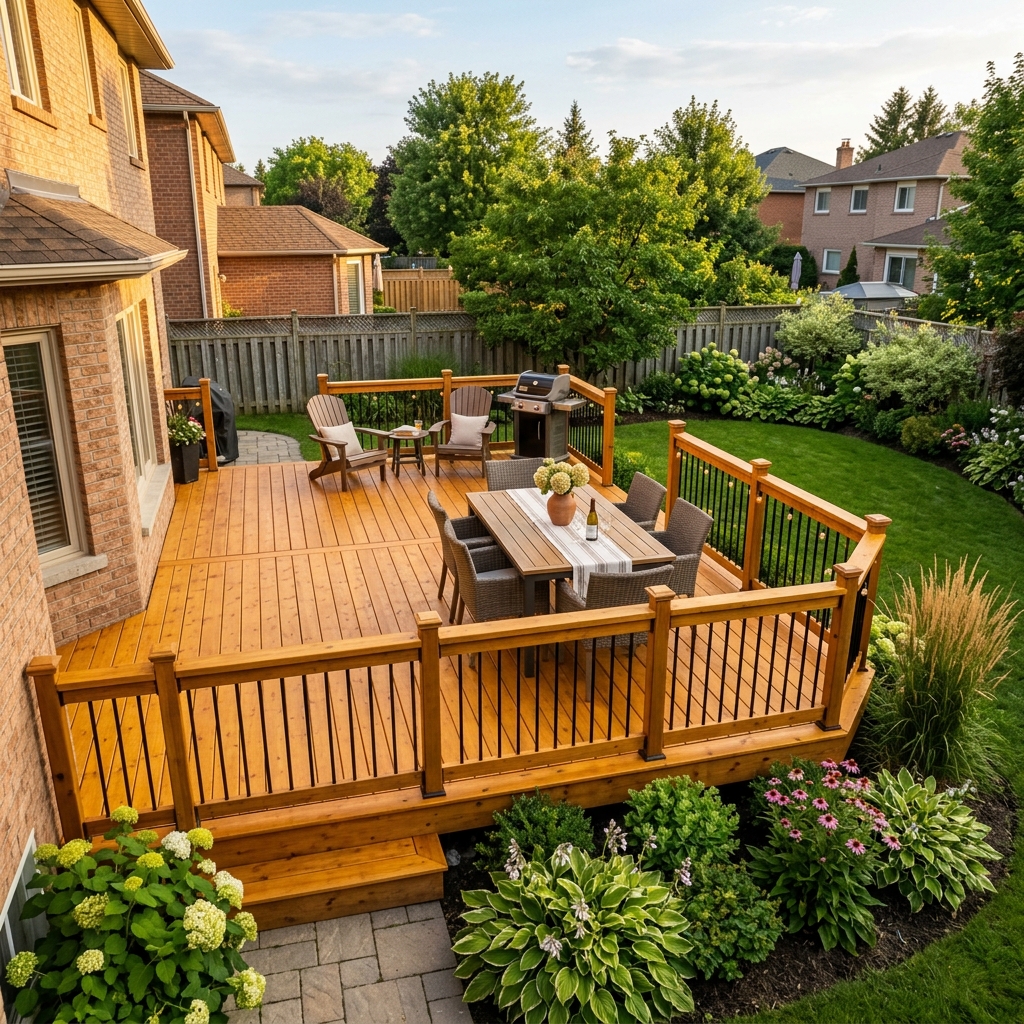
Toronto real estate conversations focus on kitchens, bathrooms, and location. Outdoor spaces rarely get the same attention in renovation planning — but they are often the first thing a buyer sees when they step into the backyard, and the last thing they think about before making an offer. A weathered, grey, splintered deck raises questions about maintenance. A freshly restored deck with clean stain and tight boards communicates that the entire property has been looked after. This guide looks at what deck restoration actually does for perceived and appraised value in the GTA market.
What GTA Buyers Actually Look For
In the Toronto and GTA market, a deck is not a bonus feature — it is an expected part of most detached and semi-detached properties. Buyers do not typically add value for a deck being present; they deduct value for a deck being in poor condition.
A weathered, grey deck with peeling stain, visibly loose boards, or soft spots underfoot registers as deferred maintenance. In a buyer's mind, deferred maintenance on a visible surface raises questions about deferred maintenance on invisible ones. It affects perceived trust in the condition of the entire property.
A professionally restored deck — clean boards, fresh uniform stain, tight railings, no soft spots — communicates the opposite. It is a signal that the homeowner has maintained the property carefully. That signal has real dollar value in a competitive showing environment.
The ROI Numbers: Restoration vs. Replacement vs. Addition
Home renovation ROI data from the Canadian real estate and appraisal industry consistently shows that outdoor living space improvements rank among the highest-returning projects before a sale. Here is how deck-related investments typically compare:
- Deck restoration (cleaning, repairs, staining) — typically $600 to $2,000 for a standard GTA backyard deck; estimated return at sale is $2 to $4 for every $1 invested in a competitive market, primarily through faster sale and reduced buyer negotiation on condition
- Full deck replacement — $5,000 to $20,000 depending on size and materials; typical return at sale is $0.60 to $0.85 per dollar invested, since buyers see a deck as a basic expectation, not a luxury upgrade
- New deck addition on a property without one — $8,000 to $30,000; return varies significantly by neighborhood and buyer profile, often 50 to 75 cents on the dollar
The pattern is consistent: restoration delivers a better return per dollar than replacement or new construction because you are converting a negative (deferred maintenance) to a neutral or positive, at low cost. Replacement and new additions simply raise the baseline expectation without dramatically exceeding it.
Curb Appeal vs. Structural Signal
There are two distinct ways a deck's condition affects value, and they work differently in a real estate transaction.
Curb appeal (emotional first impression) — A well-presented deck creates a positive emotional response during a showing. Buyers can picture themselves using it. This is harder to quantify but real estate agents consistently cite outdoor living presentation as one of the highest-impact factors in the 30 seconds a buyer forms their initial impression of a property.
Structural signal (inspection and negotiation) — A home inspector will note visible deck condition issues in their report: soft boards, failing stain, loose railings, post condition. Any item in an inspection report becomes a negotiation lever. Buyers routinely use structural concerns to negotiate $5,000 to $15,000 off asking price — for issues that often cost $1,500 to fix properly. Restoring the deck before listing closes that gap entirely.
The financial argument for pre-listing restoration is particularly strong in this second category. Spending $1,200 on a professional restoration to avoid a $5,000 to $8,000 buyer negotiation is straightforward math.
When to Restore Before Listing
Timing matters. Deck restoration in Ontario requires adequate temperature and humidity conditions — ideally above 10°C with no rain forecast for 48 hours during and after application. In the GTA, this means the optimal pre-listing restoration window is:
- May and June — ideal conditions, ahead of the peak spring/summer listing season
- September — strong conditions for fall listings; work must be completed before overnight temperatures drop consistently below 10°C
- Late March to April — possible but weather-dependent; we book these jobs conservatively with weather monitoring
Plan to complete restoration at least two weeks before your first showing. Fresh stain needs a full curing period before heavy foot traffic, and freshly stained wood looks its best after the initial surface sheen settles.
What Appraisers Consider
Formal appraisers in Ontario assess outdoor structures as contributing features of the property, with condition being a significant modifier of that contribution.
A deck in excellent condition contributes positively to a property's appraised value relative to comparable sales. A deck in poor condition can be flagged as a condition adjustment — reducing the appraised value by the estimated cost to cure the defect. This estimated cost-to-cure in an appraisal report is often higher than the actual contractor cost, because appraisers use conservative replacement assumptions rather than restoration costs.
A professional restoration report or invoice for recently completed work is useful documentation to have available for appraisers, particularly for higher-value properties where outdoor living space is a meaningful component of the overall valuation.
Value Beyond the Sale
Not every deck restoration decision is made with a listing in mind. The case for regular maintenance is also a financial one for homeowners who plan to stay.
A cedar deck that is restored professionally every three to four years realistically lasts 20 to 25 years. The same deck without any maintenance typically requires replacement in 10 to 12 years. The maintenance investment over that period is $6,000 to $10,000. Replacement at year 12 is $10,000 to $20,000 — and starts the maintenance clock again.
Regular restoration is not just about aesthetics. It is preventive structural maintenance. The stain seals end grain against moisture infiltration, which is the primary cause of rot in deck boards and structural members. Keeping the wood sealed delays or prevents the structural failures that make restoration no longer viable and replacement necessary.
Frequently Asked Questions
Should I restore my deck before or after listing my home?
Before, in almost every case. Restoration removes a potential inspection item, improves first-impression photos and showings, and reduces buyer leverage in price negotiation. The cost of restoration is typically far less than the negotiating discount buyers request when a deck shows visible wear.
Will buyers notice a freshly stained deck or just take it for granted?
Both, in a useful way. Buyers may not consciously note a well-maintained deck, but they strongly notice a neglected one. The goal of pre-listing restoration is to remove a negative from their experience, not to create a feature they will pay a premium for. Neutral is the target — and it is worth achieving.
My deck needs some board repairs as well as staining. Is it worth fixing everything before listing?
Yes. Loose or soft boards will appear in a home inspection report. Any inspection item is a negotiation tool for the buyer, and the amount they use it for is almost always more than the actual repair cost. Fix the boards, stain the deck, and remove the issue entirely before the inspector arrives.
Does a covered or screened-in porch have better ROI than an open deck?
Covered structures typically appraise at a higher per-square-foot value than open decks because they extend the usable season. However, the restoration principle is the same — condition matters more than structure type. A covered porch in poor condition carries the same deferred-maintenance perception risk as an open deck.
Get Your Free Quote
Fill out the form below and we'll get back to you within 24 hours with a personalized quote for your property.