
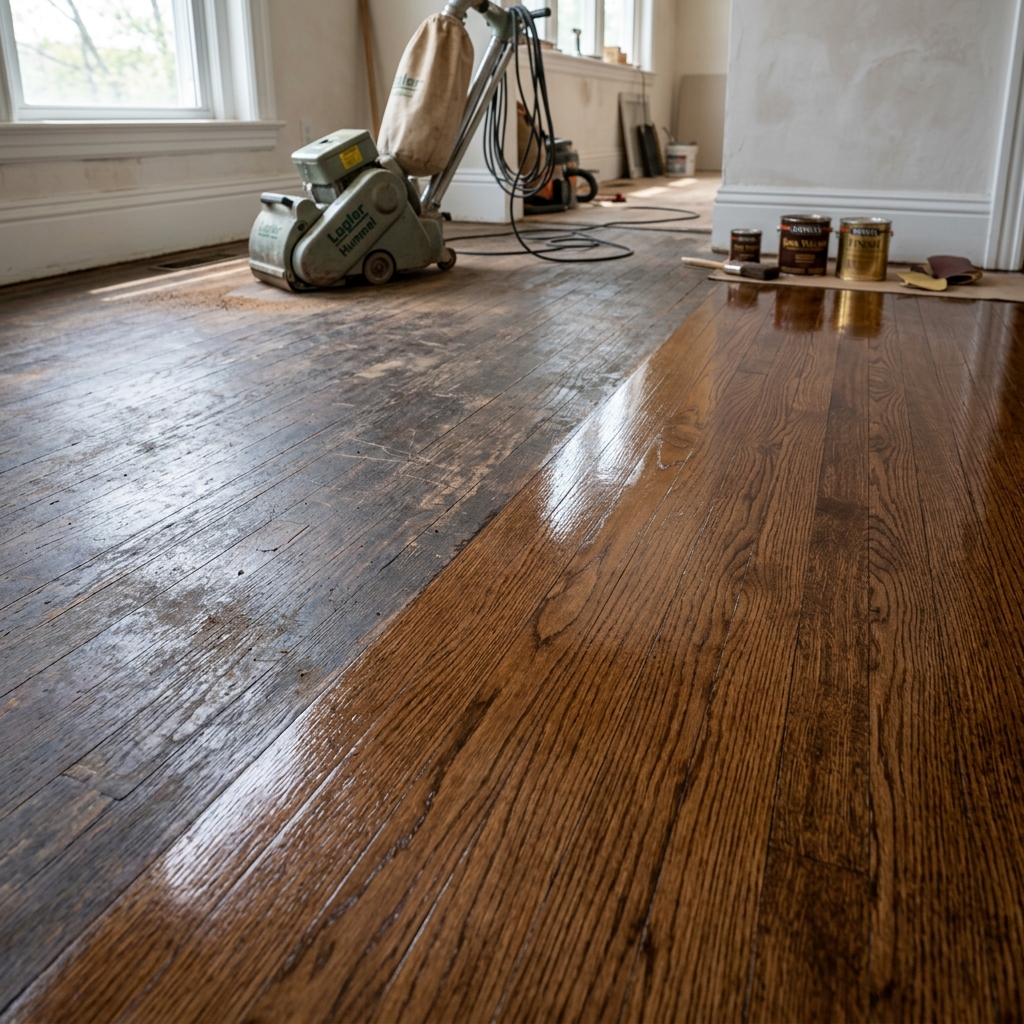
Replace hardwood floors that did not need replacing and you waste twenty thousand dollars. Refinish floors that should have been replaced and you spend ten thousand on work that fails within five years. The decision sits squarely on four variables that most homeowners cannot evaluate without help — and most flooring retailers will not help you evaluate honestly because they earn substantially more on replacement than on refinishing. This guide gives you the decision framework, the warning signs that tip the balance toward replacement, and the wear-layer math that tells you how many refinishing cycles your floors have left.
The Four-Question Decision Framework
Honest answers to four questions get you to the right refinish-versus-replace decision in nearly every case.
- How thick is the remaining wear layer? The wear layer is the wood above the tongue-and-groove joint. Solid hardwood typically starts with a 6 to 8 mm wear layer and loses approximately 1 mm per professional refinishing cycle. If the remaining wear layer is under 2 mm, refinishing is risky.
- Is the underlying structure intact? Subfloor failure, joist sag beyond 1/4 inch over a span, water damage that has reached the subfloor, or widespread board cupping caused by moisture issues all point toward replacement rather than surface restoration.
- How much board-level damage exists? Localized damage (a few water-stained boards near a former dishwasher leak, a few boards damaged by a moved appliance) can be laced in during refinishing. Widespread board damage across more than 10 percent of the floor often makes refinishing impractical.
- How long do you plan to live with these floors? Under five years: refinishing usually wins on cost. Over fifteen years: the calculation depends on wear-layer remaining. Under ten years for a property you plan to sell: refinishing almost always wins because the visual outcome is identical and the cost difference is substantial.
When Refinishing Works
Refinishing is the right answer when:
- Wear layer measurement is above 2 mm (which is the case for most floors with one or fewer prior refinishing cycles)
- Subfloor and joists are sound — no spongy areas, no visible deflection, no water damage history
- Board-level damage is limited to under 10 percent of the floor and can be addressed by lacing in matching wood
- The hardwood species and installation type can accept the stain and finish you actually want — most red oak, white oak, maple, and ash installations refinish well; some exotic species and engineered installations do not
- You like the existing floor layout — refinishing preserves the existing installation; replacement is the only path to changing board direction, plank width, or installation type
Most GTA hardwood floors meeting these criteria can be refinished for $6 to $14 per square foot for typical species, delivering visual outcomes indistinguishable from new installation at one-third to one-half the cost.
When Replacement Is Required
Replacement is the right answer when:
- Wear layer is under 2 mm — additional refinishing risks sanding through to the tongue-and-groove joint, which destroys the floor
- Subfloor failure has occurred — refinishing the surface does not address structural issues underneath
- Water damage has reached the subfloor or joist system
- More than 15 percent of boards show significant damage that cannot be laced in
- The existing installation type is incompatible with desired changes (changing from narrow strip to wide plank, changing direction, switching species)
- The existing flooring is laminate or low-end engineered hardwood that cannot be sanded
Replacement on a typical 1,500 square foot main level in the GTA in 2026 runs $14 to $25 per square foot installed for solid hardwood, $10 to $18 per square foot for engineered hardwood. That puts a 1,500 sq ft replacement project at $21,000 to $37,500 — versus $9,000 to $21,000 for refinishing the same area.
The Wear-Layer Math
The wear layer determines how many refinishing cycles a floor has left. Honest math:
- Solid hardwood typical starting wear layer: 6 to 8 mm (3/4-inch nominal flooring with the wood above the tongue measuring approximately 1/4 inch)
- Per professional refinishing cycle: 0.8 to 1.2 mm removed depending on stripping severity
- Per amateur DIY refinishing cycle: 1.2 to 2 mm removed (less skilled grit-sequencing destroys more wood)
- Minimum safe wear layer for additional refinishing: approximately 1.5 to 2 mm
This means a typical solid hardwood floor can support five to seven professional refinishing cycles before wear-layer exhaustion. A floor that has had two amateur refinishing attempts may have only one or two cycles remaining. A floor in a heritage Markham or Toronto property that has been refinished four or five times over the past century may be at end-of-refinishing-life.
Engineered hardwood is fundamentally different — most engineered installations have wear layers of 2 to 4 mm from the factory and can be refinished only one to two times in their entire service life. Some thin-layer engineered products cannot be refinished at all.
Cost Comparison
Honest 2026 GTA pricing for a typical 1,500 square foot main level installation:
Refinishing:
- Standard red oak or maple: $9,000 to $15,000 ($6 to $10/sq ft)
- Wide-plank quarter-sawn oak: $13,500 to $21,000 ($9 to $14/sq ft)
- Heritage softwood pine: $12,000 to $21,000 ($8 to $14/sq ft)
- Exotic species (walnut, hickory, premium maple): $16,500 to $27,000 ($11 to $18/sq ft)
Replacement (material + installation):
- Standard solid red oak or maple: $21,000 to $33,000 ($14 to $22/sq ft)
- Wide-plank quarter-sawn oak: $30,000 to $48,000 ($20 to $32/sq ft)
- Engineered hardwood: $15,000 to $27,000 ($10 to $18/sq ft)
- Premium hardwood (walnut, exotic species): $33,000 to $54,000+ ($22 to $36/sq ft)
The replacement premium ranges from approximately 100 percent to 200 percent over equivalent refinishing depending on species and installation type. For floors that meet the refinishing criteria, the cost difference is the largest single argument for refinishing as the default choice.
Heritage Floor Considerations
Heritage hardwood floors deserve a specific note in this decision framework. Original Victorian or Edwardian hardwood installations in Toronto, Markham (Unionville, Markham Village), Oakville (Old Oakville), and Aurora heritage corridors carry meaningful property value beyond their square footage cost.
For heritage floors, the wear-layer math is often constrained — many heritage installations have been refinished multiple times over the past century and have minimal wear layer remaining. Standard sand-and-refinish methods can damage heritage material to the point of no return.
The right approach for heritage floors with thin wear layers is typically alternative refinishing methods: chemical-only finish removal without aggressive sanding, hardwax oil application that does not require full sand-and-refinish, or carefully calibrated minimum-pass sanding that removes failing finish without further reducing wear-layer thickness. Replacement of heritage floors with modern equivalent material is rarely the right answer because it permanently destroys property value associated with original construction.
Investment Property vs Primary Residence
The decision framework shifts somewhat for investment properties versus primary residences.
For primary residences with multi-decade ownership horizons, the wear-layer math matters substantially because future refinishing cycles affect long-term value. Replacement at the right time preserves the option to refinish multiple times in the future.
For investment properties or properties planned for sale within five years, refinishing almost always wins because the visual outcome is identical and the cost saving flows directly to seller or owner profit. The future-refinishing-cycle argument only matters for owners planning to live in the property long-term.
Hidden Costs of Replacement
Replacement quotes rarely capture the full project cost. Items that frequently appear as change-orders mid-project:
- Subfloor repair or replacement when underlying issues are revealed during tear-out (typically $3 to $7 per sq ft)
- Threshold and transition piece replacement to match new flooring height or species
- Door undercut work where existing doors do not clear new floor heights
- Trim and baseboard replacement or refinishing — original trim is often paint-stuck to existing flooring and damages during removal
- Furniture moving, storage, and replacement during multi-day installation
- Off-gassing accommodation — many homeowners cannot occupy spaces during cure for water-based or oil-based finishes
These items typically add 15 to 30 percent to the headline replacement quote. Refinishing avoids virtually all of them because the existing installation remains in place.
Frequently Asked Questions
How can I tell how thick my floor's wear layer is?
The most reliable method is removing a heating register or floor vent and measuring the visible wood above the tongue-and-groove joint with a ruler. A floor with 4 mm or more remaining can be safely refinished multiple times. Under 2 mm and you are at high risk of sanding through. A professional assessment includes this measurement at multiple points across the floor to identify any thin areas.
Is engineered hardwood always cheaper than solid hardwood replacement?
Often but not always. Mid-grade engineered hardwood with thin wear layers is cheaper than solid hardwood. Premium engineered hardwood with thick wear layers (3-4 mm) and exotic species can match or exceed solid hardwood pricing. The pricing premium for solid hardwood is largest at the budget end of the market and smallest at the premium end.
Will my floors look new after refinishing or just acceptable?
Properly executed refinishing on floors with adequate wear layer produces results visually indistinguishable from new installation. The exception is heritage floors with thin wear layers — the careful approach required to preserve the floor often leaves modest visible character that is generally considered desirable on heritage installations rather than a defect.
How disruptive is refinishing compared to replacement?
Refinishing typically takes 3 to 5 days for a 1,500 square foot main level with full sand and three coats of finish. Replacement takes 5 to 10 days plus the time required for any subfloor or substrate work. Both require the affected rooms to be cleared of furniture; refinishing usually allows return to spaces faster because no underlying construction work happens.
My floors have water damage from a flood. Refinish or replace?
It depends on whether water reached the subfloor. Surface water damage that affected only the wood surface can usually be addressed by refinishing with localized board replacement. Water damage that has saturated boards through their depth, reached the subfloor, or caused widespread cupping requires replacement of affected areas at minimum and often the full installation. A professional moisture assessment within 30 days of any significant water event is critical for making the right decision.
Get Your Free Quote
Tell us about your project — we get back within 1 business day with honest pricing.