
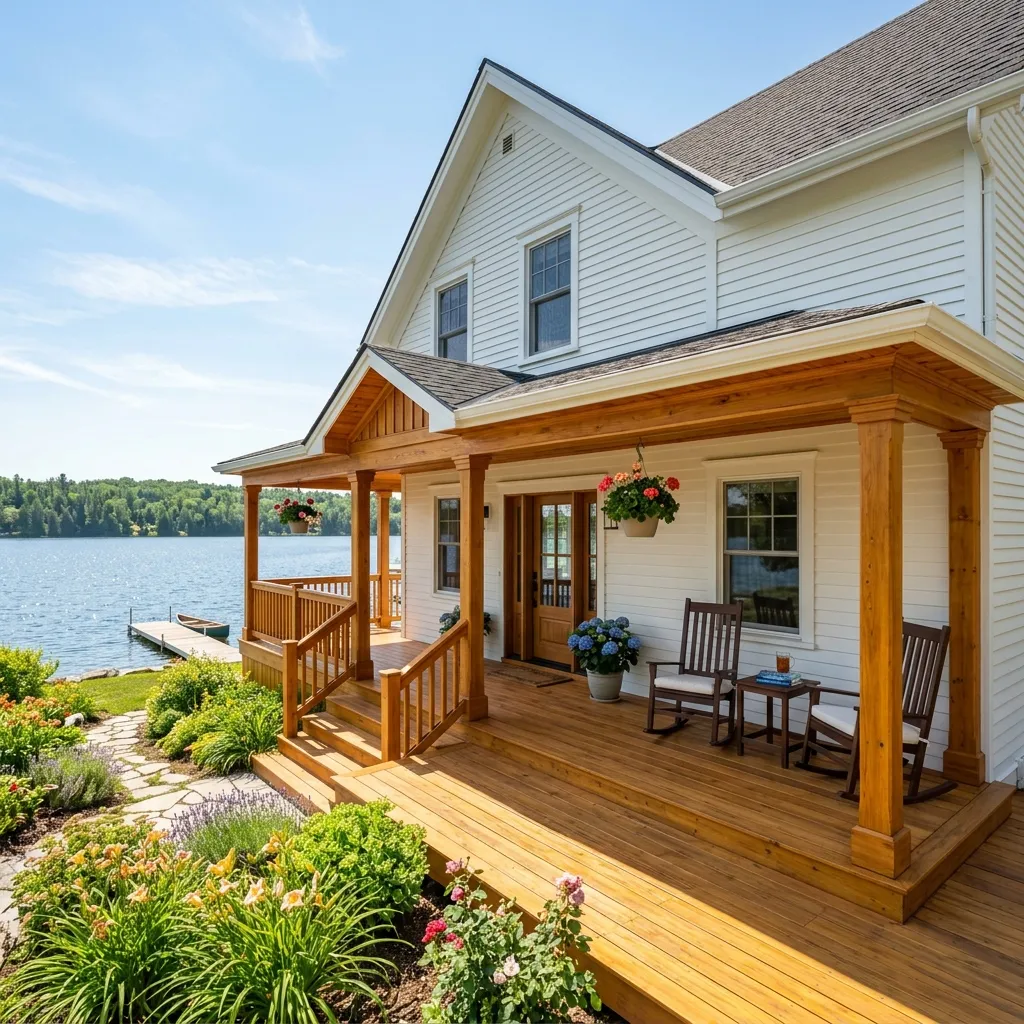
A cedar deck or porch in The Beaches is not a Toronto deck — it is a lakefront deck. The neighbourhood sits on the Lake Ontario shore with full southern exposure across open water and direct salt-laden air drift. Most of the Beaches housing stock is heritage frame construction with original or first-generation cedar exterior detail. Add the boardwalk-zone humidity, the fall storm exposure, and the persistent overnight dew off the water, and you have an environment that punishes cedar harder than anywhere else in Toronto. Standard Toronto staining protocols produce 18 to 24 month finishes here — the same protocol delivers 4 to 5 years one kilometre inland. This guide explains exactly what The Beaches climate does to cedar and what restoration protocols actually work in Queen East, Williamson Road, and the boardwalk-zone properties.
The Beaches Microclimate
The Beaches sits in a microclimate band that resembles Old Oakville lakefront more than it resembles inland Toronto. The neighbourhood occupies the south-facing shore of Lake Ontario with no significant landform interruption between the housing stock and open water. The result is a climate that combines:
- Full southern exposure over open water — UV that reflects off the lake surface adds roughly 15 percent to incident UV at deck surfaces compared to inland properties at the same latitude.
- Salt-laden air from continuous lake-water evaporation, depositing minerals on horizontal surfaces at measurable rates.
- Boardwalk-zone humidity with relative humidity averaging 8 to 15 percent above inland Toronto year-round.
- Fall storm exposure when southerly winds drive lake moisture and debris directly onto south-facing structures.
- Persistent overnight dew as lake-surface air cools and condenses onto cedar surfaces nightly during humid summer weeks.
These conditions stack on the same wood at the same time. Each one reduces finish life independently; combined, they produce 18 to 24 month finishes from products that deliver 4 to 5 years one kilometre inland.
South-Facing Lake Exposure and UV
Lake-surface UV reflection is the most under-appreciated stress on Beaches cedar. The lake reflects roughly 15 to 20 percent of incident UV during summer months — additional UV that hits south-facing decks from below as well as from above. Cedar that takes a "normal" UV dose from the sky takes nearly double the dose at the Beaches between direct and reflected exposure.
The consequences are visible in finish failure patterns. Beaches cedar fades faster, develops UV-driven surface checking sooner, and loses pigment at roughly twice the rate of inland Toronto cedar under otherwise identical product specification. Standard pigment-density stain produces visibly faded finish within 12 to 18 months on Beaches south-facing surfaces.
The protocol fix is higher-pigment-density stain product within the same Expert Stain & Seal product line — the marine-grade or semi-solid formulations that read slightly more opaque than standard semi-transparent. The trade-off is reduced wood-grain visibility for substantially longer pigment life.
Salt Deposits on Toronto Shoreline Properties
Lake Ontario is fresh water, but lakefront air carries dissolved minerals that deposit on horizontal surfaces during the evaporation cycle. The deposits accumulate visibly on deck rails, beam tops, and post tops within 30 days of cleaning on Beaches properties. The same chemistry that affects Old Oakville lakefront cedar applies to Beaches cedar at comparable distance from shore.
Mineral deposits cause three failure modes:
- Adhesion failure when stain is applied over deposits — the bond is to the mineral layer, not the wood, and the mineral layer eventually disconnects.
- Pigment migration as moisture cycles through the deposits and carries pigment toward the surface.
- Localized UV damage as mineral particles refract and concentrate UV at specific points.
The fix is a dedicated salt-deposit rinse with calcium-removal chemistry before any cleaning or staining. This adds half a project day but prevents the failure modes that drive premature lakefront finish breakdown.
Heritage Frame-House Cedar Considerations
The Beaches housing stock leans heavily heritage. Original cedar trim, porch detail, and deck installations on Williamson Road, Queen East, and the boardwalk-zone homes are typically 60 to 100 years old with multiple finish layers from successive decades.
Heritage cedar at this age is denser, more brittle, and more sensitive to aggressive preparation than modern cedar. Standard restoration approaches that work on subdivision cedar will damage Beaches heritage cedar. The protocol differences include:
- Soft-wash preparation under 500 PSI rather than standard 800 PSI on heritage installations.
- Hand sanding with 120 to 220 grit on isolated areas rather than mechanical sanding across entire surfaces.
- Citrus-based or solvent-based stripping rather than caustic strippers when previous finishes need removal.
- Reduced stain application coverage — heritage cedar absorbs less than modern cedar at the same nominal coverage rate.
The Beaches Restoration Protocol
Our protocol for Beaches Toronto cedar within 800 metres of the lakeshore:
- Property assessment with proximity-to-shore measurement, salt-deposit density inspection, and heritage cedar evaluation.
- Salt-deposit rinse with calcium-removal chemistry, before any wood cleaner.
- Soft-wash cleaning with biocide-fortified percarbonate cleaner at extended dwell — sodium hypochlorite addition for properties under canopy or in heavy mould pressure zones.
- Wood brightening with oxalic acid to restore pH after cleaning chemistry.
- Extended dry-down window of 72 hours minimum, with moisture-meter verification.
- High-pigment-density stain application with Expert Stain & Seal marine-grade or semi-solid formulation depending on heritage colour requirements and wood condition.
- End-grain sealing on every cut — mandatory on lakefront cedar.
- Annual maintenance recommendation with rinse-and-inspection at 12 months — Beaches properties benefit from annual maintenance more than any other Toronto neighbourhood.
Honest Pricing for Beaches Properties
Our standard GTA deck staining rate is $3 to $6 per square foot. Beaches properties within 800 metres of the lakeshore typically run in the upper end of that range — roughly $4 to $7 per square foot — reflecting:
- Salt-deposit rinse adding half a project day.
- Marine-grade or high-pigment product cost premium of roughly 15 percent over standard.
- Extended dry-down windows on canopy-shaded heritage properties.
- Heritage-appropriate prep on older installations.
- Mandatory end-grain sealing on every cut.
For a typical 300 square foot Beaches cedar deck or porch, expect $1,400 to $2,500 for full restoration with the lakefront-specific protocol. Larger heritage installations on Williamson Road or boardwalk-zone properties run $2,500 to $5,500. Annual maintenance plans for repeat clients run $300 to $600 depending on property size.
All restoration work carries our 3-year written warranty on workmanship. Beaches properties on annual maintenance plans typically run 4 to 5 years between full restoration cycles versus 2 to 3 years for properties without maintenance.
Frequently Asked Questions
Frequently Asked Questions
How far inland from the boardwalk does the lakefront protocol apply?
Roughly 800 metres for full lakefront protocol, with partial application up to about 1.2 kilometres depending on local topography. Properties south of Queen Street East typically use full protocol; properties between Queen East and Kingston Road use partial protocol with reduced salt-deposit rinse and standard biocide loading; properties north of Kingston Road typically use standard inland Toronto protocol. We confirm the appropriate protocol during the on-site assessment.
How often does Beaches cedar need full restoration?
Every 3 to 4 years on the lakefront protocol described here, with annual maintenance plans extending each interval to 4 to 5 years. Inland Toronto cedar typically runs 4 to 6 years between cycles. Beaches cedar runs roughly one cycle shorter due to the combined UV, salt, and humidity stress. Annual maintenance is the single most valuable practice and substantially extends each restoration interval.
My Beaches deck is on solid stain. Should I switch?
Yes, in nearly every case. Solid stain on Beaches lakefront cedar fails roughly every 18 months due to the combined exposure stresses, and each strip-and-restain cycle progressively damages the cedar fibre. Switching to penetrating stain stops the damage and extends deck lifespan substantially. The transition cost (full strip plus penetrating stain application) is recovered in maintenance savings within 4 to 5 years and the deck preservation benefit is permanent.
Are there products to recommend for DIY annual maintenance?
A wood-safe percarbonate cleaner applied with low-pressure rinsing is appropriate DIY work for annual maintenance. Avoid bleach-based household cleaners — these damage cedar fibres on prolonged contact and interfere with the next stain application. Avoid pressure washing above 600 PSI on Beaches heritage cedar — the surface is more fragile than inland cedar due to additional weathering. Stain touch-ups are not recommended for DIY because matching marine-grade pigment density and avoiding lap marks under lakefront conditions is genuinely difficult.
Get Your Free Quote
Tell us about your project — we get back within 1 business day with honest pricing.