
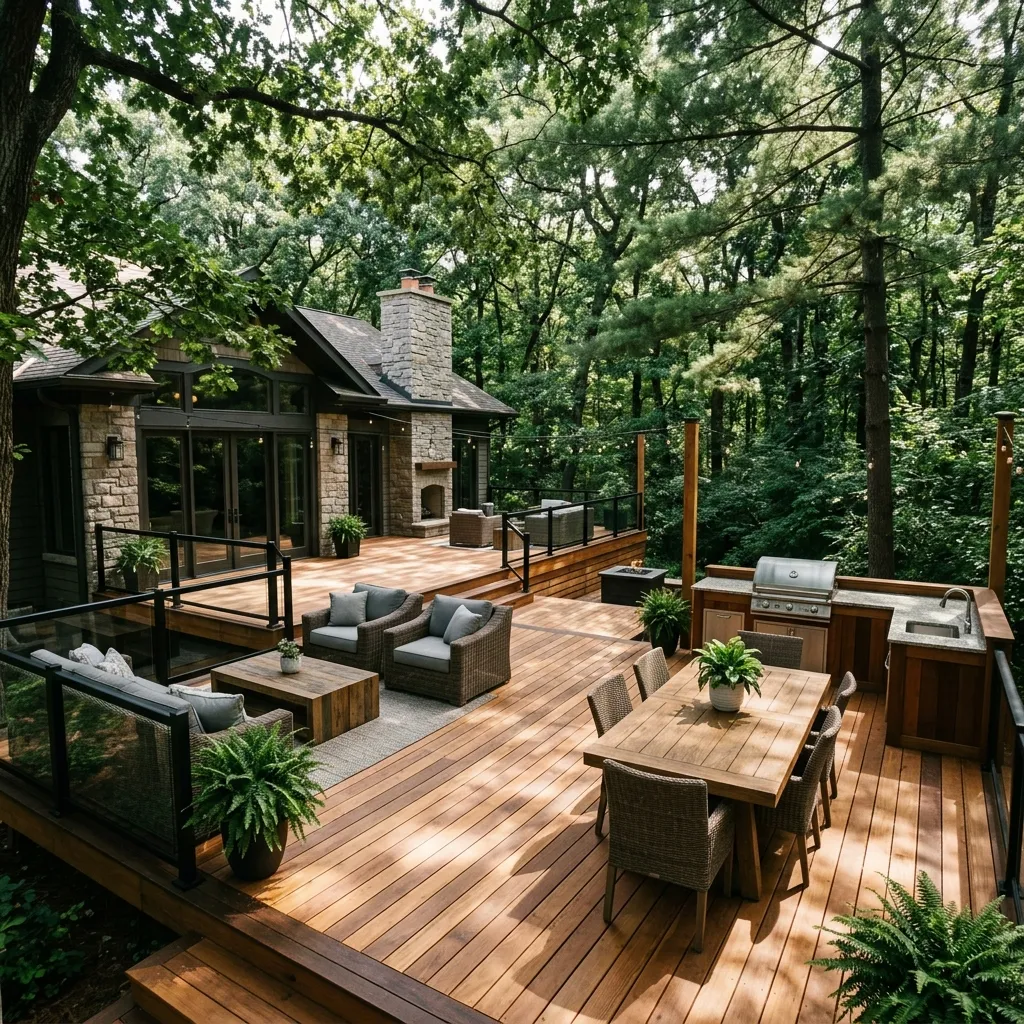
Lorne Park is geographically Mississauga, but climatically it operates more like Oakville lakefront. The neighbourhood sits in the lake-effect humidity band that wraps the western shore of Lake Ontario, the mature tree canopy is denser than most of Mississauga, and the housing stock leans heavily toward premium hardwood and cedar deck construction that demands different chemistry than pressure-treated lumber. Standard Mississauga staining protocols — calibrated for inland subdivisions in Erin Mills, Square One, and similar zones — fail in Lorne Park within 24 months. This guide explains exactly why Lorne Park cedar performs differently and what the protocol should be.
The Lorne Park Microclimate
The lake-effect humidity band on the western shore of Lake Ontario extends roughly 800 metres to 1.5 kilometres inland depending on local topography and prevailing winds. Lorne Park sits squarely in that band — the entire neighbourhood operates under elevated humidity, slower wood drying, and increased mould pressure compared to inland Mississauga.
Three measurable climate differences from inland Mississauga:
- Relative humidity averages 8 to 12 percent higher year-round than properties 2 kilometres inland.
- Surface drying time after rain is 50 to 70 percent longer on horizontal cedar surfaces.
- Mould and algae establishment rates are roughly twice the rate of inland properties under comparable canopy conditions.
These are not small differences. They cascade through every stage of restoration — from prep dwell times to dry-down windows to stain product choice — and produce visibly different finish performance over 24 to 48 months.
Why Inland Mississauga Protocols Fail Here
Standard inland Mississauga deck staining uses contractor-grade penetrating oil-based stain over thoroughly-prepped cedar with a 48-hour dry-down window after cleaning. This protocol produces 4 to 5 year finishes in Erin Mills, Mineola inland, and similar zones.
The same protocol applied to Lorne Park cedar produces 18 to 24 month finishes. Three failure modes appear in sequence:
Months 6 to 12: surface mould. The biocide content of standard inland stain is calibrated for inland mould pressure. Lorne Park's elevated humidity and canopy shade overwhelm standard biocide loading. Visible mould colonies appear on the finish surface within the first year.
Months 12 to 18: localized peeling. Wood that did not reach optimal moisture content during the standard 48-hour dry-down window now releases trapped moisture upward through the finish. Peeling appears at end grains, knot areas, and any structural areas with reduced air circulation.
Months 18 to 24: full finish degradation. The combination of mould penetration and moisture-driven peeling produces a finish that requires full restoration roughly half as fast as inland properties.
This is not a contractor failure — it is a protocol mismatch. Standard inland chemistry simply does not handle lake-effect conditions, regardless of who applies it.
Canopy Density and Mould Pressure
Lorne Park's tree canopy is among the densest residential canopies in the GTA. Mature oak, maple, and pine create persistent shade over most yard areas during the growing season, with full sun exposure typically only at midday in mid-summer.
Persistent canopy shade plus elevated humidity creates a biological pressure cooker on cedar surfaces. Mould and algae spores find consistently moist conditions for establishment; the spores establish before any stain finish can fully cure; the established colonies produce visible discoloration that spreads under the finish surface and feeds further mould growth.
The protocol fix is biocide-fortified chemistry at every stage — cleaning, brightening, and stain application all use products with elevated biocide content rather than standard inland formulations. This is the same approach we use on Old Oakville lakefront properties for the same reason.
Premium Wood Stock Considerations
Lorne Park's housing stock leans heavily toward larger custom homes with premium deck materials. Cedar is common; ipe, garapa, and mahogany are increasingly common; pressure-treated lumber is uncommon outside of structural framing components.
Premium hardwoods need different stain chemistry than cedar. Ipe and garapa absorb very little stain — these woods are dense enough that penetrating stains designed for cedar over-saturate the surface and produce uneven absorption. Hardwood-specific products (typically tung oil-based finishes rather than the linseed-oil-based products used on cedar) are the appropriate specification.
The hardwood-vs-cedar distinction matters because Lorne Park properties often have mixed-material decks — cedar joists with hardwood deck boards, or hardwood main decks with cedar railings. Treating the entire deck as a single-material project produces uneven finish performance. We assess every Lorne Park deck for material composition and may use different products on different sections of the same project.
The Lorne Park Restoration Protocol
Our protocol for Lorne Park properties:
- Material identification across the deck surface — cedar, pressure-treated lumber, ipe, garapa, mahogany, or composite. Different sections may be different materials.
- Wood cleaning with biocide-fortified percarbonate cleaner at extended dwell.
- Sodium hypochlorite biocide application at controlled dilution to kill established mould and algae colonies.
- Wood brightening with oxalic acid to restore natural pH.
- Extended dry-down window of 72 hours minimum, with moisture-meter verification at multiple depths.
- Material-specific stain application — Expert Stain & Seal penetrating oil-based stain on cedar and softwoods; tung oil-based hardwood finish on premium hardwood sections; appropriate transitions between materials.
- End-grain sealing on every cut, especially important under canopy where moisture entry rates are elevated.
- Annual maintenance plan for repeat clients — light cleaning at 12 months substantially extends each restoration cycle.
Honest Pricing for Lorne Park Decks
Our standard GTA deck staining rate is $3 to $6 per square foot. Lorne Park properties typically run in the upper end of that range or slightly above — typically $4 to $7 per square foot — reflecting:
- Biocide-fortified chemistry vs standard inland chemistry.
- Extended dry-down windows adding 1 to 2 project days.
- Material-specific product selection on mixed-material decks.
- Premium hardwood compatibility on ipe, garapa, and mahogany sections.
- End-grain sealing on every cut as standard, not optional.
For a typical 500 square foot Lorne Park cedar deck, expect $2,000 to $3,500 for full restoration including the canopy-specific protocol. Premium hardwood decks (ipe or garapa) run $3,500 to $7,000 due to specialty product requirements. Mixed-material decks fall between these ranges depending on hardwood percentage. We provide free on-site assessments — Lorne Park condition variability is too wide for accurate phone quoting.
All restoration work carries our 3-year written warranty on workmanship.
Frequently Asked Questions
Does the Lorne Park protocol apply to all of Mississauga or just Lorne Park?
Just the lake-effect band — Lorne Park, Mineola lakeside, Port Credit, and small adjacent zones. Most of Mississauga (Erin Mills, Square One, Heartland, Streetsville, Meadowvale, Cooksville inland) operates under standard inland GTA conditions and uses the standard cedar staining protocol. We confirm the appropriate protocol during the on-site assessment based on actual property location and microclimate exposure.
I have a hardwood deck (ipe / garapa). Can the same contractor do both cedar and hardwood work?
Yes — we work both regularly. The product selection differs (tung oil-based finishes for hardwood vs penetrating oil-based for cedar) and the application protocol differs (single-coat saturation for hardwood vs two-coat for cedar), but the prep philosophy is the same. The key is recognizing during the assessment that hardwood is hardwood and treating it accordingly. Contractors who use cedar protocols on ipe or garapa produce blotchy finishes within months.
How often does Lorne Park cedar need restoration?
Every 3 to 4 years for cedar with the canopy-specific protocol described in this article. Inland Mississauga cedar typically runs 4 to 5 years between cycles; Lorne Park cedar runs slightly less due to canopy mould pressure even when humidity is the same. Annual maintenance — a soft-wash rinse and visual inspection — is more valuable here than in any other Mississauga zone and substantially extends each cycle interval.
My deck looks fine but it is two years old. Should I do anything?
Yes — this is the optimal moment for an annual maintenance visit, not waiting until visible failure begins. A light wash with biocide-fortified cleaner removes any colonizing mould before it establishes; a moisture-meter check confirms the wood condition; minor finish wear gets noted for the next full restoration cycle. Properties on annual maintenance plans typically run 5 to 6 years between full restorations rather than the 3 to 4 typical without maintenance.
Get Your Free Quote
Tell us about your project — we get back within 1 business day with honest pricing.