
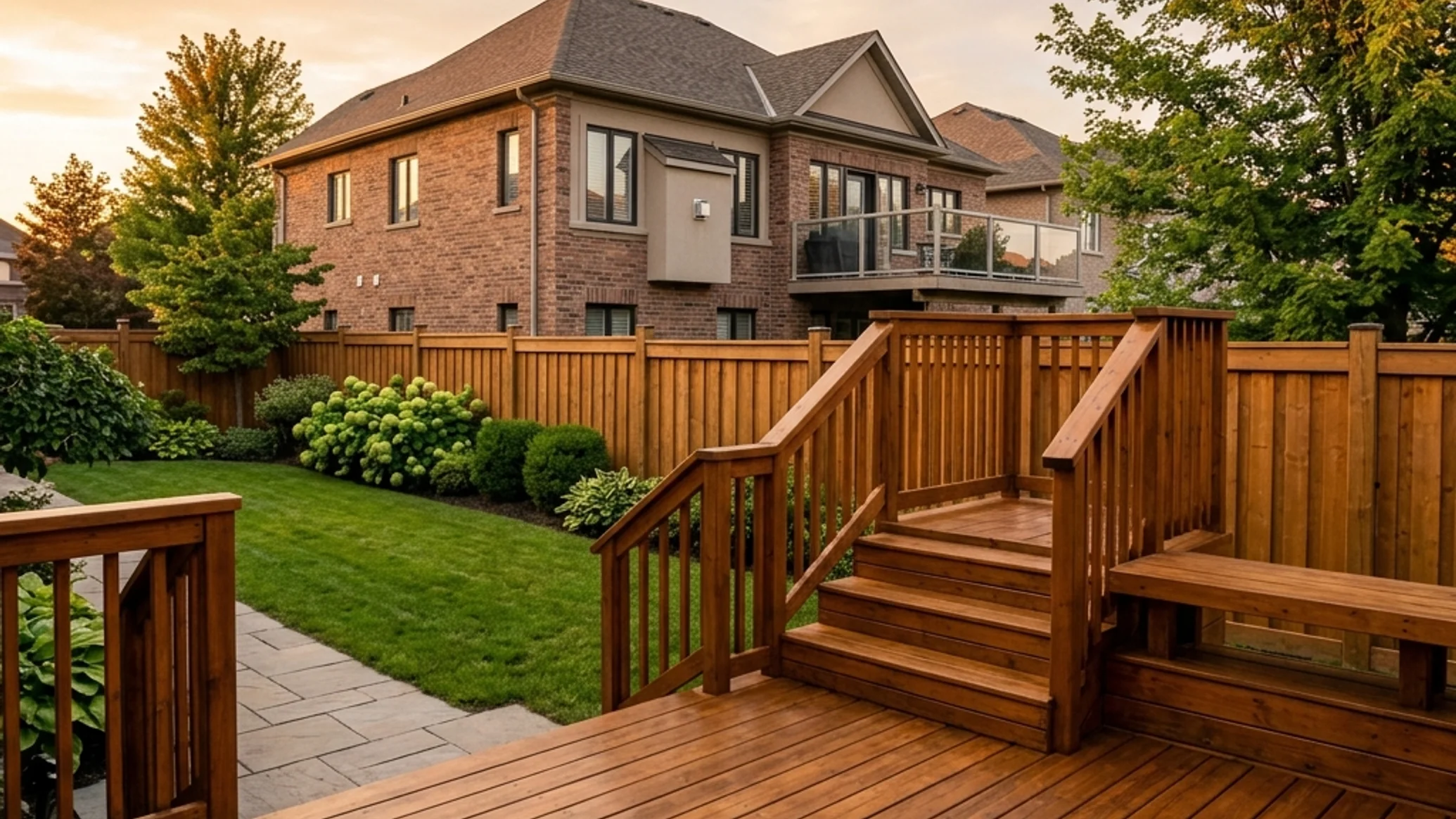
Brampton has the largest cohort of 2010s residential subdivisions in the GTA. Mount Pleasant, Springdale, Castlemore, Heart Lake, Bramalea, and the Sandalwood corridor all hit major build phases between 2008 and 2018. The pressure-treated and cedar decks built into those homes are now 8 to 18 years old — squarely in the window where the original builder finish has failed, the wood has weathered visibly, and the choice is restoration or eventual replacement. Brampton also has the highest concentration of long privacy fence runs in the GTA because of subdivision lot layouts, which puts most homeowners on a fence-staining cycle alongside the deck. This guide covers what Brampton homeowners actually need to know about restoration in 2026.
The Brampton Deck Demographic Right Now
Brampton built faster than any other GTA municipality in the 2008-2018 cycle. Roughly 80 percent of residential decks in Mount Pleasant, Springdale, and Castlemore were installed by builders alongside the original home construction, almost exclusively in pressure-treated lumber, with the standard 2-coat builder-grade clear sealer or light tone semi-transparent stain applied once before handover.
That original finish lasted 18 to 36 months. By year three to five, most homeowners noticed visible greying of the wood. By year five to seven, dimensional movement started producing visible cupping on the wide decking boards. By year eight to ten, fastener corrosion stains, board splitting, and end-grain breakdown became common.
The 2008-2010 build cohort is now in the structural decision zone — restore the existing deck, or accept that board replacement is needed soon. The 2014-2018 cohort is in the optimal restoration window — wood is sound, finish is gone, single restoration cycle returns the deck to near-original condition for the next 5 to 7 years.
Builder-Grade Pressure-Treated vs Cedar
Brampton subdivisions used two main deck materials. The treatment protocol differs significantly between them.
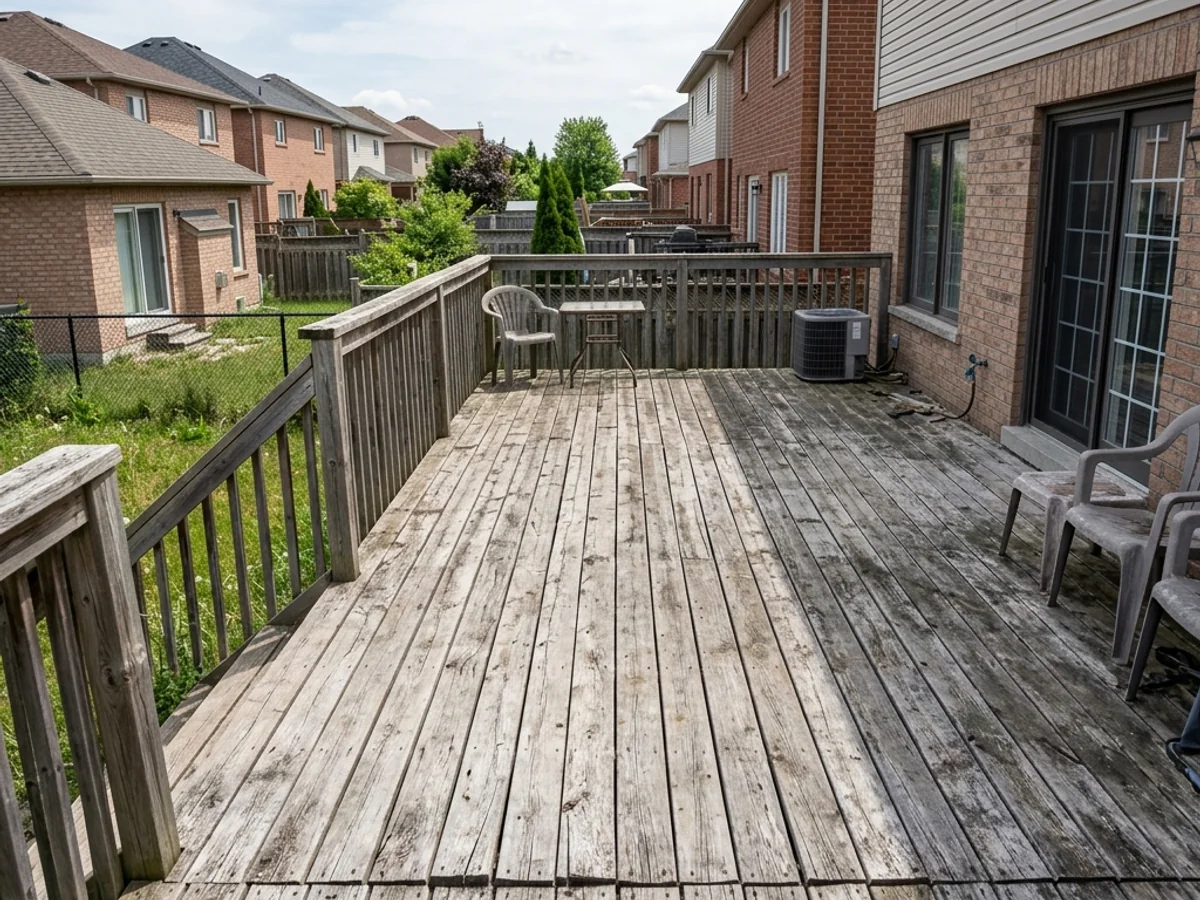
Builder-grade pressure-treated lumber. Used in roughly 80 percent of Brampton residential decks. The pressure treatment that gives the wood its green-to-brown initial tone protects the wood structurally against rot and insect damage but does not protect against UV or moisture cycling. Without an applied finish, pressure-treated wood greys completely within 18 months and starts cracking and cupping by year three to five. Restoration on pressure-treated lumber requires aggressive cleaning (the surface is usually mildewed and chemically aged), brightening to restore wood tone, and a penetrating semi-transparent stain that bonds into the surface fibres. Builder-grade pressure-treated also requires more product per square foot during application than cedar because the surface is more porous.
Cedar. Used in the higher-end Heart Lake and Toronto Gore neighbourhoods, and as upgrade decks in mid-tier subdivisions. Cedar ages more attractively than pressure-treated lumber but breaks down faster without finish — uncoated cedar in Brampton open-exposure subdivision lots can show grain-tear and end-grain failure within 4 to 6 years of installation. Cedar restoration is generally easier than pressure-treated restoration because the wood accepts stain more uniformly and requires less aggressive prep. Stain penetration is also better, producing 4 to 6 year cycles between full restorations vs 3 to 5 year cycles on pressure-treated decks.
The single biggest mistake in Brampton deck restoration is using the same product and protocol on both materials. Pressure-treated lumber needs higher pigment density and more aggressive brightening; cedar accepts a wider range of finishes and benefits from end-grain sealing that is often skipped on pressure-treated quotes.
Fence Restoration at Subdivision Scale
Brampton subdivision lots are typically 30 to 40 feet wide with privacy fence on both side property lines and across the back. Total fence run per typical lot: 80 to 130 linear feet of cedar privacy fence at 6 feet tall.
Subdivision fences are usually shared with neighbours, which complicates the decision to restore. Three common scenarios:
- Single-owner fence on the owner-occupied side: straightforward restoration decision.
- Shared fence with co-owner agreement: typically split 50-50 by linear footage if both sides are restored; one side can be done without the other but the unrestored side ages faster.
- Shared fence where the other side declines to participate: single-side restoration is possible and looks reasonable from the restored side, but expect a 1 to 2 year reduction in finish life on the joint between boards because the back side continues to weather and pulls moisture differently.
Restaining a full subdivision fence run takes 1.5 to 2 days of work for typical lots. The work is repetitive but exposure-intensive because the fence sees full sun on the side facing the street or alley, while the yard-facing side sees variable shade depending on landscaping. Two-coat application on both faces is standard for full restoration.
Inland Climate vs Lakeshore Mississauga
Brampton sits 25 to 35 kilometres inland from Lake Ontario. The climate impact on outdoor wood is meaningfully different from Mississauga lakeshore neighbourhoods, even though both are GTA.
- Wider thermal swings. No lake-effect temperature moderation, so summer-night cooling and winter-day warming are more extreme. Wood goes through wider expansion-contraction cycles per year, which favours penetrating finishes over film-forming finishes.
- Lower ambient humidity. Brampton air is drier on average than lakeshore Mississauga, especially in summer. Wood dries faster between rains, which means re-staining can proceed sooner after wet weather, but it also means uncoated wood dries out and cracks faster.
- More variable wind. Open subdivision lots take wind from any direction without breaking it on dense built environment or mature canopy. Driving rain and wind-blown debris affect end-grain board exposure more than in canopy-shaded older neighbourhoods.
Practical consequence: Brampton decks and fences need more aggressive end-grain sealing during restoration than lakeshore Mississauga decks. Skipping end-grain treatment is the most common cause of premature finish failure on Brampton restorations.
Realistic Brampton Cost Ranges
Brampton residential restoration pricing in 2026:
- Deck staining (full restoration): $3.00 to $6.00 per square foot, in line with the broader GTA. Typical 250 sq ft Brampton subdivision deck: $750 to $1,500.
- Deck stripping (failed prior solid stain): add $1.50 to $3.00 per square foot. Pressure-treated decks with failed builder solid stain are common in Brampton; stripping is required before re-finishing with a penetrating stain.
- Fence staining (per linear foot, 6 ft tall, both sides): $8 to $15 per linear foot. Typical 100 linear foot subdivision fence: $800 to $1,500.
- Single-side fence staining: $5 to $9 per linear foot.
- Combined deck and fence (typical lot): $1,500 to $3,000 most common range; up to $4,500 for larger lots or heritage Heart Lake properties.
All restoration work carries our 3-year written workmanship warranty. Brampton restoration costs are usually quoted on-site after measurement; off-site phone quotes are typically a range estimate only.
Colour Choice and Brampton Neighbourhoods
Brampton subdivision homes are predominantly brick-and-stone exteriors in warm reddish-brown to grey palettes. Stain colour selection benefits from coordinating with the home primary exterior tone.
- Red and reddish-brown brick homes (most common): warm-brown semi-transparent stains read as cohesive. Avoid grey-tone stains that fight the brick.
- Grey and stone-accent homes (newer subdivisions): neutral browns and warm greys both work; pure red-brown can clash.
- Mixed brick and siding homes: follow the brick rather than the siding for stain coordination — brick reads as the dominant exterior element.
Semi-transparent stains in the Expert Stain & Seal line cover the range of warm browns and neutral tones suitable for Brampton subdivisions. Solid stains are typically discouraged because they require complete restripping every 18 to 24 months on pressure-treated decks — significantly more expensive over a 10-year horizon than semi-transparent maintenance.
Brampton Permits and Bylaws
Restoration work in Brampton does not require a building permit. The same OBC thresholds that apply across the GTA cover Brampton — new construction or structural changes need a permit, restoration does not. Brampton has been actively enforcing on unpermitted structural additions during home sales, which makes confirming permit history important for buyers and sellers, but is unrelated to restoration work.
Fence height bylaw in Brampton: 1.0 metre maximum in the front yard, 2.0 metres maximum in the rear and side yards. Restoration of an existing fence at any height is not regulated. Building a fence taller than the bylaw maximum requires a variance application.
Frequently Asked Questions
Who does deck staining in Brampton?
Several reputable residential restoration contractors operate in Brampton, including Beaver Wood Restoration. Brampton subdivisions are a major part of our service area — Mount Pleasant, Springdale, Castlemore, Heart Lake, Bramalea, and the Sandalwood corridor are all within our regular routing. We provide free on-site assessments and detailed itemized quotes; pricing on Brampton subdivision decks typically lands in the $750 to $1,500 range for the most common 200 to 300 square foot decks.
How much does it cost to stain a fence in Brampton?
Full two-sided fence staining on a 6-foot privacy fence in Brampton runs $8 to $15 per linear foot in 2026. A typical 100 linear foot subdivision fence run costs $800 to $1,500 for both sides. Single-side staining (when a shared fence neighbour declines to participate) costs $5 to $9 per linear foot. Fence pricing is usually quoted by linear footage rather than square footage because the panel height across the GTA is largely standardized at 6 feet.
Do I need a permit for deck restoration in Brampton?
No. Cleaning, stripping, staining, sealing, and surface board replacement on an existing permitted deck do not require a building permit in Brampton or anywhere else in the GTA. The Ontario Building Code permit requirements apply to new construction or structural changes (joists, beams, posts, footings, redesigned railings or stairs). Restoration is not regulated by Brampton Building.
How often should I restain my deck in Brampton climate?
Brampton pressure-treated decks on a properly applied penetrating semi-transparent stain typically need full restoration every 3 to 5 years, with light annual cleaning between cycles. Cedar decks in the same conditions hold finish for 4 to 6 years. Inland Brampton climate produces slightly shorter cycles than lakeshore Mississauga (which gets temperature moderation from Lake Ontario). Pressure-treated decks left without finish age much faster — visible greying within 18 months and structural damage within 7 to 10 years.
Get Your Free Quote
Tell us about your project — we get back within 1 business day with honest pricing.