
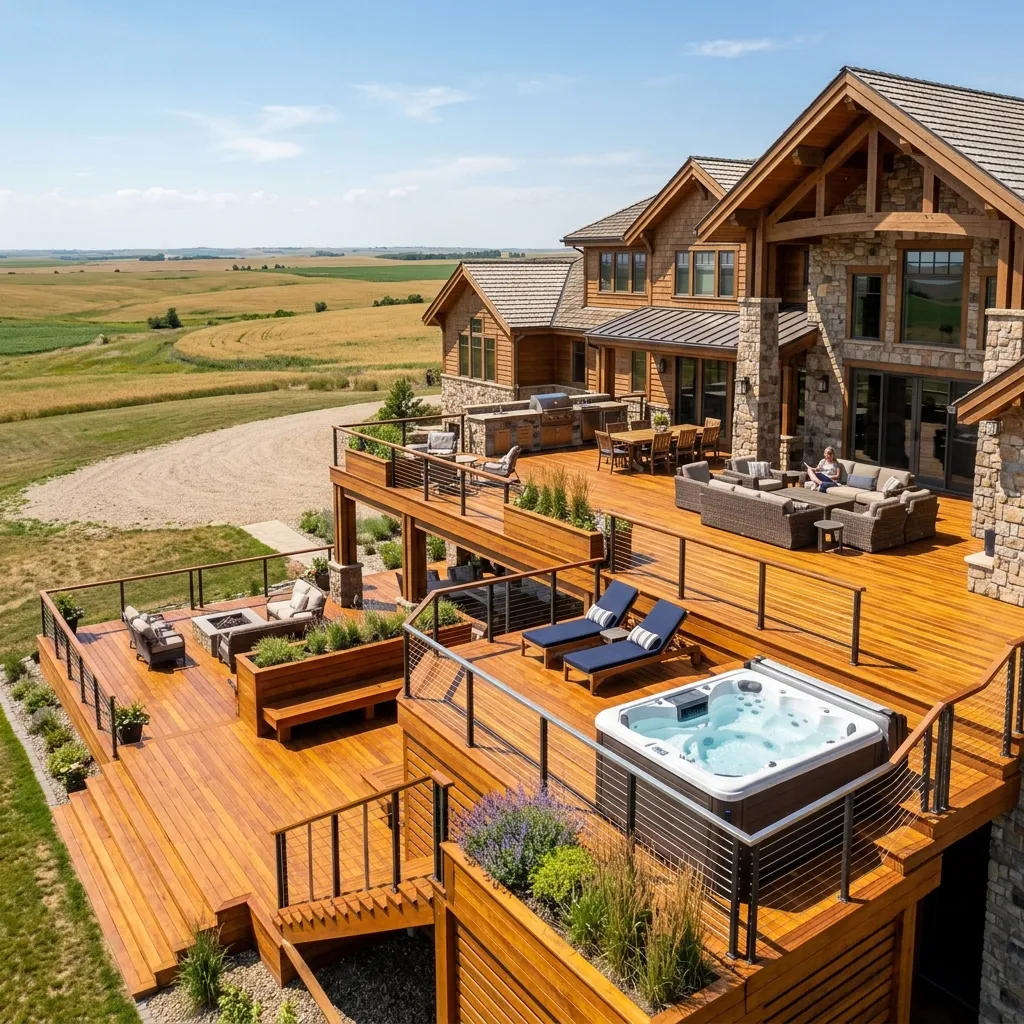
A 1,200 square foot cedar deck on a Kleinburg estate property and a 1,200 square foot cedar deck in Cabbagetown are not the same project. The Kleinburg deck takes UV from sunrise to sunset with no canopy interruption, sees rural dust embedded in the finish during application, and dries out faster between cycles than any inland neighbourhood in the GTA. Standard contractor schedules and standard stain products produce 18-month finishes on these properties when the same protocol delivers four to six years on shaded urban decks. This guide explains exactly why Kleinburg cedar weathers faster and what changes in our restoration protocol when we work King Township estates, plus realistic pricing for the larger surface areas these properties carry.
Why Open-Exposure Cedar Fails Faster in Kleinburg
Three conditions stack on Kleinburg estate properties that do not exist on shaded urban GTA decks. Each one shortens finish life independently. Together, they cut the maintenance cycle in half.
Continuous UV from sunrise to sunset. Kleinburg estate lots typically have minimal mature canopy at the deck location — the deck sits in full sun for 8 to 12 hours daily during summer. Toronto canopy-shaded decks in The Annex, Cabbagetown, or Forest Hill take direct UV for two to four hours. The lifetime UV dose on a Kleinburg deck is roughly three times higher per year, and UV is the primary driver of stain pigment failure.
Wider thermal swings. Open rural lots cool faster overnight than urban lots that retain heat from surrounding buildings and pavement. Kleinburg cedar moves through wider expansion-contraction cycles than urban cedar — estimated 15 to 20 percent more dimensional movement per season. Penetrating finishes handle this; film-forming finishes crack.
Wind-driven moisture. Open lots offer no windbreak. Driving rain hits Kleinburg decks at angles urban decks rarely see, with much of the moisture arriving on the typically-protected end grain of boards. End-grain moisture is the leading cause of board rot, and end-grain sealing is the most common shortcut on standard staining quotes.
The Agricultural Dust Problem
Kleinburg sits next to active agricultural land in King Township. Wind-borne dust from fields embeds into wet stain during application and onto recently-dried stain during cure. We have measured visible dust contamination in stain finishes applied within 100 metres of an active field on a windy spring day — finishes that produce a gritty texture and accelerated UV failure due to the embedded particulate.
Our protocol for Kleinburg jobs differs from other GTA areas in three ways:
- Weather-window scheduling. We avoid days with wind speeds above 20 km/h from the agricultural side, even if temperature and humidity are otherwise within spec.
- Pre-application surface decontamination. A second cleaning pass within 24 hours of stain application removes any dust that has settled on the prepped surface.
- Application timing. Early-morning or late-afternoon application windows when wind is typically calmer, even if it means longer project days.
This is also why we strongly discourage homeowners from attempting DIY staining in Kleinburg. The conditions are unforgiving and the visible failure modes are immediate.
Scheduling Around Rural Conditions
The optimal staining window for Kleinburg estates is narrower than the inland GTA. Late May through mid-July gives stable temperatures, low pollen, and predictable wind. Late August through late September gives a second window — cooler nights but stable enough conditions for full cure. We avoid early spring (high pollen, agricultural dust from field tilling) and October onwards (overnight temperatures unpredictable, high cure-failure risk).
Kleinburg projects are also typically larger — 800 to 2,000 square feet of deck surface, often spread across multiple levels and including substantial railing systems. Larger surface area means longer project duration, which means more weather windows must align. We typically book Kleinburg projects in early March for May–July execution to lock the best weather windows.
Product Changes for Estate Properties
Standard GTA stain specification is a contractor-grade penetrating oil-based stain with moderate UV-blocking pigment load. For Kleinburg open-exposure work, we specify higher pigment density within the same Expert Stain & Seal product line — typically the higher-pigment formulations that read as semi-solid rather than semi-transparent at the same dilution. The trade-off is a slight reduction in wood-grain visibility for substantially better UV resistance on full-sun surfaces.
Where horizontal surfaces are particularly exposed (south-facing decks with no nearby structures), we apply three coats rather than the standard two. The third coat is half-coverage, applied within the first 24 hours of the second coat curing, and significantly extends finish life on extreme-exposure properties.
Vertical surfaces — railings, post wraps, balusters — receive the standard two-coat treatment. The exposure differential between horizontal walking surfaces and vertical surfaces is large enough on Kleinburg properties that uniform treatment would over-coat verticals or under-coat horizontals.
Honest Pricing for Estate-Scale Decks
Our standard GTA deck staining rate is $3 to $6 per square foot. Kleinburg estate properties typically land in the upper end of that range or slightly above due to four factors:
- Larger surface area means more product, more labour days, more weather risk to manage.
- Higher prep complexity. Estate decks are typically multi-level with custom railings, integrated planters, and built-in seating that take additional masking and detail work.
- Three-coat application on horizontal surfaces adds roughly 15 percent to product cost and 20 percent to labour vs standard two-coat work.
- Access logistics. Long driveways and gated properties require coordination that adds setup time per project day.
For a typical 1,200 square foot Kleinburg estate deck with railings and stairs, expect $5,500 to $9,500 for a full restoration cycle. Stripping a previously failed solid stain on the same deck adds $2,000 to $4,500 depending on coverage. We provide free on-site assessments — we do not quote estate properties over the phone because the condition variability is too wide.
All restoration work carries our 3-year written warranty on workmanship.
Realistic Maintenance Cycle
Honest expectations for Kleinburg cedar maintained on our protocol:
- Year 0: Initial restoration with three-coat horizontal application.
- Year 1: Light annual rinse and visual inspection. No product application.
- Year 2: Light cleaning and spot touch-up on highest-exposure boards. No full recoat.
- Year 3 to 4: Cleaning, brightening, and full recoat at half-coverage on horizontal surfaces. Vertical surfaces typically inspected and touched up only.
- Year 5 to 6: Full restoration cycle returns. Maintenance tracks closely from this point.
Compared to inland GTA cedar (4 to 6 years between cycles), Kleinburg cedar runs 3 to 4 years between cycles. The annual rinse-and-inspect pattern is more important here than anywhere else in the region — catching finish breakdown at month 30 rather than month 48 prevents wood damage that would otherwise require sanding back to bare cedar.
Frequently Asked Questions
Do you serve all of King Township or just Kleinburg?
We serve King Township broadly — Kleinburg, King City proper, Schomberg, Kettleby, Nobleton, and the rural acreage between. The estate-scale protocol described in this article applies to all open-exposure properties across the township; the canopy-shaded properties in older parts of King City village proper are treated more like inland GTA decks.
My Kleinburg deck is on solid stain. Can it be saved?
Almost always, yes — but it requires complete stripping back to bare cedar before semi-transparent stain can be applied. Stripping is expensive on large estate decks ($2,000 to $4,500 typically), but the math heavily favours stripping once and switching to penetrating stain over continuing the solid stain maintenance cycle. A solid stain on Kleinburg cedar fails roughly every 18 to 24 months and progressively damages the cedar fibre with each strip-and-restain. Switching to penetrating stain stops the damage and extends the deck lifespan by decades.
How early do I need to book for a Kleinburg project?
Earlier than for urban GTA work. We open Kleinburg bookings in early March for May–July execution and routinely fill those slots within four to six weeks. Late-summer slots (August to late September) book by mid-May. If you call in June expecting summer service, expect a fall booking instead.
Can I do touch-up between full restoration cycles myself?
Annual rinses and light cleaning are appropriate DIY work — a wood-safe cleaner, calibrated low-pressure rinse, and inspection take a half-day. Stain touch-ups are not DIY-friendly on Kleinburg properties because matching pigment density and avoiding lap marks under estate-scale exposure is genuinely difficult. We offer a touch-up service between cycles for repeat clients.
Get Your Free Quote
Tell us about your project — we get back within 1 business day with honest pricing.