
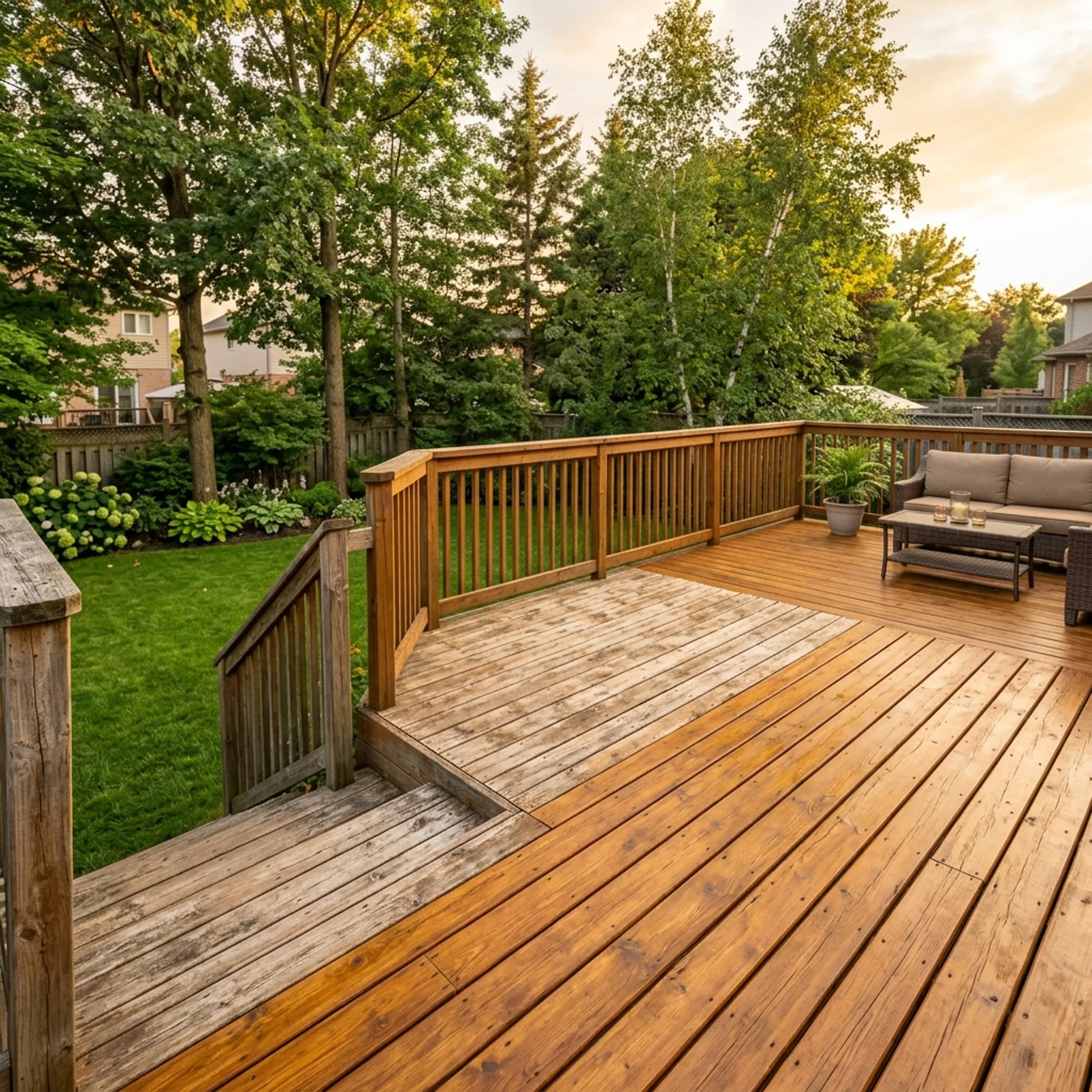
How long deck stain lasts is one of the most-asked and worst-answered questions in wood care, because the honest answer is a range, not a number — and the range is wide. In Canada's climate, a clear sealer might survive a single season while a quality penetrating stain on a sheltered railing can hold for four or five years. The variables are the finish type, whether the surface is horizontal or vertical, the sun and traffic it takes, and above all the quality of the prep underneath. This guide gives realistic lifespan figures by finish, explains what shortens them, and shows how to get the most years out of any system.
Quick Answer: Deck Stain Lifespan at a Glance
In Canada's climate, deck stain lifespan ranges from about one year for a clear sealer to four to five years for a pigmented penetrating stain on a sheltered surface. For the typical case — a quality semi-transparent stain on a deck walking surface — expect 2 to 3 years before a maintenance recoat. The single biggest controllable factor is not the brand of stain; it is the quality of the surface prep underneath it.
This guide is about how long a finish physically lasts and why. If what you actually want to know is when to act on your specific deck, pair it with our companion piece on how often to restain a deck in Toronto, which covers the maintenance schedule and the signs it is time.
Lifespan by Finish Type
The more pigment a finish carries, the more it shields the wood from UV — the main thing that degrades a finish — so heavier-pigment products last longer between coats. The trade-off is how they fail and how hard they are to renew.
| Finish type | Lifespan (horizontal) | How it fails |
|---|---|---|
| Clear sealer / water repellent | ~1 year | UV greying; no colour to fade |
| Toner / lightly pigmented | 1–2 years | Fades, thins evenly |
| Semi-transparent (penetrating) | 2–3 years | Fades and wears at traffic paths |
| Solid / opaque stain | 3–4 years | Wears, can peel if film builds up |
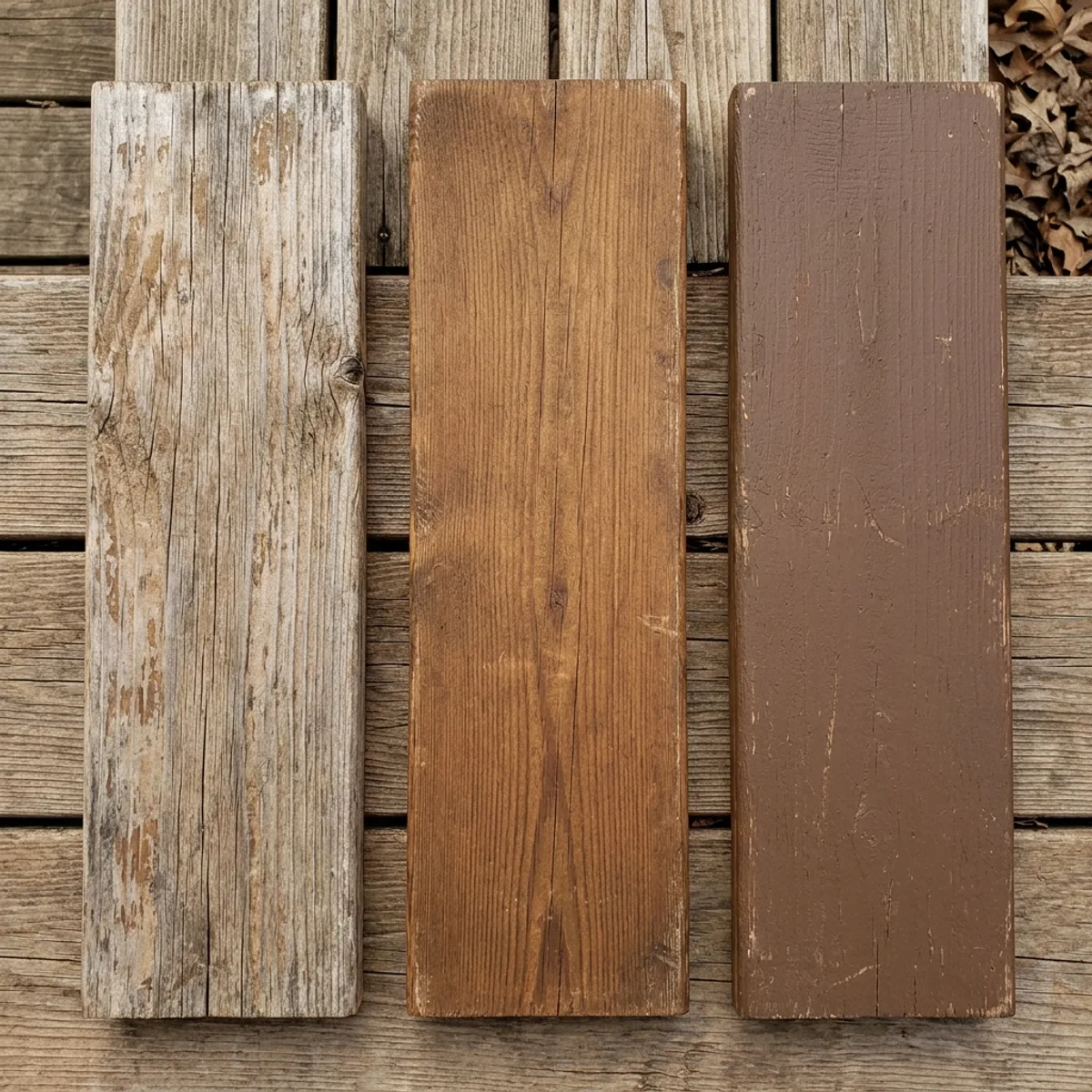
Clear and lightly tinted products look beautiful on day one because they show off the wood, but with little or no pigment they offer the least UV protection and the shortest life. Semi-transparent penetrating stains are the practical default for most decks: enough pigment for real protection, and they wear away rather than peel, so renewal is simple. Solid stains last longest between coats but, like paint, can build a film over repeated applications and start to peel — the failure mode we cover in stain vs paint.
Horizontal vs Vertical Surfaces
The same can of stain, applied on the same day, lasts roughly twice as long on vertical surfaces as on horizontal ones. Railings, fence boards, and skirting shed water and snow quickly and take less direct overhead sun and zero foot traffic. Deck boards and stair treads take all of it. That is why a fence stained at the same time as a deck still looks good when the deck floor is overdue — and why cedar fence maintenance runs on a longer cycle than deck-floor maintenance.
Plan your budget and schedule around this asymmetry rather than fighting it: recoat the walking surface on its shorter cycle and the vertical surfaces on their longer one.
What Shortens Stain Life
Six factors decide where in the range a given deck lands, and most of them are at least partly in your control:
- Prep quality (the big one). Stain applied over a dirty, glossy, or improperly sanded surface cannot bond and fails early regardless of product quality. Most short-lived stain jobs are prep failures, not product failures. This is the factor that separates a one-year result from a three-year result.
- Sun exposure. UV is the primary degrader. A south- or west-facing deck with no shade can lose a year of life compared to a shaded one.
- Foot traffic. Stain wears mechanically at the paths people use most, so high-use decks thin out faster.
- Standing water and drainage. Puddling boards, downspout splash zones, and slow-melting snow piles strip finish locally years before the rest of the deck.
- Over-application. More is not better with penetrating stains — excess product that cannot soak in sits on the surface, never cures properly, and peels. Two thin, well-absorbed coats outlast one heavy one.
- Wrong product for the wood. Dense hardwoods reject heavy oils; soft cedar drinks them. Matching the product to the species matters.
The Canadian Climate Multiplier
Canadian conditions push every figure above toward the shorter end. The GTA alone cycles through dozens of freeze-thaw events each winter, each one stressing the bond between finish and wood as moisture in the surface layer freezes, expands, and thaws. Snow sits on horizontal boards for months, keeping them wet far longer than rain ever would. Summer UV is strong on unshaded decks, and the swing between humid summers and dry, frozen winters keeps the wood constantly moving. A finish rated for several years in a mild, dry climate should be read as a shorter number here — and as a vertical-surface, shaded number at that. Lakefront and open-exposure properties weather even faster, as we cover in best deck stain for the Lake Ontario climate.
How to Make Stain Last Longer
You cannot change the climate, but you can move a deck from the short end of its range to the long end:
- Invest in prep. A proper clean, any needed brightening, and the right surface profile do more for longevity than any product upgrade. This is where the years are won.
- Use a penetrating, pigmented stain and apply it correctly. Two thin coats that fully absorb, applied in the right weather window, outperform a thick single coat. Our guide on the best time and temperature to stain covers the conditions that let a coat cure properly.
- Recoat before failure, not after. The cheapest deck to maintain is one that is recoated while the old finish is merely thinning, not gone. Waiting until bare grey wood appears forces a full strip-and-refinish.
- Keep it clean and draining. Sweep off leaves and debris that hold moisture, keep gaps clear so water drains, and use pads under furniture to prevent wear points.
Done well, this keeps a deck on the inexpensive clean-and-recoat cycle indefinitely. We provide free on-site assessments across Toronto and the GTA to recommend the right finish and prep for your deck's wood and exposure, and our staining work carries a 3-year written workmanship warranty.
Frequently Asked Questions
How long does deck stain last?
In the Canadian climate, deck stain lifespan ranges from about one year for a clear sealer to four or five years for a pigmented penetrating stain on a sheltered vertical surface. The typical case — a quality semi-transparent stain on a deck walking surface — lasts 2 to 3 years before a maintenance recoat. Heavier-pigment products last longer because pigment shields the wood from UV, but they are harder to renew. The biggest controllable factor is prep quality, not the product itself.
Why did my deck stain only last one year?
The most common cause is prep, not product. Stain applied over a surface that was dirty, still glossy from old finish, damp, or not properly sanded cannot bond to the wood and wears off quickly. Other causes are using a clear or lightly tinted product (which offers little UV protection), over-applying so the excess sits on the surface and peels, applying in the wrong weather, or a fully sun-exposed, high-traffic surface. A proper clean-and-prep before recoating usually fixes a short-life problem.
Does solid stain last longer than semi-transparent?
Yes, solid stain generally lasts longer between coats — typically 3 to 4 years on horizontal surfaces versus 2 to 3 for semi-transparent — because its heavy pigment blocks more UV. The trade-off is the failure mode: solid stain can build a film over repeated coats and peel, which makes renewal a full strip rather than a simple recoat. Semi-transparent stains wear away gradually and are renewed with just a clean and a fresh coat, which is why many homeowners prefer them despite the slightly shorter interval.
How long does stain last on a fence versus a deck?
Stain lasts roughly twice as long on a fence as on a deck floor using the same product. Fence boards are vertical, so they shed water and snow quickly, take less direct overhead sun, and get no foot traffic. Deck walking surfaces take standing water, snow load, the most sun, and all the foot traffic, so they wear far faster. Expect to recoat a deck floor every 2 to 3 years and a fence every 3 to 5.
Can I make my deck stain last longer?
Yes. The biggest lever is prep — a proper clean, brightening if needed, and the right surface profile do more for longevity than any product upgrade. Beyond that: use a pigmented penetrating stain applied as two thin, fully absorbed coats in the right weather window; recoat before the old finish fails rather than after bare wood appears; and keep the deck clean and draining with furniture pads at wear points. These habits move a deck from the short end of its lifespan range to the long end.
Get Your Free Quote
Tell us about your project — we get back within 1 business day with honest pricing.