
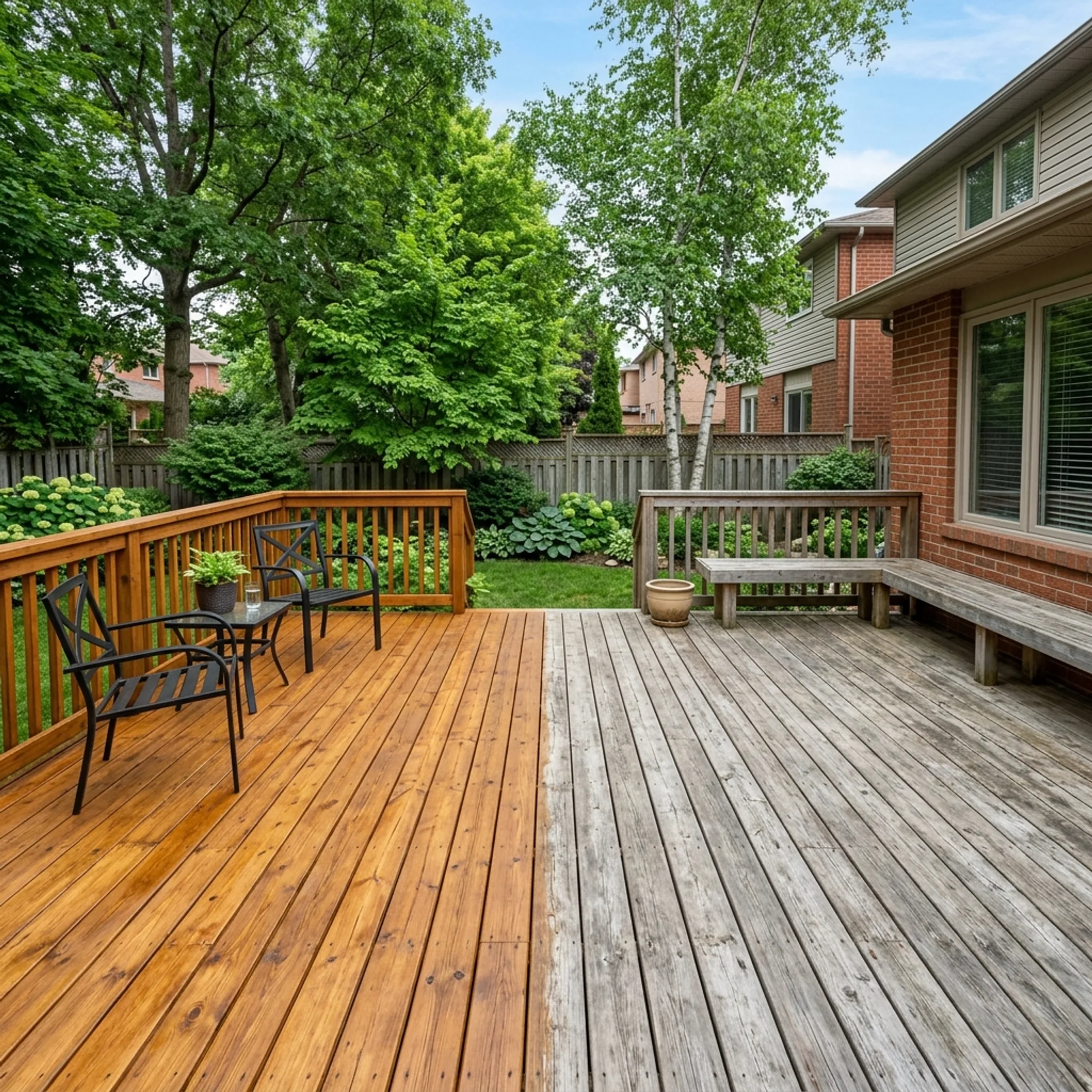
The honest answer is that most decks in Toronto and the GTA need recoating every two to four years, but that range hides almost everything that matters. A penetrating semi-transparent stain on a shaded railing can hold for four full seasons, while the same product on a south-facing horizontal walking surface can be due at the two-year mark. Clear sealers fade in a single Ontario winter. The freeze-thaw cycling, summer UV, and snow that sits on horizontal boards for months all push GTA decks toward the shorter end of the range. This guide gives you a finish-by-finish reseal schedule, the factors that shorten the cycle, and a simple test you can do yourself to know whether this is the year.
Quick Answer: How Often to Restain a Deck in Toronto
For most Toronto and GTA decks, plan on recoating the horizontal walking surface every 2 to 3 years and the railings, fascia, and vertical surfaces every 4 to 5 years. That assumes a quality penetrating semi-transparent stain applied over properly prepared wood. The schedule shifts with three things: the finish you used, how much sun the deck takes, and the wood itself.
The single most useful habit is to stop thinking of staining as a one-time event and start thinking of it as a maintenance cycle. A deck recoated on schedule — a quick clean and a fresh coat before the old finish fails — never needs an expensive strip-and-refinish. A deck that is left until the finish is visibly gone needs full restoration, which costs two to three times as much. The frequency question is really a money question.
Reseal Interval by Finish and Surface
Different finishes are designed to last for different lengths of time, and the same finish behaves very differently on a surface you walk on versus one you only look at. Here is a realistic schedule for the GTA climate:
| Finish type | Horizontal (deck boards, stairs) | Vertical (railings, fence, skirting) |
|---|---|---|
| Clear sealer / water repellent | 1 year | 1–2 years |
| Toner / lightly pigmented oil | 1–2 years | 2–3 years |
| Penetrating semi-transparent | 2–3 years | 3–5 years |
| Solid / opaque stain | 3–4 years* | 4–6 years |
*Solid stain lasts longer between coats but fails by peeling rather than fading, which means the recoat is a full strip rather than a clean-and-coat. We cover that trade-off in our breakdown of solid versus semi-transparent stain for cedar decks. The more pigment a finish carries, the more UV protection it provides and the longer it lasts — but the harder it is to renew. Penetrating finishes hit the practical sweet spot for most homeowners, which is why we use them on the majority of GTA deck projects.
What Shortens the Cycle
The intervals above are a starting point. Six factors pull a specific deck toward the shorter end of its range:
- Sun exposure. UV is what breaks down stain. A fully south- or west-facing deck with no tree cover can need recoating a full year sooner than a north-facing or shaded deck of the same age and finish. This is the biggest single variable after finish type.
- Foot traffic. Stain wears mechanically as well as chemically. High-traffic paths — the line from the patio door to the stairs, the area around a barbecue or hot tub — thin out first. A deck used daily through the summer ages faster than a rarely-used one.
- Standing water and poor drainage. Boards that hold puddles, or that sit under a downspout, lose their finish in the wet zones years before the rest of the deck. Snow that piles and melts slowly in one corner does the same thing.
- Wood species. Cedar holds finish well but weathers fast once the finish is gone. Pressure-treated pine moves more with humidity, which stresses the finish film. Hardwoods are dense and can reject penetrating oils if over-applied.
- Prep quality on the last coat. Stain applied over a dirty, glossy, or poorly sanded surface never bonds properly and fails early no matter how good the product is. Most "the stain only lasted a year" complaints trace back to prep, not product.
- The finish itself. A clear or lightly tinted product simply does not last as long as a pigmented one, because pigment is the UV shield. If you want the longest interval, you accept more colour.
Signs It Is Time (The Water Test)
You do not have to guess. The most reliable indicator is how the deck handles water. Sprinkle a cup of water across a few different areas — a traffic path, a shaded section, and a sun-exposed board:
- Water beads up and sits on top: the finish is still doing its job. No recoat needed this year.
- Water soaks in slowly and darkens the wood: the finish is thinning. Plan to recoat this season or next.
- Water soaks in immediately and the board darkens right away: the finish is gone in that area. The wood is now absorbing moisture and the clock is running on greying and surface damage. Recoat now.
Other visual signs back this up: uneven fading with bright patches and worn paths, a rough or fuzzy surface texture, grey or silvering wood at the edges, and a general loss of colour depth. If you see bare grey wood anywhere on the walking surface, you are past the easy maintenance window and into restoration. For the related question of how long a finish should physically last before you reach this point, see our companion guide on how long deck stain lasts in Canada.
Why Boards Wear Faster Than Railings
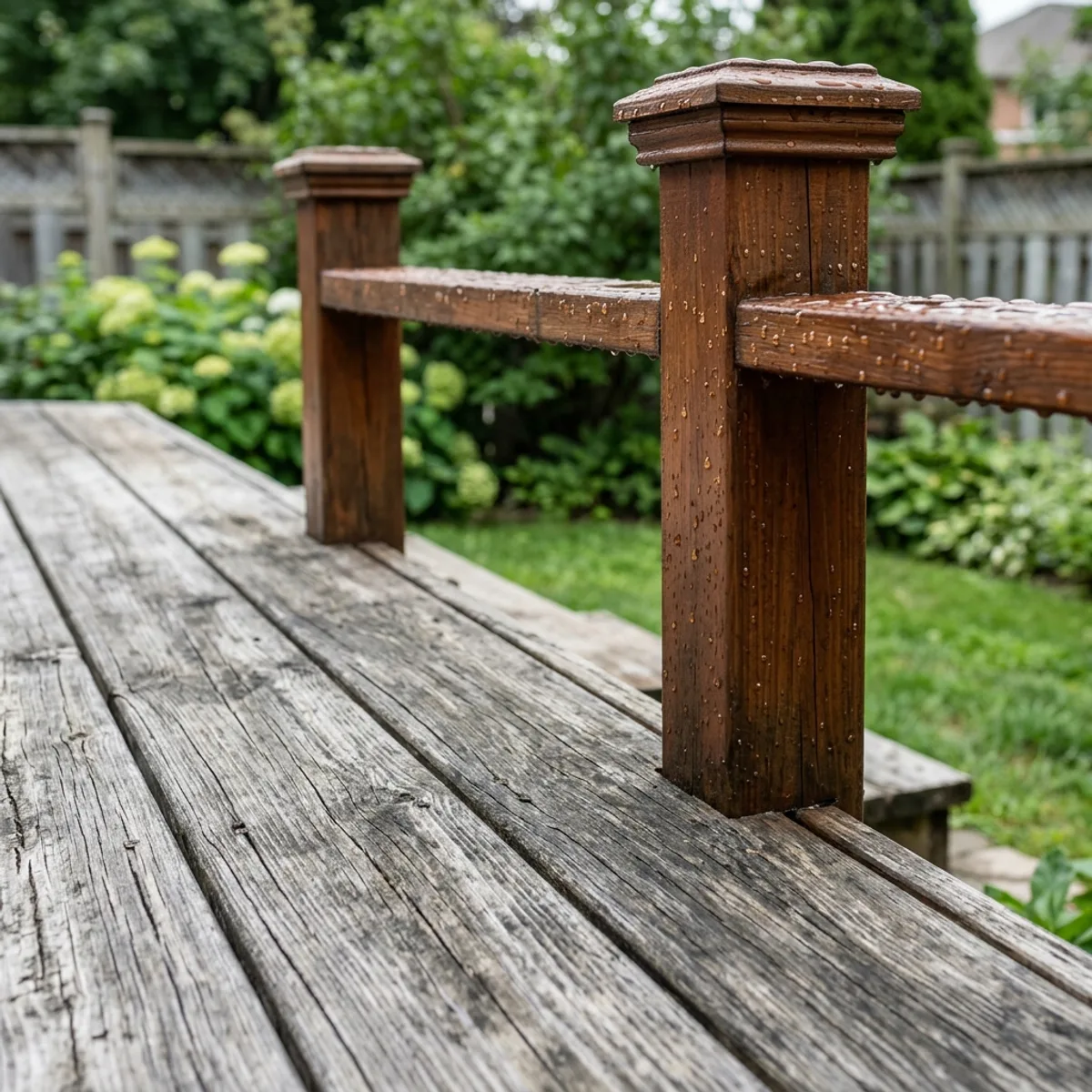
It surprises homeowners that the railings can look great while the deck boards look exhausted, even though everything was stained on the same day. There is a physical reason. Horizontal surfaces take the full force of three things that vertical surfaces largely escape: direct overhead sun for the longest part of the day, foot traffic, and standing water and snow that drains off a vertical surface in minutes but sits on a horizontal one for hours or months.
As a rule of thumb, a deck floor wears roughly twice as fast as the railings and skirting around it. This is why a sensible maintenance plan does not recoat the whole deck on the same schedule. Many of our GTA clients do a walking-surface recoat at the two-to-three year mark and only refresh the railings every second cycle. It saves product, labour, and disruption while keeping the parts that fail first protected.
The Toronto Freeze-Thaw Factor
Toronto and the surrounding GTA sit in a climate that is genuinely hard on exterior wood. The region cycles through dozens of freeze-thaw events each winter, where moisture in the top layer of wood freezes, expands, thaws, and contracts — repeatedly, over months. Each cycle works at the bond between finish and wood. Add summer UV that can be intense on unshaded decks, big humidity swings between July and January, road salt tracked onto stairs, and snow that sits on horizontal boards from December through March, and you have a set of conditions that pushes most decks toward the shorter end of every recoat range.
The practical takeaway: schedules written for milder climates do not apply here. If a product label promises four or five years, read that as the vertical-surface, shaded, mild-climate number — and assume your Toronto deck floor will want attention sooner. Recoating before winter is especially valuable, which is why we cover timing in our fall deck maintenance guide and the best time and temperature to stain in the GTA. Getting the timing and the frequency right together is what keeps a deck out of the expensive strip-and-refinish cycle.
We provide free on-site assessments across Toronto and the GTA. If you are not sure whether your deck is due, a short visit (or the water test above) will tell you definitively — and recoating on schedule is always cheaper than waiting for a full restoration.
Frequently Asked Questions
How often should I restain my deck in Toronto?
Plan to recoat the horizontal walking surface of a Toronto deck every 2 to 3 years and the railings and vertical surfaces every 4 to 5 years, assuming a quality penetrating semi-transparent stain. South- and west-facing decks with no shade, high-traffic decks, and decks finished with clear or lightly tinted products need recoating sooner. The most reliable check is the water test: if water no longer beads on the surface and soaks straight into the wood, it is time to recoat.
What happens if I wait too long to restain my deck?
Once the finish wears through to bare wood, the wood starts absorbing moisture, greying from UV, and developing surface checking and a rough, fuzzy texture. At that point a simple clean-and-recoat is no longer enough — the deck needs a full strip, sand, and refinish, which typically costs two to three times as much as a maintenance recoat. Restaining on schedule, before the old finish fails, is the cheapest way to own a wood deck over time.
Do I need to strip the old stain every time I recoat?
Not if you are using a penetrating semi-transparent or toner finish and you recoat on schedule. These finishes wear away by thinning and fading rather than peeling, so a maintenance coat goes on after a thorough clean and light surface prep. Stripping is only required when you are dealing with a failed solid stain or paint that is peeling, when you are switching finish types, or when the deck has been neglected long enough that bare grey wood is exposed.
How can I tell if my deck needs restaining this year?
Do the water test. Sprinkle water on a traffic path, a shaded area, and a sun-exposed board. If the water beads and sits on top, the finish is still working. If it soaks in slowly and darkens the wood, plan to recoat this season. If it soaks in immediately, the finish is gone in that spot and you should recoat now. Combine this with a visual check for faded patches, worn paths, and any grey or silvering wood.
Why do my deck boards look worse than my railings?
Horizontal surfaces wear roughly twice as fast as vertical ones because they take direct overhead sun, all of the foot traffic, and standing water and snow that drains off railings in minutes but sits on boards for hours or months. This is normal and expected. A cost-effective plan recoats the walking surface every 2 to 3 years and refreshes the railings every second cycle rather than treating the whole deck on one schedule.
Get Your Free Quote
Tell us about your project — we get back within 1 business day with honest pricing.