
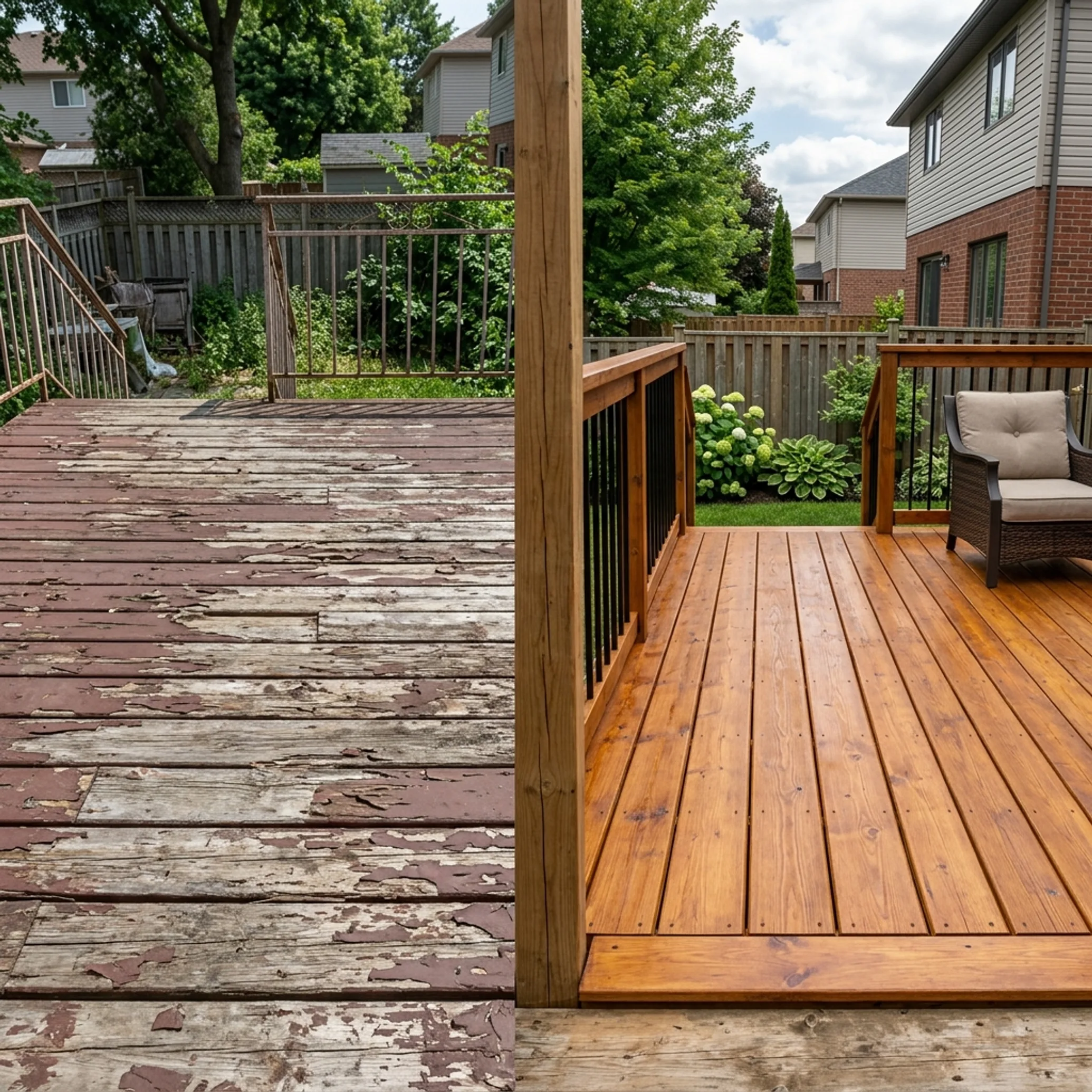
Stain and paint are not two flavours of the same product — they protect wood in fundamentally different ways, and that difference matters enormously on a deck. Paint forms a film that sits on top of the wood; stain, especially a penetrating one, soaks in and colours the wood from within. On a horizontal walking surface in Toronto's freeze-thaw climate, that distinction is the difference between a finish that wears gracefully and one that peels into a stripping nightmare. This guide compares the two head to head, explains why paint fails on deck boards here, and identifies the few situations where paint is still a reasonable choice.
Quick Answer: Stain or Paint a Deck?
For a deck walking surface in Toronto and the GTA, stain is almost always the right choice — and a penetrating stain in particular. Paint forms a film on top of the wood that traps moisture underneath and cannot flex with the constant freeze-thaw movement and foot abrasion a deck floor takes, so it peels. Once paint peels on a deck, the only fix is a full, expensive strip back to bare wood.
Paint still has a legitimate place — on vertical, low-traffic surfaces, or on wood that has already been painted and cannot be economically stripped. But on the boards you actually walk on, stain wins on lifespan, maintenance, safety, and total cost.
Stain vs Paint: Side by Side
The two finishes differ on almost every dimension that matters for a deck:
| Factor | Stain (penetrating / semi-transparent) | Paint (film-forming) |
|---|---|---|
| How it protects | Soaks into wood, colours from within | Forms a film on the surface |
| Look | Shows wood grain and texture | Hides grain, solid opaque colour |
| Failure mode | Fades and thins gradually | Cracks, peels, and flakes |
| Recoating | Clean and apply a fresh coat | Scrape, sand, or fully strip first |
| On horizontal boards (GTA) | Performs well, wears evenly | Peels under freeze-thaw + traffic |
| Slip resistance | Good; texture remains | Can get slick when wet unless additive used |
| Moisture handling | Breathable; wood can dry out | Traps moisture if film is breached |
| Reversibility | Easy to maintain or change | Hard to reverse once applied |
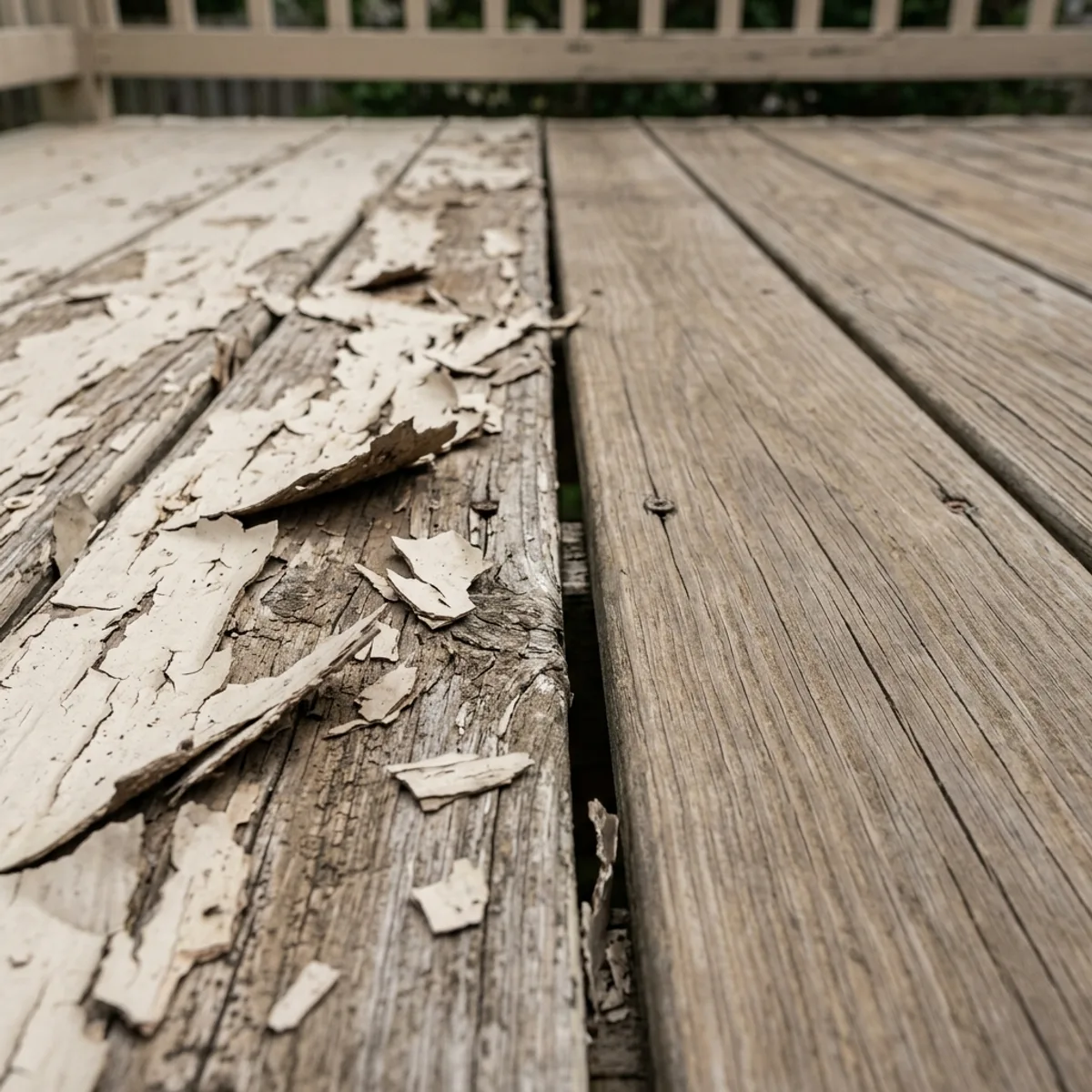
Why Paint Peels on GTA Decks
Three forces gang up on paint specifically on horizontal deck surfaces in this climate:
- Trapped moisture. Wood naturally takes on and releases moisture with the seasons. A breathable penetrating stain lets it do that. A paint film blocks it — so when moisture inevitably gets under the film (through an edge, a crack, or the underside of the board), it cannot escape. It pushes the film off from below. This is the root cause of most deck paint failure.
- Freeze-thaw movement. The GTA goes through dozens of freeze-thaw cycles each winter. Each one makes the wood swell and shrink slightly. A rigid paint film cannot keep up with that movement indefinitely; it micro-cracks, water gets in, and peeling accelerates.
- Foot abrasion. A deck floor is walked on, dragged across, and scuffed. A surface film wears through at traffic points and edges, opening exactly the entry points that let moisture under the film.
The result is the familiar sight of a painted deck that looked great for a year or two and then began flaking in sheets. And here is the painful part: a peeling stain just needs a clean and a fresh coat, but a peeling paint job must be scraped and stripped back to bare wood before anything new can go down — a far more expensive job. We explain the underlying chemistry in our deep dive on penetrating versus film-forming finishes.
When Paint Still Makes Sense
This is not an argument that paint is never appropriate. There are real cases for it:
- Vertical, low-traffic surfaces. Railings, skirting, posts, lattice, and porch ceilings do not take foot traffic or standing water, so a film finish survives much longer there. Painting these to match house trim is a common and reasonable choice.
- Wood that is already painted. If a deck or porch was painted years ago and the paint is sound, stripping it all off to switch to stain can be more expensive than simply maintaining the paint. In that case, scrape, spot-prime, and repaint the failing areas.
- You want a specific solid colour. If the goal is an opaque colour that matches the house exactly, you have a better option than paint: a solid (opaque) stain. It gives you full colour coverage like paint but still penetrates and breathes better, so it handles a deck environment far more forgivingly. We compare the pigment options in our solid versus semi-transparent guide.
The pattern to notice: paint earns its place on the parts of a deck you look at, not the parts you walk on.
The 10-Year Cost Reality
Paint can look cheaper on day one, but the deck-floor maintenance cycle reverses that quickly. A stained deck floor follows a low-cost rhythm: clean and recoat every two to three years, no stripping. A painted deck floor follows a high-cost rhythm: the film peels, and each renewal requires scraping or full stripping before repainting — labour-heavy work that, on a typical deck, can run into the thousands each cycle. Over ten years, the stained floor stays in the clean-and-coat lane while the painted floor pays for repeated strip-and-repaint cycles.
The same logic that makes solid stain expensive to renew makes paint worse, because paint is even more prone to peeling on horizontal wood. For a fuller treatment of how finish choice drives long-term cost, see how long deck stain lasts in Canada.
Our Recommendation
For deck walking surfaces in Toronto and the GTA, we use a penetrating semi-transparent or solid stain — we work with Expert Stain & Seal products because they penetrate well and hold up to this climate. For railings and trim that need to match a painted house, a solid stain (or paint on those vertical surfaces specifically) is a sound choice. We do not recommend painting the boards you walk on; the freeze-thaw and traffic conditions here make peeling a matter of when, not if.
If your deck is currently painted and peeling, the right move is usually a full strip back to bare wood followed by a quality stain system — and our deck staining and deck refinishing services are built around exactly that. We provide free on-site assessments across the GTA to recommend the right finish for your specific deck, wood, and exposure. Our staining and refinishing work carries a 3-year written workmanship warranty.
Frequently Asked Questions
Should I stain or paint my deck?
For the walking surface of a deck in Toronto and the GTA, stain is almost always the better choice — especially a penetrating stain. Paint forms a film that traps moisture and cannot flex with freeze-thaw movement or survive foot traffic on horizontal boards, so it peels and then requires expensive full stripping to renew. Stain soaks into the wood, wears gradually, and is renewed with a simple clean-and-recoat. Paint is reasonable only on vertical, low-traffic surfaces like railings, or on wood that is already painted.
Why does paint peel on decks but not on fences or siding?
Because deck boards are horizontal and walked on. Horizontal surfaces hold standing water and snow, take the most direct sun, and endure foot abrasion — none of which a vertical fence or wall surface deals with to the same degree. Moisture gets under the paint film and cannot escape, freeze-thaw cycling cracks the rigid film, and foot traffic wears it through at the edges. Those entry points let water under the film and it peels. The same paint on a vertical surface can last for years.
Can I stain over a deck that was previously painted?
Not directly. Stain needs to penetrate bare or stained wood, and it cannot soak through a paint film. To switch a painted deck to stain, the paint must first be fully stripped and the wood sanded back to a clean, absorbent surface. This is more labour than a standard recoat, but it puts the deck onto the much cheaper, longer-lasting stain maintenance cycle going forward. We handle this as part of deck refinishing.
What is the difference between solid stain and paint on a deck?
Both give an opaque, solid colour that hides the wood grain, but they behave differently. Paint forms a thick surface film that traps moisture and peels on horizontal deck boards. Solid (opaque) stain carries heavy pigment for full colour and UV protection but still penetrates the wood and remains more breathable, so it handles a deck environment more forgivingly. If you want a solid colour on a deck, solid stain is the safer choice over paint.
Is a stained deck more slippery than a painted one?
Generally the opposite. A penetrating stain leaves the natural wood texture intact, which provides grip. A paint film can become slick when wet unless a non-slip additive is mixed in, and as paint wears unevenly it can create smooth patches. For a walking surface where wet conditions are common, the texture of a stained deck is usually the safer surface.
Get Your Free Quote
Tell us about your project — we get back within 1 business day with honest pricing.