
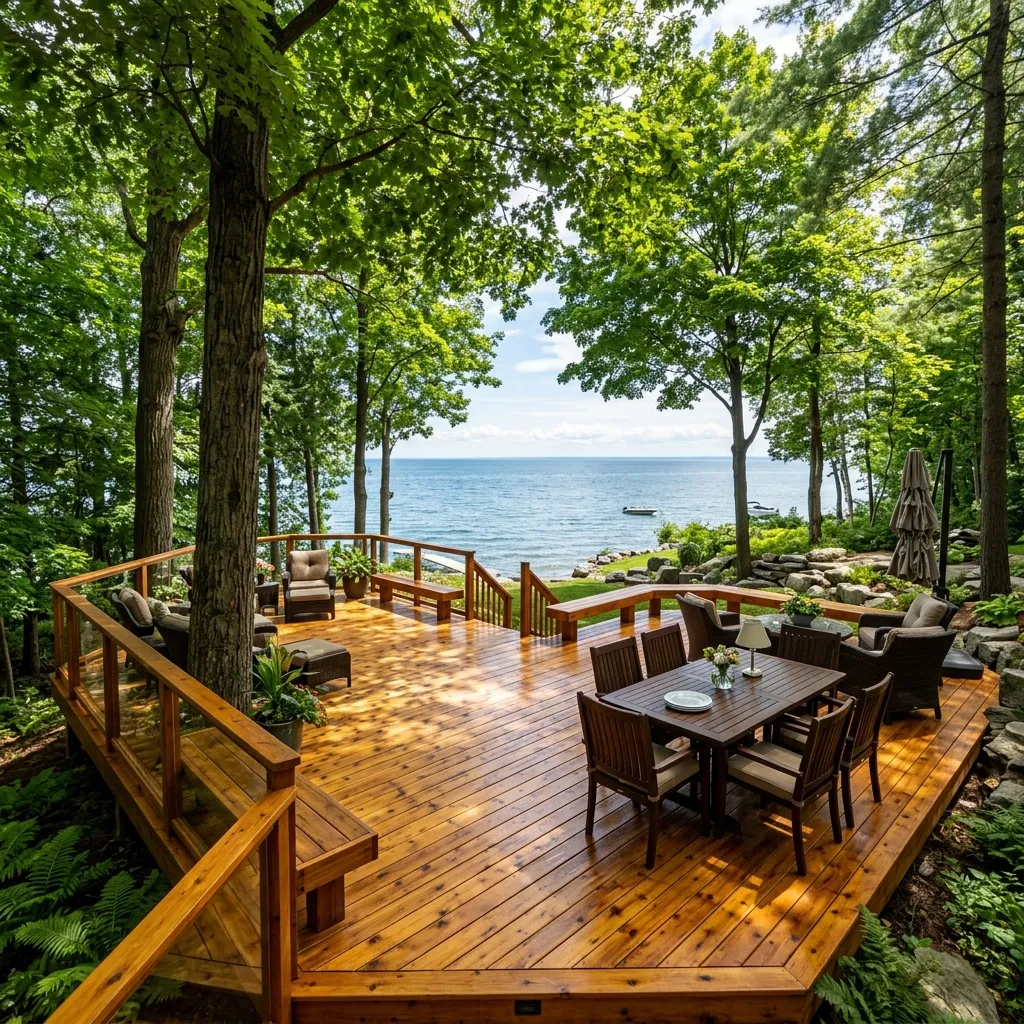
A cedar deck on Lakeshore Road in Old Oakville is the most punishing residential exterior wood environment in the GTA. Three independent stresses — salt-laden air, persistent lake-effect humidity, and heavy tree canopy — stack on the same wood at the same time, and standard inland GTA stain protocols fail predictably within 18 to 24 months. Old Oakville lakefront restoration requires marine-grade product specification, salt-deposit prep work, and biocide-fortified chemistry inland properties never need. This guide explains what Lake Ontario actually does to cedar within 500 metres of the shore, the specific product and prep changes that produce a 4-year finish instead of an 18-month one, and what real lakefront restoration costs in 2026.
The Three Lakefront Stresses on Cedar
Old Oakville cedar within 500 metres of Lake Ontario operates under conditions that do not exist anywhere else in the GTA except other lakefront strips of comparable proximity. Three stresses combine, each amplifying the others:
Salt-laden air. Lake Ontario is fresh water, not salt — but lakefront air carries dissolved minerals deposited as the water evaporates from the surface. These minerals settle on horizontal surfaces (deck boards, railing tops, beam tops) at measurable rates. We have measured visible mineral deposits accumulating within 30 days of a fresh deck cleaning on Lakeshore Road properties. The minerals interfere with stain absorption and cause finish failure at the wood-stain interface.
Lake-effect humidity. Air above Lake Ontario carries 15 to 25 percent higher relative humidity than air a kilometre inland during summer months. This humidity drives moisture into cedar fibres faster than inland conditions and slows post-stain cure. Cedar that takes 48 hours to reach optimal pre-stain moisture content inland needs 72 to 96 hours on the lakefront.
Heavy tree canopy. Old Oakville lakefront properties typically sit under mature canopies that shade decks throughout the day. Shaded cedar grows mould and algae at roughly twice the rate of open-exposure cedar, and the persistent shade dampness slows finish cure beyond what humidity alone would cause.
The Salt-Deposit Problem on Lake Ontario Properties
The salt-deposit problem is the single biggest difference between standard GTA deck restoration and Old Oakville lakefront work. It is also the most commonly overlooked issue — most contractors price lakefront work as "Oakville pricing plus a small premium" without changing the actual protocol.
Mineral deposits on cedar create three failure modes:
- Adhesion failure when stain is applied over the deposits — the stain bonds to the mineral layer rather than the wood, and the mineral layer eventually disconnects from the wood beneath, taking the stain with it.
- Pigment migration as moisture cycles through the deposit layer and carries pigment toward the surface, causing visible streaking and uneven colour development.
- Accelerated UV breakdown because mineral particles refract and concentrate UV at the wood surface, producing localized fade patterns visible within the first season.
The fix is a dedicated salt-deposit rinse before any cleaning or staining work begins — typically a 30 to 45 minute additional process per project that uses calcium-removal chemistry rather than standard wood cleaners. Skipping this step is the number-one reason lakefront stain jobs fail prematurely.
Lake-Effect Humidity and Mould Pressure
Lake-effect humidity creates a persistent biological pressure that inland cedar does not face. Cedar fibres remain at higher equilibrium moisture content; surfaces stay damp longer after rain; mildew and mould colonies establish faster.
Standard GTA cedar staining uses a wood-safe percarbonate cleaner with single-stage application. For Old Oakville lakefront work, we add biocide chemistry — a sodium hypochlorite-based mildewcide applied at controlled dilution after the salt-deposit rinse and before the brightener. The biocide kills active mould and algae colonies that would otherwise re-establish under the new stain finish.
We also extend the dry-down window before stain application. Inland cedar at 15 percent moisture content is ready for stain; lakefront cedar at the same reading often has higher moisture content one millimetre below the surface. We use moisture meters at multiple depths and require the deeper readings to drop below 18 percent before staining proceeds.
Marine-Grade Product Specification
Standard GTA cedar staining uses a contractor-grade penetrating oil-based stain. For Old Oakville lakefront work within 500 metres of the shore, we specify the marine-grade variant in the same Expert Stain & Seal product line — same penetrating-finish category, but formulated with maximum biocide additives and higher pigment density specifically for marine and lake environments.
The marine-grade specification trades off slight cost increase (roughly 15 percent product cost premium) for substantially longer finish life under lakefront conditions. On standard GTA inland cedar the marine-grade product would be over-spec; on Old Oakville lakefront cedar it produces a 3 to 5 year finish where the standard product produces 18 to 24 months.
End-grain sealing is also more important on lakefront properties than inland. Salt deposits accumulate on cut ends faster than on face surfaces, and unsealed end grain is the leading rot entry point on lakefront decks. We apply end-grain sealer to every cut board edge as standard protocol — not as an optional upgrade.
The Old Oakville Restoration Protocol
Our complete Old Oakville lakefront protocol:
- On-site assessment with proximity-to-shore measurement, deposit-density inspection, and moisture-content baseline at multiple depths.
- Salt-deposit rinse with calcium-removal chemistry, applied before any wood cleaner.
- Wood cleaning with percarbonate cleaner at extended dwell.
- Biocide application with sodium hypochlorite at controlled dilution.
- Wood brightening with oxalic acid to restore natural pH after the alkaline cleaning chemistry.
- Extended dry-down window (72 to 96 hours typical) with moisture-meter verification at depth.
- Spot repair and sanding as needed.
- Two-coat marine-grade penetrating stain application with end-grain sealing on every cut.
- Annual maintenance plan with rinse and inspection at 12 months — lakefront properties benefit from annual maintenance more than inland properties.
The protocol takes 4 to 6 days for typical lakefront properties — longer than standard inland deck work primarily due to the extended dry-down window after biocide application.
Lakefront Pricing Reality
Our standard GTA deck staining rate is $3 to $6 per square foot. Old Oakville lakefront properties within 500 metres of the shore run roughly 20 to 30 percent above that range — typically $4 to $8 per square foot — reflecting:
- Salt-deposit rinse adding half a day of additional labour.
- Biocide chemistry and extended dry-down adding 2 to 3 additional project days.
- Marine-grade product cost premium of roughly 15 percent over standard.
- Mandatory end-grain sealing on every cut, not optional.
- Higher proportion of premium materials (ipe, garapa, mahogany) in this market versus pressure-treated lumber.
For a typical 600 square foot lakefront cedar deck with railings, expect $3,000 to $5,500 for full restoration including the lakefront-specific protocol. Premium hardwood decks (ipe or similar) run $4,500 to $8,000 due to product compatibility requirements. Stripping a previously failed solid stain on lakefront cedar adds $1,500 to $4,000.
All restoration work carries our 3-year written warranty on workmanship, with the understanding that lakefront properties will see year-3 finish degradation that inland properties typically do not — annual maintenance plans bridge between full restoration cycles.
Frequently Asked Questions
Does the lakefront protocol apply to all Oakville properties or just lakefront?
Just lakefront. Oakville properties further than approximately 500 metres from Lake Ontario operate under standard inland GTA conditions and use our standard cedar staining protocol. The 500-metre threshold is approximate — properties on elevated ground or with strong westerly tree breaks may need only partial lakefront protocol; properties with direct unobstructed exposure to the lake use the full protocol regardless of strict distance. We confirm the appropriate protocol during the on-site assessment.
How often does lakefront cedar need full restoration?
Every 3 to 5 years on the marine-grade protocol described in this article. Inland Oakville cedar typically runs 4 to 6 years between cycles; lakefront cedar runs roughly one year less due to the additional environmental stress. Annual maintenance — a soft-wash rinse and visual inspection — extends each interval and is more important on lakefront properties than anywhere else in the GTA.
My lakefront deck has been on solid stain for years. Can it be saved?
Yes, in nearly every case. The procedure is complete stripping back to bare cedar followed by the lakefront-specific protocol described above. Stripping is more expensive on lakefront properties due to the salt-deposit prep that must occur before stripping chemistry can work effectively, but the math heavily favours stripping once and switching to penetrating stain over continuing the solid stain failure cycle. A solid stain on lakefront cedar typically fails every 18 to 24 months.
Are there products to recommend for DIY maintenance between cycles?
Annual rinses with a wood-safe cleaner are appropriate DIY work. Avoid bleach-based household cleaners — these damage cedar fibres on prolonged contact and can interfere with the next stain application. Avoid pressure washing above 600 PSI on lakefront cedar; the surface is more fragile than inland cedar due to the additional weathering. Spot stain touch-ups between cycles are not recommended for DIY because matching marine-grade pigment density and avoiding lap marks requires application experience these properties do not forgive.
Get Your Free Quote
Tell us about your project — we get back within 1 business day with honest pricing.