
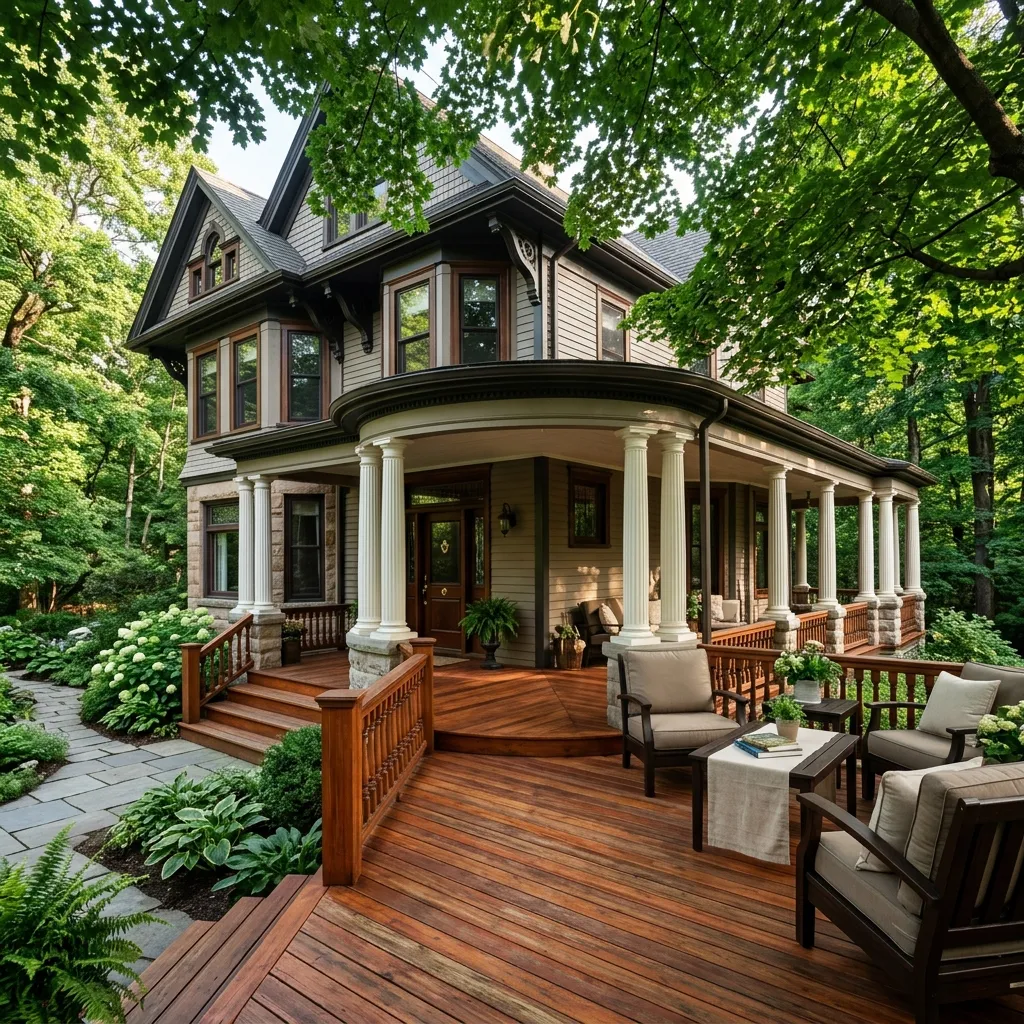
Forest Hill, Rosedale, Lawrence Park, and the Bridle Path collectively hold some of the oldest and most carefully maintained cedar deck and porch installations in Toronto. The properties are architecturally stunning and the wood stock is premium. The restoration work is also technically harder than most contractors expect, because the same mature tree canopy that gives these neighbourhoods their character traps moisture against deck surfaces, accelerates mould colonization, and slows finish cure beyond what most contractors plan for. This guide explains why prestige Toronto neighbourhoods are not the easy work they look like, and what the real protocol is for cedar in heavy-canopy conditions.
What Mature Canopy Actually Does to Cedar
Mature tree canopy provides aesthetic value, property value, and noise damping. It also creates measurable challenges for any cedar exterior wood surface beneath it.
Persistent shade. Forest Hill and Rosedale canopies typically allow 1 to 3 hours of direct sun exposure on deck surfaces during summer. Inland open-exposure decks see 8 to 12 hours. The shade keeps surface temperatures lower and humidity higher than open-exposure cedar.
Slower drying. Surface moisture from rain, dew, or irrigation lingers 2 to 4 times longer than open-exposure decks. Cedar fibre never fully dries between rain events during humid summer weeks.
Organic debris accumulation. Leaves, pollen, and organic particulate accumulate on horizontal surfaces year-round. Even with regular sweeping, debris embeds into stain finishes during cure and provides a substrate for mould establishment.
Reduced UV. The same shade that produces moisture problems also reduces UV-driven stain pigment failure. Canopy-shaded cedar finishes fade more slowly than open-exposure cedar — but this reduced UV is a minor benefit compared to the moisture and biological pressure.
Forest Hill and Rosedale Wood Stock
The cedar in Toronto's prestige neighbourhoods is generally older, denser, and higher-quality than cedar in newer subdivisions. Many decks and porches are original to homes built in the 1920s through 1960s, restored multiple times across decades. Some installations are second-generation but built from premium clear-grade or quarter-sawn cedar that is uncommon in modern construction.
Higher-quality cedar has fibre density that affects restoration in three ways:
- Slower stain absorption than commodity-grade cedar. Standard application coverage rates over-apply on dense heritage cedar; the excess sits on the surface, attracts canopy debris, and produces uneven cure.
- Better long-term performance once correctly stained. Heritage cedar holds finish longer than commodity cedar — 5 to 7 years between cycles is realistic on canopy-shaded heritage cedar with appropriate product selection.
- Less forgiveness of preparation mistakes. Heritage cedar reveals every prep shortcut. Lap marks, missed end-grain sealing, uneven sanding all show against the dense fibre that does not blend imperfections the way softer modern cedar does.
The Shade-Mould Failure Pattern
Canopy-shaded cedar fails differently than open-exposure cedar. The failure pattern is mould-driven rather than UV-driven, and it appears earlier and progresses more aggressively if not addressed.
Year 1: Surface mould colonization begins in the most shaded areas — typically the deck section closest to the house wall, beneath stairs, around posts. Visible only as slight discoloration; easily mistaken for normal weathering.
Year 2: Mould colonies establish under the finish surface. Visible discoloration spreads. Localized darkening and slight surface unevenness develops. Most homeowners do not address at this stage because the deck still looks acceptable from a distance.
Year 3: Mould penetration reaches cedar fibre. Wood begins to blacken below finish surface. Cleaning and brightening can no longer fully reverse the colour change without aggressive sanding that removes wood.
Year 4 and beyond: Wood damage from mould penetration is permanent. Restoration produces a deck that looks acceptable but with permanent discoloration in heavily-affected zones.
The intervention point is year 1 — biocide-fortified annual maintenance prevents the colonization that drives the failure cascade. Every year deferred makes the eventual restoration progressively more aggressive.
The Canopy-Adjusted Restoration Protocol
Our protocol for Forest Hill, Rosedale, Lawrence Park, and Bridle Path canopy-shaded cedar:
- Detailed assessment with mould-penetration evaluation, fibre-density inspection, and finish-history documentation.
- Biocide-fortified cleaning with extended dwell — sodium hypochlorite at controlled dilution kills established colonies before stain application.
- Wood brightening with oxalic acid to restore pH and lighten any tannin-driven darkening from prolonged moisture.
- Extended dry-down window of 72 to 96 hours under canopy conditions, with moisture-meter verification at multiple depths.
- Heritage-appropriate stain application — Expert Stain & Seal penetrating oil-based stain at reduced coverage rate (heritage cedar absorbs less than commodity cedar) with biocide-fortified formulation.
- End-grain sealing on every cut. Mandatory in canopy conditions where moisture entry rates are elevated year-round.
- Annual biocide-rinse maintenance plan — the single most valuable practice for canopy-shaded cedar. Catches mould colonization before establishment.
The protocol takes 5 to 7 days for typical heritage Toronto properties — longer than standard cedar restoration primarily due to extended dry-down requirements and heritage-appropriate prep speed.
Heritage Aesthetic Considerations
Forest Hill and Rosedale property values benefit from architectural and material consistency. Modern bright stain colours sit awkwardly against heritage architecture; weathered earth tones, traditional barn red, and natural cedar honey palettes integrate appropriately with the surrounding properties.
Translucent and lightly-pigmented finishes that show full grain are appropriate for heritage cedar where the wood character is part of the property value. Solid stains and high-pigment finishes that obscure grain are technically functional but reduce the visual quality of the cedar that property owners restored specifically for its character.
Property-specific heritage palettes are available for restoration matching when prior finish history is documented. We can recommend colour options consistent with the original installation period during the assessment.
Pricing for Prestige Neighbourhood Work
Our standard GTA deck staining rate is $3 to $6 per square foot. Forest Hill, Rosedale, Lawrence Park, and Bridle Path properties typically run in the upper end of that range — typically $5 to $8 per square foot — reflecting:
- Detailed heritage assessment and finish-history documentation.
- Biocide-fortified chemistry at every stage.
- Extended dry-down windows under canopy conditions.
- Heritage-appropriate prep with hand sanding rather than mechanical sanding on older installations.
- Mandatory end-grain sealing on every cut.
For a typical 400 square foot Forest Hill cedar deck or porch, expect $2,000 to $3,500 for full restoration with the canopy-specific protocol. Larger heritage installations on Bridle Path estate properties can run $5,000 to $12,000 reflecting deck scale and heritage protocol complexity. Annual maintenance plans for repeat clients run $400 to $800 depending on property size.
All restoration work carries our 3-year written warranty on workmanship. Heritage installations on annual maintenance plans typically run 5 to 7 years between full restoration cycles versus 3 to 4 years for properties without maintenance.
Frequently Asked Questions
Is canopy actually a problem? My deck looks fine.
Looking fine at year 2 does not mean fine. The mould colonization that produces year-3 wood damage typically appears as minor discoloration in year 1 and looks like ordinary weathering through year 2. By the time damage is visibly obvious, prevention is no longer an option — restoration is. The right time to address canopy conditions is during a maintenance visit at year 1 or 2 when intervention is cheap and reversible.
My Rosedale deck has been on the same finish for 8 years. Is it still salvageable?
Almost certainly yes, with the right protocol. Heritage cedar at 8 years on the same finish typically shows surface mould, partial fade, and isolated end-grain damage — all reversible through the protocol described in this article. We have restored cedar with 12+ years on a single finish cycle. The prep work is more aggressive on long-deferred properties, which translates to higher cost, but the wood itself is rarely lost.
Should I cut back canopy trees to improve deck life?
Generally no — the canopy is the property value reason for being in Forest Hill or Rosedale in the first place, and removing or substantially trimming mature trees affects property value far more than canopy-related deck maintenance costs. The right move is keeping the canopy and adjusting the deck restoration protocol to match. Some surgical trimming to allow direct sunlight on deck areas for 1 to 2 hours daily during summer can substantially help finish performance, but full canopy removal is rarely warranted.
Are heritage colour palettes required by zoning?
No formal zoning requirement governs deck stain colour in Forest Hill, Rosedale, Lawrence Park, or Bridle Path. The recommendation toward heritage palettes is aesthetic and property-value-driven rather than legally required. Toronto Heritage Conservation Districts have stricter rules but those apply only to specific listed heritage properties, not the neighbourhoods broadly. We provide colour recommendations during the assessment but the final choice is yours.
Get Your Free Quote
Tell us about your project — we get back within 1 business day with honest pricing.