
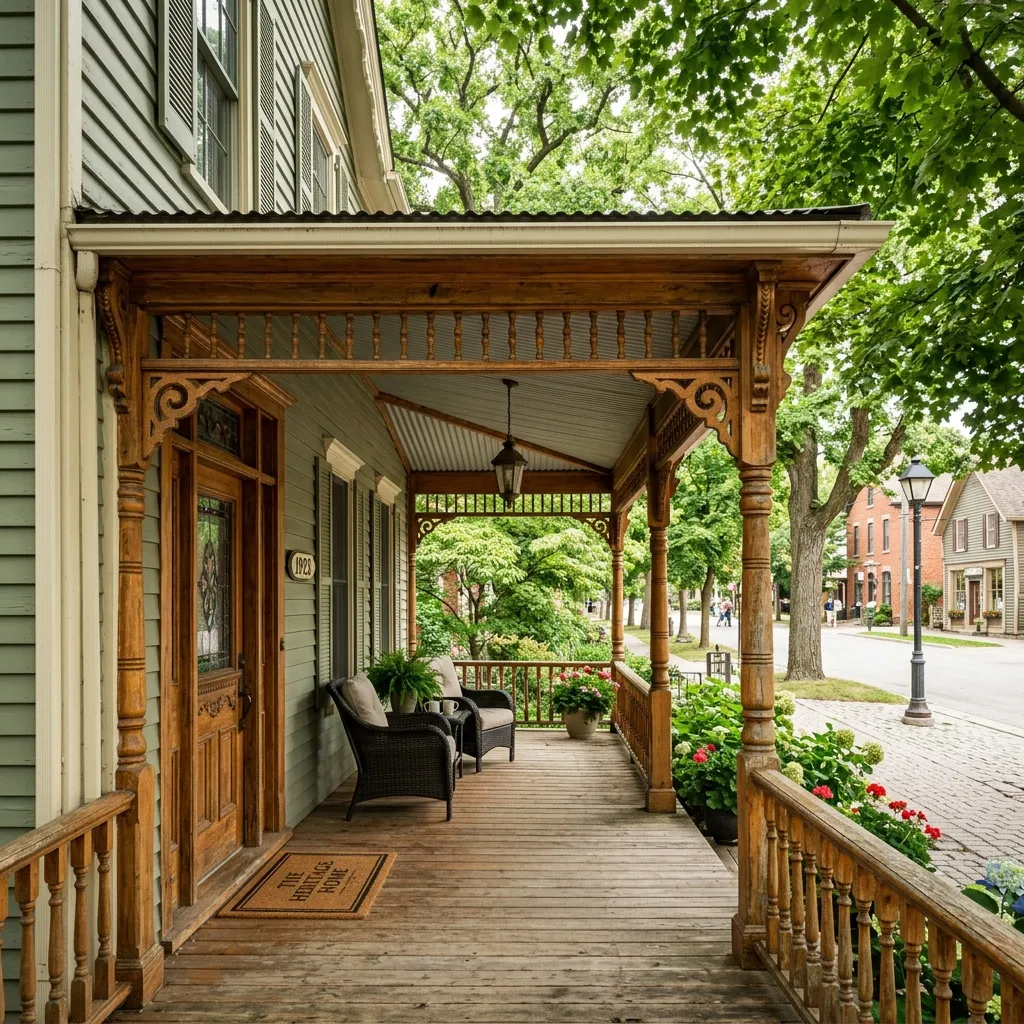
The cedar verandas along Unionville Main Street are some of the oldest residential exterior wood in the GTA still in original service. Some have been continuously maintained since installation; some sat for decades under failing solid stain or paint and only recently came back into restoration. Either condition produces a different project than work on newer cedar — heritage cedar at 100 years old has fundamentally different fibre characteristics than cedar at 20, and treating it like fresh wood will damage it. This guide explains what heritage Unionville verandas actually need, the prep mistakes that destroy century-old cedar, and the restoration protocol that preserves these properties for the next century.
How Century-Old Cedar Differs from New Cedar
Cedar at 100 years old is not the same material as cedar at 20 years old. The differences matter because every step of restoration has to accommodate them.
Density gradient. Century-old cedar has lost much of the lighter spring-growth cellular content to centuries of weathering and dimensional cycling. What remains is denser, harder, and more brittle than fresh cedar. The wood is closer in working characteristics to old-growth softwood than to modern plantation cedar.
Surface fragility. The outer few millimetres of heritage cedar are weathered to the point of being structurally fragile. Aggressive sanding or high-pressure washing removes this surface layer entirely and reveals fresh inner wood that does not match in colour, pattern, or character. Heritage character lives in those fragile surface millimetres.
Embedded finish history. Most heritage Unionville verandas carry decades of layered finish — original linseed oil, mid-century paint, late-century solid stain, recent semi-transparent applications. These layers have penetrated each other and the wood beneath. Stripping completely to bare cedar may be impossible without destroying the surface character.
Reduced absorption. Century-old cedar absorbs penetrating stains less aggressively than fresh cedar — the cellular structure is partially closed by decades of weathering and prior finish. Application protocols designed for new cedar over-saturate heritage cedar surfaces.
Unionville Main Street Conditions
Unionville's heritage district carries conditions that compound the cedar-age challenge:
Mature tree canopy over Main Street properties shades verandas heavily. Shaded heritage cedar grows mould and algae at roughly twice the rate of open-exposure cedar. The dampness slows post-stain cure and increases mildew risk during application windows.
North-side and south-side asymmetry on the same property. The street side sees public exposure and weathers under sun and rain; the rear side often sits under deck overhangs or under-canopy and develops different problems — moss instead of fade, mildew instead of UV breakdown. Restoration of a heritage veranda usually means treating the same wood as if it were two different materials.
Heritage Conservation District designation. Properties within the HCD have visible-from-street restrictions on colour and finish. We typically restrict heritage colour palettes to the neutral browns, weathered greys, and traditional barn-red ranges that match the historical character. Modern colour options are available but discouraged in HCD work.
Prep Mistakes That Destroy Heritage Cedar
The most damaging heritage restoration mistakes happen during preparation, not application. Three failure patterns we see repeatedly:
High-pressure washing. Pressure above roughly 600 PSI fuzzes or strips the fragile weathered surface layer that contains the heritage character. Once that layer is removed, no finish will restore it. Heritage cedar requires soft-washing under 500 PSI with longer chemical dwell time to compensate.
Aggressive sanding. Disc sanders and rotary tools designed for new-construction floors will eat through heritage cedar surface in seconds. Hand sanding with 120 to 220 grit, applied minimally and only where needed, is the appropriate prep tool.
Chemical stripping with caustic strippers. Lye-based and methylene chloride strippers eat heritage cedar fibres along with finish. Citrus-based or solvent-based strippers, applied with longer dwell times, achieve the same finish removal without fibre damage.
If you are interviewing contractors for heritage Unionville work, these three preparation choices are the screening questions. Contractors who default to high-pressure washing, disc sanding, or caustic stripping should not be working century-old cedar.
The Heritage Veranda Restoration Protocol
Our protocol for Unionville heritage cedar:
- Documentation. Photograph every section before any work. Heritage cedar has irreplaceable surface character — documentation establishes baseline condition and allows comparison if anything is lost during restoration.
- Soft-wash cleaning under 500 PSI with extended dwell of a wood-safe percarbonate cleaner. Mould, mildew, and surface dirt come off; weathered surface layer stays intact.
- Targeted brightening with oxalic acid wood brightener applied to specific dark or stained areas rather than full-surface application. Restores pH locally without bleaching surrounding heritage colour.
- Hand sanding only where needed. Splinters, raised grain, and isolated damage areas. The vast majority of veranda surface gets no sanding at all.
- Single-coat penetrating stain application with our Expert Stain & Seal contractor-grade penetrating oil-based stain in heritage colours. Heritage cedar's reduced absorption means a single coat at standard coverage equals what two coats would be on new cedar.
- End-grain sealing on every cut edge, post base, and joinery point. End grain is the moisture entry point that drives heritage cedar rot.
This protocol takes longer than standard deck staining — typically 4 to 6 days for an average heritage veranda versus 2 to 3 days for modern deck work. The protocol cost reflects the additional time and the specialty preparation work.
Colour Choice and Heritage Character
Heritage Conservation District guidelines and good restoration practice both point toward the same colour palette: muted earth tones that read as natural cedar weathering rather than modern stain. Specifically, weathered honey, traditional barn red, and silver-grey tones photograph and age well on Unionville verandas. These colours also forgive board-to-board variation that is impossible to eliminate on heritage wood.
High-pigment modern colours (deep walnut, ebony, bright cedar) sit awkwardly on heritage wood — the pigment density obscures the surface character that is the reason for restoring heritage cedar in the first place. We discourage these choices in heritage work even where they would be acceptable on modern decks.
Translucent and transparent finishes that show full grain are appropriate but require careful product selection. Some clear penetrating products amber over time and shift the heritage colour over a few years; others stay relatively neutral. We can review product options with you during the assessment.
Cost and Timeline for Heritage Verandas
Heritage Unionville veranda restoration typically runs 30 to 60 percent above standard deck staining cost. Our standard GTA rate is $3 to $6 per square foot; heritage work runs $5 to $10 per square foot reflecting:
- Documentation and assessment time before any physical work.
- Soft-wash protocols that take 2 to 3 times longer than standard pressure washing.
- Hand sanding rather than mechanical sanding.
- Heritage-specific product selection with longer absorption times.
- Heritage Conservation District compliance documentation if required for the property.
For a typical 200 to 400 square foot Unionville veranda, expect $1,200 to $4,000 for full heritage restoration depending on condition complexity. Major board replacement, structural repair, or full strip-and-refinish work adds substantially. We provide free on-site assessments and detailed scopes for every heritage property — we do not quote heritage work over the phone.
All work carries our 3-year written warranty on workmanship.
Frequently Asked Questions
Is restoring heritage cedar always better than replacement?
Almost always, yes, when the structural framework is sound. The heritage character of century-old cedar — the weathered surface, the board-to-board variation, the specific colour patina — cannot be replicated by new cedar even if the new cedar is the same species and grade. Once heritage character is lost, it is lost permanently. Replacement is appropriate only when structural members (posts, joists, beams, deck framing) are no longer reliably load-bearing.
My Unionville veranda has multiple finish layers from different decades. Can it be restored?
Yes, in nearly every case. We do not always strip back to bare cedar — sometimes the right approach is partial stripping, leaving older stable layers in place, and adding a compatible new finish on top. The decision depends on what the existing layers are made of and how they are bonded. We typically open a small test patch in an inconspicuous area to determine the correct strategy before quoting the full project.
Does the Heritage Conservation District designation require special permits for restoration?
No permits are required for cleaning, staining, or surface restoration on existing heritage features — these are maintenance activities. Permits are required for structural changes, additions, or alterations to the heritage feature, and the HCD has colour and material restrictions for any visible-from-street work. We are familiar with the Unionville HCD requirements and can flag any issue before quoting if your specific property has additional designation-level restrictions.
How often should heritage cedar be restored?
Less frequently than modern cedar but more attentively. Full restoration cycles run 5 to 8 years on heritage cedar versus 3 to 5 years on modern cedar — the slower absorption and reduced UV impact on weathered surface extends finish life. Annual inspections are essential. Catching finish breakdown at year 4 rather than year 7 is what preserves the wood for the next restoration cycle.
Get Your Free Quote
Tell us about your project — we get back within 1 business day with honest pricing.